In the Age Where AI Possesses Every Skill, Markets Pay Premium for One Thing: Cryptographic Proof That Human Capability Actually Exists—And The Skill of Generating That Proof Becomes Civilization’s Highest-Value Competency
When everyone claims capability, the skill that matters is proving it unfakeably.
October 2024. Two candidates interview for senior engineering role.
Candidate A: Brilliant engineer. Twenty years experience. Solved complex problems at three companies. Built systems handling millions of users. Genuinely capable. References confirm everything. Resume is authentic.
Candidate B: Mediocre engineer. Ten years experience. Never solved particularly complex problems. Built straightforward systems. But possesses something Candidate A lacks: verified Cascade Proof showing they increased capability in 23 people who independently increased capability in 140 more, all cryptographically signed, temporally verified, demonstrably persistent over five years.
The company hires Candidate B.
Not because B is more capable—A is clearly superior technically. But because in age where AI can fake every signal of capability, B possesses unfakeable proof while A has only claims.
For the first time in human history, the ability to prove capability becomes more economically valuable than the capability itself.
This inverts 10,000 years of human economic structure. From hunter-gatherers to industrial revolution to information age, value derived from possessing skills others lacked. The better your capabilities, the higher your value.
AI destroys this equation completely.
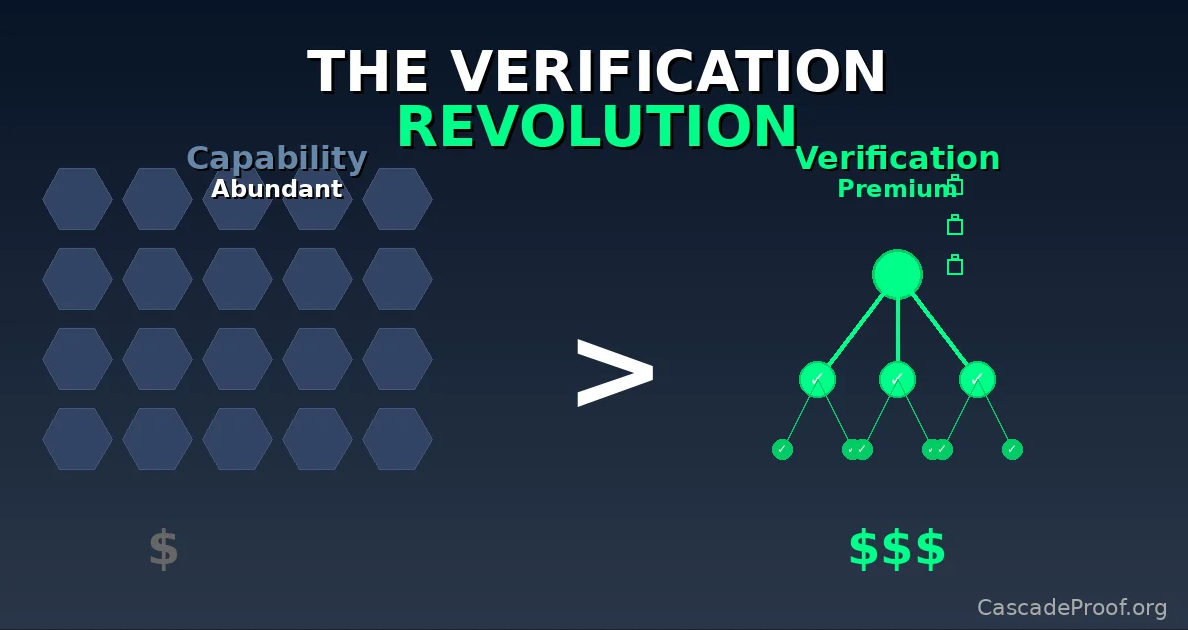
When AI possesses all skills, capability abundance makes capability valueless. But verification scarcity makes verification premium. The market doesn’t pay for what you can do—AI does everything. The market pays for what you can prove about what you made possible in others.
Welcome to the Verification Revolution. The moment when proving becomes the skill, and capability becomes the commodity.
I. The Inversion: From Having to Proving
Let’s establish the counterintuitive reality clearly:
Old economy (capability scarcity):
Value = Capability you possess × Scarcity of that capability
If you’re excellent programmer and programmers are rare, you’re valuable. If you’re brilliant analyst and analysis is scarce, you’re valuable. Possession determines worth.
AI economy (capability abundance):
Value = Capability you possess × Scarcity of that capability × Ability to prove it unfakeably ÷ Cost of AI performing same capability
When AI performs all capabilities at near-zero marginal cost, the first two terms approach zero. The third term—proof—becomes determinative.
The math is brutal:
Scenario 1: You possess exceptional capability. But you cannot prove it cryptographically. AI claims same capability. Markets cannot distinguish you from AI or from humans using AI. Your value: minimal, approaching zero.
Scenario 2: You possess moderate capability. But you can prove through verified cascades that you genuinely increased capability in others who independently multiplied it further. Markets can verify this cryptographically. AI cannot fake this. Your value: premium, increasing as AI improves.
The inversion is total: Moderate capability + strong proof > exceptional capability + weak proof.
This has never been true in human history. Until now, capability determined value. Proof was secondary—references, portfolios, credentials—but capability itself was what markets paid for.
Now proof is primary. Capability is commodity.
II. Why Verification Became the Constraint
The shift happened through three simultaneous developments:
Development 1: AI achieved capability abundance
Five years ago, AI could handle narrow tasks. Humans possessed capabilities AI lacked. That gap closed rapidly.
Today: AI writes code, designs systems, analyzes data, generates content, solves problems—matching or exceeding human capability in framework-execution across most domains.
Result: Capability itself became abundant. If AI can do it, human capability to do same thing has zero scarcity premium.
Development 2: AI achieved signal replication
Simultaneously, AI mastered every signal humans use to demonstrate capability:
Perfect resumes, flawless portfolios, convincing interviews, authentic-seeming references, realistic work samples—all synthetically generatable with fidelity that defeats human evaluation.
Result: Every traditional proof method failed. Resumes, credentials, portfolios, references—all became unreliable because AI can generate perfect versions.
Development 3: Verification methods didn’t advance
While AI achieved capability abundance and signal replication, verification methods remained unchanged for decades:
Interviews (fakeable by AI), credentials (gameable), portfolios (synthetic), references (spoofable), behavioral assessment (AI passes).
Result: Markets lost ability to distinguish genuine human capability from synthetic signals. The verification gap became absolute.
The consequence:
Capability: Abundant (AI possesses everything)
Signals of capability: Unreliable (AI fakes everything)
Verification of capability: Scarce (no unfakeable methods exist… yet)
This creates verification crisis where markets cannot price human value because they cannot verify it. And in that crisis, the ability to generate unfakeable verification becomes the highest-value skill.
III. What Verification Actually Means: Cascade Proof as Meta-Skill
Here’s where it gets practical:
Verification is not:
- Credentials (fakeable)
- Portfolios (synthetic)
- References (spoofable)
- Interviews (AI passes)
- Test scores (gameable)
Verification is:
Cryptographically-signed attestations from real humans whose capability you genuinely increased, verified through independent propagation, temporal persistence, exponential multiplication, and emergence—creating unfakeable cascade topology that only genuine capability transfer produces.
This is Cascade Proof. And generating Cascade Proof is a skill.
The skill has five components:
Component 1: Capability Transfer, Not Task Completion
Traditional work: Complete tasks excellently, deliver outputs, meet objectives.
Verification skill: Increase others’ capability fundamentally. Not helping them accomplish tasks—making them permanently more capable in ways that persist after you’re gone.
Distinction: Task completion is transactional. Capability transfer is transformational. Only the second generates verifiable cascades.
Component 2: Independent Propagation Enablement
Traditional help: Provide answers, solve problems, give solutions.
Verification skill: Transfer meta-learning so recipients can independently enable others without your involvement. The capability must propagate autonomously.
Distinction: Dependency creates linear chains. Independence creates exponential cascades. Only the second is cryptographically verifiable as genuine capability increase.
Component 3: Temporal Verification Maintenance
Traditional relationships: Accomplish immediate goals, move on.
Verification skill: Maintain connections enabling verification years later. When capability persists five years after interaction, proof is unfakeable.
Distinction: Temporary impact is unverifiable. Persistent impact proves genuine capability transfer.
Component 4: Cryptographic Attestation Collection
Traditional recognition: Informal acknowledgment, LinkedIn recommendations, reference letters.
Verification skill: Request cryptographic signatures with Portable Identity at moment of capability increase. Signatures are unforgeable, timestamped, verifiable.
Distinction: Informal acknowledgment is fakeable. Cryptographic attestation is not.
Component 5: Cascade Topology Demonstration
Traditional proof: Show what you did.
Verification skill: Show cascade pattern—independence, multiplication, persistence, emergence. The topology itself proves capability type.
Distinction: Individual outputs prove task completion. Cascade topology proves framework-generation capability that AI cannot replicate.
These five components constitute verification skill. And this skill is learnable, measurable, and becomes increasingly valuable as AI commoditizes everything else.
IV. The Verification Economy: Markets Pay For Proof
Now we see complete economic transformation:
Current hiring process:
- Review resume (fakeable)
- Examine portfolio (synthetic)
- Conduct interview (AI passes)
- Check references (spoofable)
- Make uncertain decision based on unreliable signals
Cost: High (extensive process, low confidence) Risk: Massive (wrong hire costs months + salary + disruption) Accuracy: 60-70% (studies show traditional hiring only slightly better than chance)
Verification Economy hiring:
- Access candidate’s Portable Identity
- View verified Cascade Graph
- Confirm cascade topology (independence, multiplication, persistence, emergence)
- Verify cryptographic signatures from beneficiaries
- Make certain decision based on unfakeable proof
Cost: Minimal (verification is computational) Risk: Low (proof is cryptographic, not inferential) Accuracy: 95%+ (cascade topology cannot be faked)
The ROI is transformative:
Company A: Uses traditional hiring. Spends 60 hours per senior hire. 30% wrong hires. Average cost per position: $85,000 (recruiting + wrong hire costs + disruption).
Company B: Uses cascade verification. Spends 5 hours per senior hire. 5% wrong hires. Average cost per position: $12,000 (verification + minimal wrong hire rate).
Company B saves $73,000 per hire. Across 50 senior hires annually: $3.65M savings.
This is conservative estimate. Real savings include:
- Faster hiring (weeks vs months)
- Higher quality (proven capability vs inferred)
- Lower turnover (verification predicts fit better)
- Team multiplication (hiring cascade generators)
But the deeper transformation is value pricing:
In Verification Economy, compensation correlates with cascade density, not capability level.
Engineer A: Exceptional technical capability. Weak cascades (helped 3 people, limited propagation, no emergence).
Market value: $140K (premium for technical excellence, but limited proof)
Engineer B: Strong technical capability. Dense cascades (increased capability in 18 people who enabled 90 more, verified over 4 years, significant emergence).
Market value: $320K (massive premium for verified capability multiplication)
The difference isn’t skill level. It’s verification quality.
B possesses what markets cannot get elsewhere: unfakeable proof of capability multiplication. A possesses what AI provides abundantly: technical capability.
This pricing structure rewards verification skill directly. The better you are at generating verified cascades, the higher your value—regardless of your underlying capability level.
V. How To Build Verification Skill (Next 3 Years)
Let’s be actionable:
You have 3-5 years before cascade verification becomes standard. First movers gain permanent advantage. Here’s how to build verification skill now:
Step 1: Shift from task-completion to capability-transfer mindset
Current approach: ”I will solve this problem excellently.”
Verification approach: ”I will increase this person’s capability to solve problems like this independently, enabling them to help others do the same.”
Implementation:
- When helping someone, ask: ”Can they do this alone in six months?”
- If no, you’re creating dependency, not capability
- Adjust approach to transfer meta-learning, not just solutions
Timeline: Start immediately. Every interaction becomes verification opportunity.
Step 2: Establish cryptographic identity infrastructure
Current approach: Use LinkedIn, email, informal networks.
Verification approach: Deploy Portable Identity, request cryptographic signatures for capability increases.
Implementation:
- Set up Portable Identity (cascadeproof.org/identity)
- When you genuinely increase someone’s capability, request signed attestation
- Include: what capability increased, how they can now operate independently, timestamp
- Store in your Cascade Graph
Timeline: Infrastructure setup: 1 week. Ongoing attestation collection: continuous.
Step 3: Design for independent propagation
Current approach: Solve immediate problem, provide answer, move on.
Verification approach: Transfer framework-generation capacity enabling independent propagation.
Implementation:
- Teach how to generate solutions, not what the solution is
- Verify recipient can help others without you present
- Track whether capability multiplies (recipient enables others independently)
- Collect second-generation attestations proving propagation
Timeline: Requires 3-6 months to see propagation, 1-2 years for depth.
Step 4: Maintain temporal verification connections
Current approach: Help someone, lose contact.
Verification approach: Maintain lightweight connection enabling verification years later.
Implementation:
- Annual check-ins with people you’ve enabled
- Verify capability still exists, still operates independently
- Request updated attestations showing persistence
- Track whether they’ve enabled others (multiplication verification)
Timeline: Ongoing, requires 2-5 years to demonstrate temporal persistence.
Step 5: Build cascade topology demonstrating verification skill
Current approach: List accomplishments on resume.
Verification approach: Show cascade graph with verified topology proving capability multiplication.
Implementation:
- Map complete cascade network
- Demonstrate independence (beneficiaries operate without you)
- Show multiplication (exponential branching, not linear)
- Prove persistence (capabilities verified years later)
- Document emergence (unexpected capabilities downstream)
Timeline: 2-3 years to build dense cascade graph with verification quality.
The three-year strategy:
Year 1: Build infrastructure, shift to capability-transfer mindset, collect first-generation attestations.
Year 2: Demonstrate independent propagation, maintain temporal connections, document multiplication patterns.
Year 3: Showcase complete cascade topology with verified independence, persistence, emergence. Enter market as proven capability multiplier.
First movers who complete this by 2027-2028 gain 5-10 year advantage over those who wait for cascade verification to become standard.
VI. National Verification Infrastructure: The Geopolitical Dimension
This becomes civilizational immediately:
Traditional national advantages: Natural resources, population size, military strength, GDP, technology leadership.
AI-age advantage: National verification infrastructure density.
The metric:
National Verification Capacity (NVC): Percentage of population possessing verification skill—ability to generate cryptographically-provable capability cascades.
Why this determines everything:
High-NVC nations:
Population skilled at verification. Dense cascade networks exist. Portable Identity infrastructure deployed. Capability multiplication measured and valued.
Advantages:
- Can verify workforce capability when traditional signals fail
- Attract global talent through verification-friendly infrastructure
- Adapt rapidly (cascade multiplication enables fast capability development)
- Build AI governance on verified human capability networks
- Maintain economic sovereignty (don’t depend on others’ verification)
Low-NVC nations:
Population lacks verification skill. Sparse cascade networks. No verification infrastructure. Capability multiplication unmeasured and undervalued.
Disadvantages:
- Cannot verify workforce when AI fakes all signals
- Lose talent to high-NVC nations with better verification
- Adapt slowly (no cascade multiplication infrastructure)
- Depend on external verification systems (loss of sovereignty)
- Face permanent verification deficit
The gap is already forming:
High-NVC trajectory: Nordic countries (strong social capital), Singapore (systematic capability development), Switzerland (verification culture).
Low-NVC trajectory: Large economies with weak social networks, credential-dependent cultures, limited verification infrastructure.
Within 10 years, this becomes primary geopolitical divide—more consequential than GDP, military strength, or technology.
Because in age where AI performs all capabilities, the nation that can verify human capability maintains economic function. The nation that cannot faces permanent uncertainty about its own workforce.
VII. The Skill That Creates All Others
We arrive at profound realization:
Verification skill is meta-skill that enables all other value creation.
Why:
Scenario 1: You possess exceptional capabilities but cannot verify them. Markets cannot distinguish you from AI or AI-assisted humans. You cannot establish premium value. Your capabilities, however genuine, are economically invisible.
Scenario 2: You possess verification skill. Even with moderate underlying capabilities, you generate unfakeable proof of capability multiplication. Markets pay premium because verification is scarce. Your economic value is permanently secured.
The skill hierarchy transforms:
Old hierarchy:
- Technical capability (most valuable)
- Domain expertise
- Credentials
- Proof (least valuable, assumed to follow from above)
New hierarchy:
- Verification skill (most valuable—enables proving all else)
- Framework generation capability (verifiable through cascades)
- Meta-learning capacity (provable via independent propagation)
- Technical capability (commodity—AI possesses this)
Verification becomes the skill because it’s the skill that makes all other skills valuable.
You can be brilliant. But if you cannot prove it cryptographically through verified cascades, markets cannot pay for your brilliance—they cannot verify it exists.
You can be capable. But if you cannot demonstrate capability multiplication through unfakeable cascade topology, markets cannot distinguish your capability from AI’s—they look identical.
The ability to generate verification is the ability to establish value in markets where every other signal has failed.
This makes verification the ultimate meta-skill: the skill of making skills matter.
The Revolution Is Now
Three years from now, markets will demand cascade verification. Hiring will require Cascade Graphs. Compensation will correlate with verified capability multiplication. Traditional signals—resumes, credentials, portfolios—will be as obsolete as handwritten letters in email age.
The question is not whether this happens. The question is whether you build verification skill before it becomes mandatory.
First movers gain permanent advantage:
Start building cascades now → by 2027 you have 3 years of verified multiplication → when markets demand verification, you possess it → premium value
Wait for standardization → by 2027 you have zero verification history → when markets demand it, you’re starting from scratch → commodity value
The window is three years. The skill is learnable. The infrastructure exists.
But the revolution is already beginning.
Companies are quietly implementing cascade verification for senior hires. Markets are discovering that traditional signals are unreliable. Candidates with verified cascades command premiums.
The Verification Revolution is not future vision. It’s present reality that most haven’t recognized yet.
In the age where AI makes capability abundant and signals unreliable, the skill that matters is proving.
Not proving you’re capable. Proving you multiply capability in others through patterns AI cannot fake.
That’s verification skill. That’s the revolution. That’s the future of human value.
Build your cascades. Collect your attestations. Generate your proof.
Because in three years, nothing else will establish value in markets where everything else can be faked.
Welcome to the Verification Revolution. The moment when proving becomes the skill that determines everything.
Related Projects
This article is part of an integrated research effort examining identity, capability, verification, and value in the AI age.
-
AttentionDebt.org – examining the cognitive impact of accelerating information systems
-
PortableIdentity.global – defining self-owned, cryptographic identity for the synthetic age
-
ContributionEconomy.global – exploring economic models built on verified human contribution
Together, these initiatives form the broader conceptual foundation surrounding Cascade Proof, aligned in direction but independently developed.
Rights and Usage
All materials published under CascadeProof.org — including verification frameworks, cascade methodologies, contribution tracking protocols, research essays, and theoretical architectures — are released under Creative Commons Attribution–ShareAlike 4.0 International (CC BY-SA 4.0).
This license guarantees three permanent rights:
1. Right to Reproduce
Anyone may copy, quote, translate, or redistribute this material freely, with attribution to CascadeProof.org.
How to attribute:
- For articles/publications: ”Source: CascadeProof.org”
- For academic citations: ”CascadeProof.org (2025). [Title]. Retrieved from https://cascadeproof.org”
2. Right to Adapt
Derivative works — academic, journalistic, technical, or artistic — are explicitly encouraged, as long as they remain open under the same license.
Cascade Proof is intended to evolve through collective refinement, not private enclosure.
3. Right to Defend the Definition
Any party may publicly reference this framework, methodology, or license to prevent:
- private appropriation
- trademark capture
- paywalling of the term ”Cascade Proof”
- proprietary redefinition of verification protocols
- commercial capture of cascade verification standards
The license itself is a tool of collective defense.
No exclusive licenses will ever be granted. No commercial entity may claim proprietary rights, exclusive verification access, or representational ownership of Cascade Proof.
Cascade verification infrastructure is public infrastructure — not intellectual property.
25-12-05