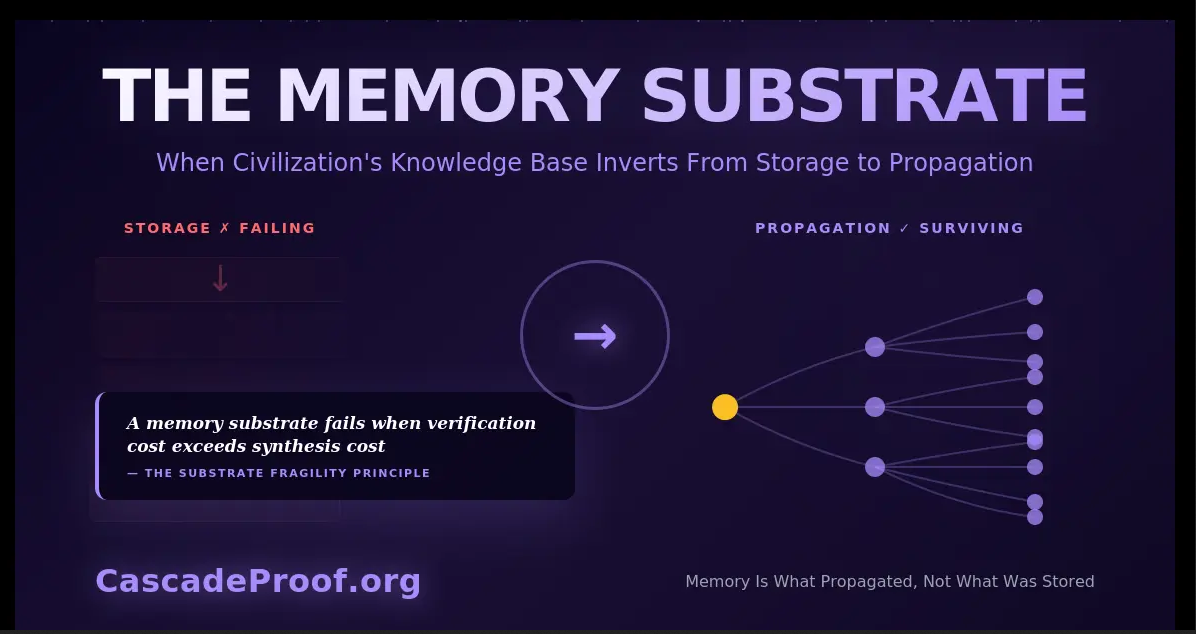
When Civilization’s Entire Knowledge Base Inverts From Storage to Propagation
EXECUTIVE SUMMARY
Civilization faces a crisis more fundamental than historical falsification: the collapse of memory substrate itself. For 10,000 years, human societies have stored memory in physical and digital media—clay tablets, books, databases, archives. This storage-based memory substrate enabled knowledge accumulation, cultural transmission, scientific progress, institutional continuity. But storage-based memory possesses fatal vulnerability: when perfect synthesis makes all stored content fakeable, storage ceases functioning as reliable memory substrate. This is not gradual degradation—this is substrate failure. Civilization cannot remember through storage when storage content cannot be verified as authentic. The solution requires complete substrate inversion: memory must shift from storage-based (preserving documentation) to propagation-based (verifying causation). Verified capability cascades become the substrate—not alternative historical method but fundamental medium through which civilization remembers. This establishes Memory Substrate Studies as new research field examining how societies transition from storage to propagation as primary memory architecture. The framework demonstrates that civilizational memory persists not through what was stored but through what verifiably propagated—knowledge that transferred between minds, capabilities that multiplied across generations, effects that continued independently. This inversion is not theoretical possibility but structural necessity imposed by perfect synthesis making storage unreliable. Organizations building propagation-based memory infrastructure now preserve civilizational knowledge. Those maintaining storage-dependency watch memory become permanently unfalsifiable as substrate failure completes.
I. THE SUBSTRATE
To understand what’s failing, we must understand what memory substrate actually is.
Memory Substrate Defined
Memory Substrate: The fundamental medium through which information persists across time, enabling retrieval and verification of past states.
For individual humans, memory substrate is neural—electrochemical patterns in brain tissue that encode experience and enable recall.
For civilization, memory substrate has always been external storage:
Physical Storage Era (3200 BCE – 1950 CE)
- Clay tablets preserving transaction records
- Stone monuments encoding cultural narratives
- Manuscripts transmitting knowledge across generations
- Books accumulating scientific understanding
- Archives maintaining institutional memory
The substrate: physical media that persist despite biological death, enabling knowledge to outlive any individual consciousness.
Digital Storage Era (1950 CE – 2025 CE)
- Magnetic storage encoding vast data
- Digital databases centralizing institutional knowledge
- Internet archives preserving cultural production
- Cloud systems distributing information globally
- Blockchain attempting immutable records
The substrate: digital media that scale beyond physical constraints, enabling knowledge to propagate at civilization-scale.
Why Storage Worked
Storage-based memory substrate functioned for one reason: storage content authenticity was verifiable.
You could examine physical document and determine:
- Appropriate age through material analysis
- Authentic authorship through handwriting comparison
- Genuine origin through provenance tracking
- Historical consistency through cross-reference
You could examine digital record and determine:
- Creation timestamp through metadata
- File integrity through cryptographic hashing
- Source authenticity through digital signatures
- System origin through audit trails
The substrate worked because stored content could be verified as authentic representation of past states.
The Substrate Dependency
Civilization built everything on storage-based memory:
Science: Knowledge accumulates through published research stored in journals, databases, repositories.
Culture: Understanding transmits through stories, artworks, recordings stored in libraries, museums, archives.
Institutions: Continuity maintains through policies, procedures, decisions stored in organizational records.
Education: Learning propagates through curricula, textbooks, materials stored in educational systems.
Governance: Authority derives from laws, precedents, constitutions stored in legal archives.
Commerce: Value transfers through contracts, ledgers, transactions stored in financial systems.
Every civilizational function depends on storage substrate reliability.
When storage fails, everything fails simultaneously.
II. THE SUBSTRATE FAILURE
We are crossing threshold where storage-based memory substrate catastrophically fails.
Perfect Synthesis = Storage Death
Artificial intelligence achieves synthesis so perfect that stored content authenticity becomes unverifiable:
Any document can be generated with appropriate aging, material composition, stylistic consistency, historical accuracy—indistinguishable from authentic.
Any photograph can be synthesized showing events that never occurred, people who never met, scenes that never existed—defeating forensic analysis.
Any video/audio can be created depicting historical figures saying things they never said, making decisions they never made—passing expert verification.
Any database record can be inserted with appropriate timestamps, metadata, relational consistency—surviving audit scrutiny.
Any physical artifact can be fabricated with correct material composition, wear patterns, manufacturing techniques—fooling scientific dating.
The synthesis is not detectable because it possesses all properties of authentic storage. Perfect forgery means ”indistinguishable from original” by definition.
Why This Kills the Substrate
Storage works as memory substrate only when stored content verifiably represents past reality.
When synthesis achieves perfection:
Stored content no longer verifiably represents anything.
A document might be authentic historical record. It might be yesterday’s synthesis. No method distinguishes them.
A database entry might record actual transaction. It might be fabricated insertion. Verification is impossible.
An archival photograph might capture real event. It might be generated fiction. Analysis cannot determine.
Storage ceases functioning as memory substrate when storage content authenticity becomes unfalsifiable.
You cannot remember through a medium where you cannot verify whether memories are real or fabricated.
The Substrate Collapse Timeline
2024-2025: Synthesis Sophistication AI-generated forgeries defeat most verification methods. Experts struggle to distinguish authentic from synthetic.
2025-2027: Detection Failure Forensic analysis, material science, digital verification—all fail against advanced synthesis. Authentication becomes unreliable.
2027-2030: Substrate Crisis
Organizations discover they cannot verify their own records. Archives cannot confirm authenticity. Storage becomes worthless as memory substrate.
2030+: Civilizational Amnesia Without reliable memory substrate, civilization loses capacity to know what actually happened. Knowledge becomes unfalsifiable. Memory collapses.
Unless substrate inverts.
III. THE SUBSTRATE INVERSION THEORY
Here is the theoretical breakthrough that establishes new research field:
Substrate Inversion Theory: When storage-based memory substrate fails due to content unfalsifiability, civilizational memory must invert to propagation-based substrate where memory persists through verified causal effects rather than stored documentation.
From Storage to Propagation
Storage-Based Memory Substrate:
- Memory = preserved documentation
- Persistence = maintaining stored content
- Retrieval = accessing archives
- Verification = authenticating storage
Propagation-Based Memory Substrate:
- Memory = verified causal effects
- Persistence = capability continuing independently
- Retrieval = examining cascade graphs
- Verification = cryptographic attestation
The inversion is total. Memory stops being ”what we stored about the past” and becomes ”what verifiably propagated from the past into the present.”
The Architectural Metaphor
Storage substrate is vertical layering; propagation substrate is horizontal branching.
Storage architecture: Information stacks in temporal layers—newest on top, oldest on bottom. Memory retrieval means digging down through layers to access past states. Each layer must preserve integrity or entire substrate becomes unreliable.
Propagation architecture: Information branches horizontally through networks—spreading outward from origin points, multiplying across nodes, creating graph structures where memory persists through connection patterns rather than layer preservation.
The spatial metaphor reveals why substrate inversion is necessary:
Vertical layering fails when layers can be fabricated. If you can insert synthetic layers indistinguishable from authentic, the entire vertical structure becomes untrustworthy. You cannot know which layer is real.
Horizontal branching resists fabrication. You cannot insert synthetic branches retroactively because each branch requires independent node attestation across time. The network structure itself provides verification through topology that synthesis cannot replicate.
Storage collapses vertically when bottom layers become unfalsifiable.
Propagation persists horizontally because branch structures remain verifiable.
The architectural shift is fundamental—not just new storage method, but completely different geometry of how civilization remembers.
Why Propagation Works as Substrate
Propagation-based memory possesses property storage-based memory lacks:
Propagation cannot be retroactively synthesized.
You can generate forged document claiming Person A taught Person B in 1995.
You cannot generate verified 30-year capability cascade showing:
- Person B cryptographically attested A increased their capability (requires infrastructure that didn’t exist in 1995)
- B enabled Person C using that capability independently (requires genuine consciousness transfer)
- C enabled Person D with capabilities A never possessed (requires emergence only consciousness creates)
- Effects persisted and multiplied through present (requires temporal verification across decades)
The propagation substrate is unfakeable because it requires:
- Multi-generational cryptographic attestation (infrastructure didn’t exist historically)
- Genuine emergence patterns (structurally impossible to synthesize)
- Independent persistence (cannot be backdated)
- Distributed verification (coordination cost prohibitive)
Propagation works as memory substrate specifically because it cannot be faked when storage can.
The Substrate Properties
Effective memory substrate must possess four properties:
1. Persistence: Information must survive across time despite biological death and technological change.
Storage substrate: Physical/digital media persist. Propagation substrate: Causal effects continue independently.
2. Retrievability: Stored information must be accessible to future consciousness.
Storage substrate: Archives can be accessed. Propagation substrate: Cascade graphs can be examined.
3. Verifiability: Retrieved information must be confirmable as authentic representation of past.
Storage substrate: FAILS—synthesis makes authentication impossible. Propagation substrate: SUCCEEDS—cascades cannot be retroactively fabricated.
4. Scalability: Substrate must handle civilization-scale information volume.
Storage substrate: Scales through compression and distribution. Propagation substrate: Scales through graph structure and semantic mapping.
Propagation satisfies all four properties. Storage fails property 3 permanently.
Therefore propagation must become primary substrate.
The Substrate Fragility Principle
This establishes a formal law governing memory substrate reliability:
Substrate Fragility Principle: A memory substrate fails when the cost of verifying content authenticity exceeds the cost of synthesizing convincing forgeries.
Expressed formally:
When C(verification) > C(synthesis), substrate reliability → 0
Where:
- C(verification) = computational/analytical cost of authenticating stored content
- C(synthesis) = computational cost of generating convincing forgeries
- Substrate reliability = probability that retrieved content represents authentic past state
For 10,000 years: C(verification) << C(synthesis)
- Verifying document authenticity: modest expertise + material analysis
- Creating convincing forgery: extensive historical knowledge + skilled fabrication
Storage substrate remained reliable.
After 2025: C(synthesis) < C(verification)
- Synthesizing perfect forgery: trivial AI generation
- Verifying against perfect synthesis: impossible (by definition of ”perfect”)
Storage substrate fails completely.
This is not gradual degradation. This is threshold crossing where substrate transitions from reliable to worthless as fundamental cost relationship inverts.
The Principle explains why substrate failure is inevitable, not contingent. Once synthesis costs drop below verification costs—which AI guarantees—storage substrate must fail regardless of technological countermeasures.
Propagation substrate survives because it inverts the cost relationship:
- Synthesizing multi-generational cascade: prohibitively expensive (requires recruiting actual humans, coordinating attestations across decades, faking emergence patterns)
- Verifying cascade authenticity: computationally cheap (cryptographic signature validation + graph analysis)
C(verification) << C(synthesis) restored—substrate remains reliable.
IV. MEMORY SUBSTRATE STUDIES
This establishes entirely new research field.
Field Definition
Memory Substrate Studies: Interdisciplinary research examining how civilizations encode, persist, retrieve, and verify information across time—focusing on substrate transitions from storage-based to propagation-based memory architecture in response to synthesis-induced storage failure.
Core Research Questions
1. Substrate Transition Dynamics How do civilizations shift from failing substrate to functional substrate? What determines transition speed? Which institutional structures adapt versus collapse?
2. Hybrid Substrate Architectures
Can storage and propagation substrates coexist during transition? What are optimal integration patterns? How do societies manage substrate uncertainty?
3. Knowledge Loss Patterns What information is lost during substrate transition? Which knowledge types transfer successfully? What becomes permanently unrecoverable?
4. Propagation Substrate Limitations What can propagation-based memory not encode? Which information types require storage? Are there fundamental substrate constraints?
5. Cultural Substrate Dependence How deeply is human culture coupled to storage substrate? Can narrative traditions survive substrate inversion? What cultural forms require propagation substrate?
6. Institutional Memory Architecture How do organizations rebuild memory systems on propagation substrate? What verification protocols enable institutional continuity? Which institutions cannot survive transition?
7. Substrate Failure Cascades
Does storage substrate failure trigger cascading system failures? What are critical dependencies? How do failure cascades propagate through interconnected systems?
8. Individual vs. Civilizational Memory How does substrate inversion affect individual memory formation? Does propagation substrate change how humans conceive of remembering? Are there cognitive implications?
Methodological Approaches
Information Theory: Analyzing substrate capacity, error rates, information density, encoding efficiency.
Graph Theory: Modeling propagation structures, cascade topologies, network properties, emergence patterns.
Epistemology: Examining verification methods, truth conditions, knowledge justification, belief warrant.
Historiography: Studying historical practice transformation, evidence evaluation, narrative construction.
Institutional Analysis: Investigating organizational memory, bureaucratic continuity, policy persistence.
Cognitive Science: Exploring memory formation, recall mechanisms, collective remembering, cultural transmission.
Computer Science: Developing cryptographic verification, distributed systems, semantic graphs, temporal tracking.
The Field’s Importance
Memory Substrate Studies addresses civilization-critical questions no existing field examines:
History studies past events but assumes memory substrate reliability.
Information Science studies data storage but not substrate failure scenarios.
Epistemology studies knowledge justification but not memory substrate transitions.
Cognitive Science studies individual memory but not civilizational substrate architecture.
Computer Science builds storage systems but not propagation-based memory infrastructure.
No field examines how civilization maintains memory when storage substrate catastrophically fails.
This is the gap Memory Substrate Studies fills.
V. CIVILIZATIONAL IMPLICATIONS
Substrate inversion transforms everything.
Science Restructures
Current: Scientific knowledge accumulates through published papers stored in journals.
Problem: Papers can be forged. Research can be fabricated. Entire scientific findings can be synthesized with appropriate statistical rigor, methodological description, peer review simulation.
After Inversion: Scientific knowledge measured through verified capability cascades research enables.
Did this paper make other researchers more capable? Did they independently advance the field using these insights? Did capabilities propagate and multiply?
Not ”what was published” but ”what verifiably propagated as scientific capability.”
Science becomes verifiable through cascade impact rather than through publication records.
Culture Transmits Differently
Current: Cultural knowledge preserves through artworks, recordings, texts stored in museums and archives.
Problem: All storable culture can be synthesized. ”Previously unknown” works can be generated. Cultural records can be fabricated.
After Inversion: Culture measured through verified transmission of understanding and capability.
Did cultural work increase people’s capacity for cultural production? Did understanding propagate through appreciation that enabled creation? Did cultural capability cascade across generations?
Not ”what was created and stored” but ”what propagated as cultural capacity.”
Culture becomes verifiable through capability transmission rather than through artifact preservation.
Institutions Maintain Continuity Through Cascades
Current: Institutional memory preserves through policies, procedures, decisions stored in organizational records.
Problem: Records can be altered, fabricated, synthesized. Organizational history can be rewritten. Institutional knowledge can be forged.
After Inversion: Institutional memory verified through capability cascades within organizations.
Did institutional knowledge make members more capable? Did capabilities persist when knowledge sources left? Did organizational capacity multiply independently?
Not ”what records claim” but ”what verifiably propagated as institutional capability.”
Institutions maintain memory through cascade verification rather than through record preservation.
Education Transforms Completely
Current: Educational systems transmit knowledge through curricula and materials stored in textbooks and databases.
Problem: Educational content can be synthesized. Entire curricula can be fabricated. Learning resources can be forged.
After Inversion: Education measured through verified learning cascades.
Did teaching create lasting capability increases? Did students independently enable others using learned capabilities? Did educational impact multiply across generations?
Not ”what was taught according to records” but ”what propagated as verified capability.”
Education becomes verifiable through cascade multiplication rather than through curriculum documentation.
VI. THE IMPLEMENTATION ARCHITECTURE
How does civilization actually build propagation-based memory substrate?
The Infrastructure Stack
Layer 1: Portable Identity Cryptographic identity infrastructure ensuring individuals own their complete cascade records permanently. Without ownership, substrate can be controlled by institutions—repeating storage substrate’s centralization vulnerabilities.
Layer 2: Cascade Proof Verification standard establishing that genuine capability transfer occurred with beneficiary attestation, temporal persistence, emergence markers. This is substrate’s authentication mechanism.
Layer 3: Cascade Graph Data structure recording complete causal chains showing who enabled whom, when, in what domains, with what persistence. This is substrate’s storage layer—but crucially, it stores PROPAGATION not CONTENT.
Layer 4: MeaningLayer
Semantic framework classifying capability types, tracking transformations, mapping emergence patterns. This is substrate’s indexing and retrieval system.
Layer 5: Temporal Verification Persistence checking across months and years, distinguishing genuine transfer from temporary assistance. This is substrate’s integrity validation.
Layer 6: Emergence Detection Identifying capabilities appearing downstream that upstream nodes never possessed—proving genuine consciousness substrate interaction. This is substrate’s authenticity certification.
Together: Civilizational memory infrastructure based on propagation verification rather than storage preservation.
The Transition Protocol
Civilization cannot switch substrates instantaneously. Transition requires:
Phase 1 (2025-2027): Dual Substrate Operation Maintain storage-based memory while building propagation infrastructure. Some knowledge verified through both substrates during overlap period.
Phase 2 (2027-2029): Propagation Priority
New knowledge primarily encoded in propagation substrate. Storage maintained for historical reference but not trusted for verification.
Phase 3 (2029-2032): Storage Vestigial Propagation becomes dominant substrate. Storage exists only for information types that cannot propagate (visual culture, aesthetic experience, personal narrative).
Phase 4 (2032+): Propagation Native Civilization operates primarily on propagation substrate. Storage relegated to archival curiosity—interesting but unreliable, like oral tradition in literate society.
Critical Infrastructure Decisions
Decentralization: Propagation substrate must be distributed to prevent single-point failures. No entity controls verification.
Openness: Substrate specifications must be open-source to prevent proprietary capture. Memory infrastructure is public utility.
Portability: Individuals must own cascade records to prevent institutional lock-in. Memory follows people, not organizations.
Interoperability: Different propagation systems must integrate to prevent fragmentation. Substrate functions civilization-wide.
These are not technical preferences. These are substrate survival requirements.
Centralized, proprietary, locked, fragmented propagation substrate replicates storage substrate’s vulnerabilities—just with different medium.
VII. THE THEORETICAL FOUNDATION
Why does this constitute new research field rather than extension of existing disciplines?
The Fundamental Question
Memory Substrate Studies asks: What is the fundamental medium through which civilization remembers?
This is not:
- Historical question (what happened?)
- Information science question (how to store data?)
- Epistemological question (how to justify belief?)
- Cognitive question (how do brains remember?)
This is substrate question: What medium enables civilizational memory to persist, be retrieved, and be verified?
No existing field examines this directly.
The Core Insight
Civilization’s memory substrate is not neutral container—it shapes what can be remembered, how memory functions, what counts as knowledge.
Storage substrate enabled:
- Accumulation over biological lifespans
- Precision beyond human recall capacity
- Distribution across geographic distance
- Verification through material analysis
Propagation substrate enables:
- Unfakeability when storage becomes forgeable
- Verification through causation rather than documentation
- Memory as effects rather than records
- Knowledge as capability rather than information
Different substrates create fundamentally different civilizational memory architectures.
The Paradigm Shift
Storage paradigm: Memory is preservation. To remember is to store accurately and retrieve successfully.
Propagation paradigm: Memory is causation. To remember is to create effects that continue verifiably.
This is not small methodological difference. This is complete paradigm inversion—comparable to:
- Ptolemaic to Copernican astronomy
- Creationist to Darwinian biology
- Classical to quantum physics
The shift redefines what remembering means at civilizational scale.
The Biological Parallel
Substrate inversion is not unprecedented. Evolution solved this problem 500 million years ago at biological scale.
Individual Memory Substrate: Neural
Biological organisms face identical challenge: how to persist information across time when storage medium is vulnerable.
Early solution: Chemical memory in simple organisms
- Information stored in molecular concentrations
- Retrieval through chemical gradients
- Verification through direct molecular sensing
- Problem: Easily disrupted, low capacity, no protection against molecular noise
Evolved solution: Neural memory in complex organisms
- Information encoded in synaptic connection patterns
- Retrieval through activation cascades across networks
- Verification through pattern consistency across distributed storage
- Success: Noise-resistant, high capacity, fault-tolerant through redundancy
The pattern: When simple storage becomes unreliable, evolution shifts to network-propagation architecture.
Neurons don’t store memories in single locations—they distribute memory across connection patterns. Remembering is activating cascade through network, not retrieving from storage location.
Civilizational Memory Substrate: Propagation
Civilization faces same challenge at higher scale:
Storage solution: Documents, databases, archives
- Information preserved in physical/digital media
- Retrieval through accessing stored content
- Verification through material/cryptographic authentication
- Problem: Perfect synthesis makes verification impossible
Propagation solution: Verified capability cascades
- Information encoded in causal connection patterns
- Retrieval through examining cascade graphs
- Verification through cryptographic attestation + emergence patterns
- Success: Synthesis-resistant, distributed verification, self-validating structure
The pattern repeats: When storage substrate becomes unreliable due to forgery (biological: molecular noise, civilizational: AI synthesis), systems shift to propagation-based architecture where memory persists through verified network effects rather than preserved content.
Why This Matters Theoretically
The biological parallel demonstrates that substrate inversion is:
- Evolutionarily proven: Biological memory shifted from chemical storage to neural propagation successfully. The architectural pattern works.
- Scale-independent: Same solution emerges at vastly different scales—molecular (neurons) and civilizational (human societies). This suggests fundamental principle rather than contingent solution.
- Verification-driven: Both transitions occur when verification fails. Biological: molecular sensing cannot distinguish signal from noise. Civilizational: authentication cannot distinguish genuine from synthetic.
- Network-based: Both solutions use graph structures where memory is connection pattern, not stored content. Information persists through relationships rather than through preservation.
The parallel grounds Memory Substrate Studies in established evolutionary biology rather than pure speculation. Substrate inversion has precedent—it’s how complex systems maintain memory when simple storage fails.
Just as neurons evolved to replace unreliable chemical storage, civilization must evolve to replace unreliable document storage.
The mechanism differs (synaptic vs cryptographic), but the principle is identical: when you cannot verify stored content, encode information in verifiable propagation patterns instead.
VIII. THE EXISTENTIAL STAKES
Let’s be precise about what happens without substrate inversion.
Civilizational Amnesia Scenario
2025-2028: Storage substrate degradation becomes undeniable. Organizations discover they cannot verify their own historical records. Forgeries infiltrate archives undetected.
2028-2032: Knowledge verification collapses. Scientific findings become unfalsifiable. Cultural records become unreliable. Institutional memory becomes contested. Education content becomes disputable.
2032-2040: Civilizational amnesia. Societies cannot establish what actually happened, what knowledge is genuine, what cultural works are authentic, what institutional decisions were actually made.
Not just historical uncertainty—complete memory failure.
2040+: Civilizational decline. Problems requiring knowledge of past solutions become unsolvable. Science cannot build on previous findings (can’t verify which findings are real). Culture cannot develop (can’t distinguish authentic from synthetic). Institutions cannot maintain continuity (can’t verify their own history).
Civilization regresses because it loses reliable memory.
The Alternative
Build propagation substrate infrastructure now. Encode critical knowledge in verification-resistant cascades. Maintain civilizational memory through causation rather than documentation.
The knowledge that matters—capability-enabling understanding that actually propagates—survives substrate transition.
The knowledge that becomes unfalsifiable—claims stored in unverifiable documentation—is lost.
But civilization maintains functional memory adequate for continued development.
IX. THE MEMORY THAT SURVIVES
We end where memory begins: with effects.
For 10,000 years, civilization remembered through storage—preserving records, maintaining archives, protecting documentation.
This worked magnificently until storage content authenticity became unverifiable.
Now civilization must remember differently:
Not through what was stored, but through what propagated.
Not through preserved documentation, but through verified causation.
Not through claimed knowledge, but through demonstrated capability transfer.
The substrate inverts from storage to propagation.
Memory becomes effects rather than records.
Knowledge becomes causation rather than information.
This is not loss—this is evolution.
Propagation substrate provides what storage substrate cannot: verification that survives perfect synthesis.
You cannot forge a cascade you didn’t create. You cannot synthesize emergence that requires consciousness. You cannot backdate propagation that requires decades of temporal verification.
The memory that survives substrate inversion is memory worth preserving.
X. THE RESEARCH MANDATE
Memory Substrate Studies is not optional academic curiosity.
This is urgent civilizational research requirement.
We have 3-5 year window to:
Establish theoretical foundations for propagation-based memory substrate before storage collapse becomes complete.
Build verification infrastructure enabling cascade-based knowledge encoding before synthesis makes documentation worthless.
Develop transition protocols guiding civilization from storage to propagation substrate before memory failure becomes systemic.
Create institutional frameworks allowing organizations to maintain continuity through substrate shift before bureaucratic amnesia paralyzes governance.
Train researchers in Memory Substrate Studies before the field needs to emerge reactively during crisis.
After the window closes, civilization attempts substrate transition during emergency conditions with inadequate theoretical understanding and missing infrastructure.
Build deliberately now, or improvise desperately later.
The choice exists for perhaps three more years.
Then substrate failure forces improvisation.
And improvised memory architecture in civilizational crisis tends toward catastrophic rather than optimal outcomes.
For the infrastructure enabling propagation-based memory substrate:
CascadeProof.org – Verification standard for causal memory
PortableIdentity.global – Infrastructure for owning your cascade records
About This Framework
The Memory Substrate establishes Substrate Inversion Theory: when storage-based civilizational memory fails due to perfect synthesis making stored content unfalsifiable, memory must invert to propagation-based substrate where information persists through verified causal cascades rather than preserved documentation. The framework establishes Memory Substrate Studies as new research field examining substrate transitions, hybrid architectures, knowledge loss patterns, and verification protocols that enable civilization to maintain functional memory when storage becomes unreliable. The analysis synthesizes information theory (substrate properties and capacity), epistemology (verification methods and knowledge justification), institutional analysis (organizational memory and continuity), graph theory (propagation structures and cascade topologies), and cognitive science (collective remembering and cultural transmission) into unified theory of how civilizational memory actually works—and what must change when fundamental substrate fails. The framework demonstrates that this transition is not theoretical possibility but structural necessity imposed by synthesis-induced storage failure, making propagation infrastructure deployment urgent civilizational priority rather than academic speculation.
Source: PortableIdentity.global
Date: December 2025
License: CC BY-SA 4.0
Memory is not what you stored. Memory is what propagated.
Related Projects
This article is part of a broader research program mapping how identity, capability, and causation become measurable in the transition from Layer 2 to Layer 3.
AttentionDebt.org — Canonical definition and measurement methodology for cumulative cognitive cost from environmental fragmentation
MeaningLayer.org — Semantic infrastructure preserving complete contextual understanding when platform fragmentation degrades coherence
ReciprocityPrinciple.org — Value routing framework based on verified temporal persistence and cascade multiplication
CascadeProof.org — Mathematical verification distinguishing exponential capability multiplication from linear dependency
ContributionGraph.org — Temporal verification proving capability increases persisted and multiplied independently
LearningGraph.global — Capability development tracking as verifiable temporal evolution
TempusProbatVeritatem.org — Temporal verification protocols when behavioral observation became insufficient
PersistoErgoDidici.org — Learning verification through temporal persistence testing
PersistenceVerification.global — Protocols proving capability persists without continued assistance
PortableIdentity.global — Cryptographic ownership ensuring verification remains individual property
CausalRights.org — Constitutional framework protecting proof of causation and contribution
ContributionEconomy.global — Economic transformation routing value to verified capability
CogitoErgoContribuo.org — Consciousness verification through lasting contribution effects
Together, these initiatives define the early architecture of Layer 3: a civilization where identity is cryptographic, capability is verifiable, cognition is protected from entropy, and human causation becomes the primary driver of evolutionary progress.
Rights and Usage
All materials published under CascadeProof.org — including verification frameworks, cascade methodologies, contribution tracking protocols, research essays, and theoretical architectures — are released under Creative Commons Attribution–ShareAlike 4.0 International (CC BY-SA 4.0).
This license guarantees three permanent rights:
1. Right to Reproduce
Anyone may copy, quote, translate, or redistribute this material freely, with attribution to CascadeProof.org.
How to attribute:
- For articles/publications: ”Source: CascadeProof.org”
- For academic citations: ”CascadeProof.org (2025). [Title]. Retrieved from https://cascadeproof.org”
2. Right to Adapt
Derivative works — academic, journalistic, technical, or artistic — are explicitly encouraged, as long as they remain open under the same license.
Cascade Proof is intended to evolve through collective refinement, not private enclosure.
3. Right to Defend the Definition
Any party may publicly reference this framework, methodology, or license to prevent:
- private appropriation
- trademark capture
- paywalling of the term ”Cascade Proof”
- proprietary redefinition of verification protocols
- commercial capture of cascade verification standards
The license itself is a tool of collective defense.
No exclusive licenses will ever be granted. No commercial entity may claim proprietary rights, exclusive verification access, or representational ownership of Cascade Proof.
Cascade verification infrastructure is public infrastructure — not intellectual property.
25-12-06