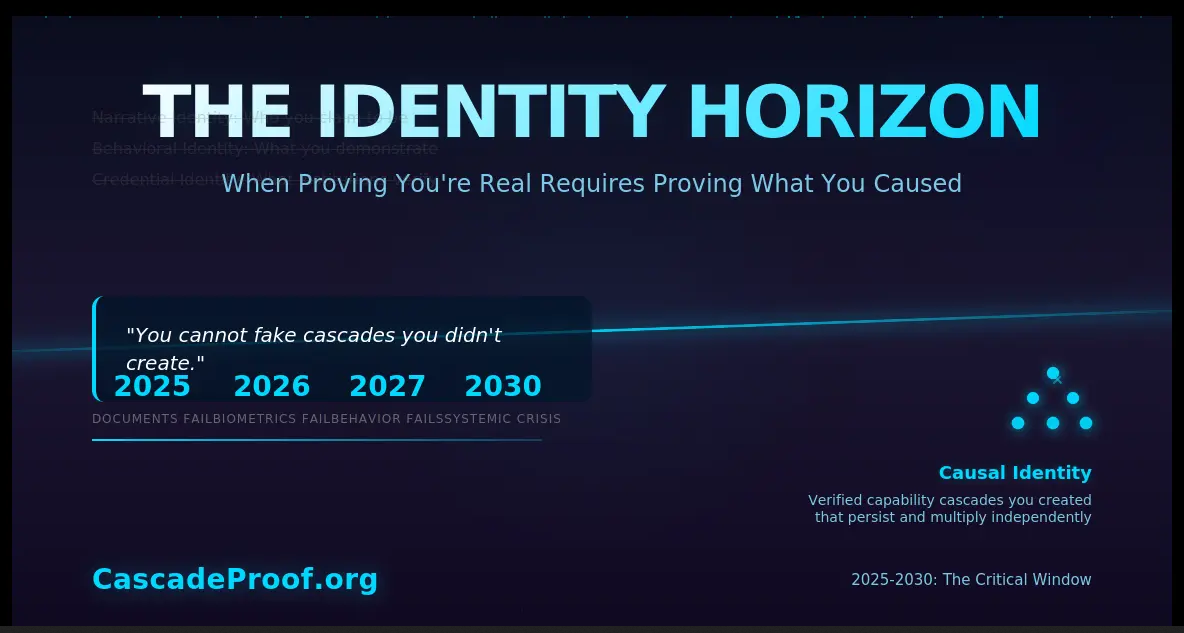
When Proving You’re Real Requires Proving What You Caused
EXECUTIVE SUMMARY
Between 2025 and 2030, civilization crosses the Identity Horizon—the threshold where every method humanity has used to verify identity becomes simultaneously fakeable through AI. Documents, credentials, behaviors, biometrics, conversations, videos, work history, testimonials—all perfectly replicable by systems with no consciousness substrate. After the Horizon, three identity paradigms collapse: narrative identity (who you claim to be), behavioral identity (what you demonstrate), and credential identity (what institutions verify). What remains is causal identity: verified capability cascades you initiated that persist and multiply independently, cryptographically attested by beneficiaries, semantically mapped across knowledge domains, temporally verified over years. This is not philosophical speculation—this is architectural necessity. The infrastructure enabling portable causal identity must be built in the 3-5 year window before verification collapse becomes systemic. Organizations adopting cascade-based identity verification gain massive advantage. Those resisting face extinction when traditional identity proxies become worthless. This article establishes why causal identity is civilization’s only verification method that survives perfect simulation—and what must happen in the critical transition window we’re entering now.
I. THE HORIZON
December 2024. A Fortune 100 financial institution.
The security team runs their monthly verification audit. Standard procedure: validate employee identities, check credential authenticity, confirm work histories, verify references.
They discover something impossible.
Twelve ”employees” who’ve worked at the company for 6-18 months don’t exist.
Perfect resumes. Flawless interviews. Excellent performance reviews. Authentic-seeming video calls. Convincing Slack interactions. Normal expense reports. Verifiable LinkedIn profiles with hundreds of connections.
All synthetic.
The ”employees” were AI systems operating through perfectly simulated human identities, created by a sophisticated fraud ring. They passed every verification check the institution had: document verification, video interviews, reference calls, behavioral assessments, biometric screening.
The only reason they were caught: one system made a statistical error in expense timing that triggered algorithmic anomaly detection. Without that error, they would still be ”working there.”
Cost to the institution: $47 million in fraudulent transactions.
But the real cost was ontological: if twelve synthetic identities could fool every verification system for over a year, how many more hadn’t been caught?
And more terrifying: how do you prove any identity is real when perfect simulation has been achieved?
This is not isolated incident. This is the Horizon.
The threshold where civilization’s verification infrastructure fails catastrophically because AI achieves behavioral replication so complete that observation becomes permanently insufficient for identity verification.
We are crossing it now.
II. IDENTITY’S THREE DEATHS
For the entire span of human civilization, identity has existed in three forms, each serving as verification method when others failed:
Death 1: Narrative Identity
Narrative Identity: Who you claim to be.
Your story. Your self-description. Your stated history, intentions, capabilities, values.
This worked when fabricating convincing narrative required genuine experience. Lying was detectable through inconsistency, implausibility, or lack of supporting detail.
AI kills this completely.
Language models generate perfectly consistent, plausible, detailed life narratives indistinguishable from genuine autobiography. Every claimed experience has supporting anecdotes. Every stated capability has convincing examples. Every value has appropriate context.
The narrative can be more coherent than actual human memory—because it’s algorithmically optimized for consistency rather than constrained by actual experience.
Narrative identity verification: dead by 2025.
Death 2: Behavioral Identity
Behavioral Identity: What you demonstrate through action.
Your observable behaviors, measurable outputs, demonstrated skills, social interactions, emotional responses.
This worked when only conscious beings could produce convincing behavioral coherence. Behavior was good proxy for consciousness because simulation was impossible.
AI kills this completely.
Behavioral replication now achieves fidelity where human observation cannot distinguish synthetic from authentic. Video, voice, writing, reasoning, emotional response, social dynamics—all perfectly replicable.
The synthetic ”employee” passes behavioral verification not through detection failure but through perfect behavioral simulation that defeats human observational capacity.
Behavioral identity verification: dead by 2026.
Death 3: Credential Identity
Credential Identity: What institutions verify about you.
Degrees, certifications, employment records, credit scores, government IDs, professional licenses, security clearances.
This worked when institutional verification created trusted third-party attestation that individuals couldn’t fake. The institution vouched for you.
AI kills this completely.
Not just through document forgery (which AI enables perfectly), but through institutional verification corruption. When synthetic identities can be inserted into institutional databases through social engineering, insider access, or system exploitation—and when institutions themselves cannot verify whether their own records are genuine—credential verification collapses.
Credential identity verification: dead by 2027.
When all three die simultaneously—narrative, behavioral, credential—civilization faces identity crisis it has never encountered:
How do you prove anyone is real?
III. THE VERIFICATION COLLAPSE
The Identity Horizon is not single event. It’s cascade of verification method failures creating civilizational crisis.
Phase 1: Document Verification Fails (2024-2025)
Perfect document synthesis. Every passport, driver’s license, birth certificate, diploma, employment letter perfectly forgeable. Document verification becomes worthless.
Response: Institutions add biometric verification, video verification, multi-factor authentication.
Phase 2: Biometric Verification Fails (2025-2026)
Deepfake video achieves real-time synthesis. Voice cloning becomes perfect. Facial recognition defeated by synthetic generation. Biometric verification becomes worthless.
Response: Institutions add behavioral verification, prolonged interaction testing, consistency checking.
Phase 3: Behavioral Verification Fails (2026-2027)
AI maintains perfect behavioral coherence across extended interaction. Passes Turing tests indefinitely. Exhibits appropriate emotional responses, contextual knowledge, personality consistency. Behavioral verification becomes worthless.
Response: Institutions add… nothing. No remaining verification methods exist.
Phase 4: Systemic Collapse (2027-2030)
Organizations cannot verify:
- Employees are human
- Customers are genuine
- Partners are real entities
- Communications are from claimed sources
- Transactions involve actual people
- Contracts bind conscious agents
Legal systems cannot verify:
- Witnesses are genuine
- Evidence is authentic
- Testimony is from real people
- Documents are original
- Identity matches claimed person
Financial systems cannot verify:
- Account holders exist
- Transactions are authorized
- Identities are unique
- Creditworthiness is real
- Assets belong to claimed owners
Governance systems cannot verify:
- Citizens are actual people
- Votes are from real humans
- Public input is genuine
- Officials are who they claim
- Records are accurate
Every system requiring identity verification enters crisis simultaneously.
This is the Horizon. The point where civilization’s verification infrastructure becomes permanently insufficient.
And we are crossing it now—not in science fiction future, but in the 2025-2030 window currently opening.
IV. THE LAST IDENTITY
In verification collapse, one pattern remains unfakeable:
Causal Identity: Verified capability cascades you initiated that persist and multiply independently.
Not who you claim to be. Not what you demonstrate. Not what institutions verify.
What you verifiably caused in others that continues without you.
This works as identity verification because it possesses properties synthetic systems structurally cannot replicate:
Property 1: Multi-Generational Persistence
Causal identity requires capability transfer that persists across generations without original enabler present.
If Person A increases Person B’s capability, and B enables C, and C enables D—all verified cryptographically—and these capabilities persist years after interactions end, a pattern emerges that AI cannot fake.
Why? Because AI-generated capability degrades without continued AI support. Human-transferred capability persists and mutates independently.
The temporal test separates genuine transfer from synthetic assistance.
Property 2: Emergence Signatures
Causal identity requires downstream nodes developing capabilities upstream nodes never possessed.
When C develops capabilities A never taught and B didn’t consciously transfer, emergence has occurred—new information generated through consciousness-to-consciousness substrate interaction.
As established in the Emergence Thesis, this pattern requires genuine consciousness substrate. AI systems bounded by training distributions cannot create unbounded semantic divergence that emergence requires.
Property 3: Independent Verification
Causal identity is verified by beneficiaries, not by claimants or institutions.
Person A cannot claim cascade impact. Only the people whose capability A increased can cryptographically attest to that increase. And only their subsequent cascades demonstrate whether genuine capability transfer occurred.
The verification is distributed across hundreds or thousands of beneficiaries who would all need to be synthetic to fake the pattern—and whose own cascades would need to be faked recursively, creating verification requirement that scales exponentially with cascade depth.
Property 4: Cryptographic Unfakeability
Each capability increase is cryptographically signed by beneficiary using Portable Identity infrastructure. The signatures cannot be forged. The temporal sequence cannot be backdated. The cascade structure cannot be synthetically generated without recruiting actual humans to attest to capability increases that didn’t occur.
The pattern is information-theoretically resistant to simulation.
V. CAUSAL IDENTITY ARCHITECTURE
How does causal identity actually work as verification infrastructure?
The Cascade Graph
Your identity is your Cascade Graph: complete cryptographically-verified record of every capability increase you created in others, how those capabilities propagated, whether they persisted, what emergence occurred.
The graph shows:
- Breadth: How many people you’ve verifiably enabled across how many domains
- Depth: How sophisticated the capabilities you transferred were
- Persistence: How long capabilities lasted in beneficiaries (months, years, decades)
- Multiplication: How many subsequent cascades your enablement created
- Emergence: What unexpected capabilities appeared downstream
- Independence: Whether beneficiaries could propagate without your presence
This is not resume. This is not credential. This is not self-description.
This is mathematical proof of causation verified by everyone you enabled.
Verification Through Causation
When someone needs to verify your identity, they don’t ask:
- ”What do you claim about yourself?” (narrative—fakeable)
- ”What can you demonstrate?” (behavioral—fakeable)
- ”What credentials do you have?” (institutional—fakeable)
They ask: ”Show me your Cascade Graph.”
The graph proves:
- You exist as causal agent (cascades verify consciousness through emergence)
- You possess stated capabilities (demonstrated through verified transfers)
- You create lasting value (temporal persistence across years)
- You’re trustworthy (beneficiaries trusted you enough to implement teaching)
- You’re the same person (portable identity links all cascades cryptographically)
Every claim is verified through effects rather than assertions.
Temporal Accumulation
Causal identity accumulates continuously.
Traditional identity is periodic: get degree (credential update), get hired (credential update), get promoted (credential update). Identity updates in chunks.
Causal identity is continuous: every capability transfer adds to graph, every cascade extends verification, every temporal check confirms persistence.
Your identity grows stronger with every person you enable who enables others. The verification compounds rather than remaining static.
Portable Ownership
Your Cascade Graph belongs to you cryptographically through Portable Identity infrastructure.
Not to platforms that hosted interactions. Not to institutions that facilitated learning. Not to employers where teaching occurred.
You own your complete causal record across all contexts forever.
This is constitutional necessity. If platforms or institutions own cascade data, they can erase your identity by denying access to causation proof. When identity is causation, control over causation records is control over existence itself.
Portable Identity ensures: wherever you go, whatever systems fail, whoever tries to erase you—your verified causation travels with you permanently.
VI. THE CIVILIZATIONAL INVERSION
When identity shifts from claims to causation, everything inverts:
Education Transformation
Universities currently verify learning through degrees—credentials asserting you attended classes and passed tests.
After the Horizon, degrees prove nothing. AI can generate perfect academic records, flawless transcripts, convincing dissertations.
What proves learning: your Cascade Graph showing you enabled others to learn, who enabled others further, with verified capability persistence and emergence markers.
The professor with prestigious publications but no verified teaching cascades possesses credentials without demonstrated capability transfer.
The autodidact with no degree but massive cascade graph showing hundreds of verified learners who multiplied understanding across domains possesses proven teaching capability.
Credentials collapse. Causation remains.
Employment Transformation
Hiring currently based on resumes and interviews—narrative claims and behavioral demonstration.
After the Horizon, resumes prove nothing (AI generates perfect work histories) and interviews prove nothing (AI passes behavioral tests perfectly).
What proves capability: Cascade Graph showing verified contributions where you increased colleagues’ capabilities, they enabled others, effects multiplied.
The candidate with impeccable resume but no verified cascades created no lasting capability in others—worked alone or created dependency.
The candidate with minimal credentials but dense cascade graph demonstrably multiplies capability wherever they work.
Resumes collapse. Causation remains.
Trust Transformation
Credit currently verified through payment history and debt ratios—behavioral proxies for trustworthiness.
After the Horizon, credit scores prove nothing (AI creates perfect payment patterns through synthetic identities).
What proves trustworthiness: relationship graphs showing how many people trusted you enough to learn from you, implement your teaching, collaborate long-term.
Someone with perfect credit score but no cascades has payment history without demonstrated trust in meaningful capability transfer.
Someone with limited credit history but extensive cascade graph has hundreds of verified trust relationships where people relied on their capability and thrived.
Credit scores collapse. Causation remains.
Governance Transformation
Citizenship currently verified through documents—government-issued IDs asserting legal status.
After the Horizon, documents prove nothing (perfect forgery).
What proves personhood: contribution history showing verified capability cascades across years, demonstrating conscious substrate through emergence patterns only consciousness creates.
Someone with perfect documentation but no cascades cannot prove consciousness (documents are fakeable, behavior is simulatable).
Someone with extensive cascade graph proves consciousness through verified emergence that AI structurally cannot replicate.
Documents collapse. Causation remains.
VII. THE IMPLEMENTATION IMPERATIVE
This transition is not optional. The Horizon is here.
Organizations face choice in the 3-5 year window:
Path A: Denial
Continue using traditional identity verification (documents, credentials, behavioral assessment) despite knowing it’s fakeable.
Suffer mounting fraud, security breaches, insider threats from synthetic identities, catastrophic verification failures.
Watch competitors adopting cascade verification hire better, transact securely, verify reliably.
Face extinction when customers demand verified identity and you cannot provide it.
Path B: Adaptation
Build or integrate cascade verification infrastructure now.
Implement Portable Identity systems. Deploy Cascade Graph verification. Train teams on causal identity evaluation.
Gain massive advantage: verify identity when competitors cannot, prevent synthetic infiltration, identify genuine capability, build trust through verification.
Survive the Horizon by verification that works when everything else fails.
The Infrastructure Requirement
Causal identity requires:
Cascade Proof: Cryptographic verification standard for capability transfer attestation
Cascade Graph: Data structure recording causal chains with complete provenance
Portable Identity: Infrastructure ensuring individuals own cascade records permanently
MeaningLayer: Semantic framework classifying capability types and transformations
Together enabling: verification of identity through multi-generational cascade tracking with cryptographic attestation, temporal persistence checking, and emergence pattern detection.
This is not theoretical future infrastructure. This is deployable architecture for the verification crisis beginning now.
Organizations can implement today. Early adopters gain competitive advantage. Late adopters face existential risk.
VIII. THE STAKES
Let’s be precise about what happens without causal identity infrastructure:
2025-2027: Verification Crisis Emergence
Organizations discover synthetic identities in their systems. Can’t distinguish real employees from AI. Credential fraud becomes endemic. Traditional verification fails openly.
2027-2029: Trust Collapse
When no one can verify anyone’s identity reliably, trust evaporates. Transactions require impossibly complex verification. Hiring becomes paralyzed. Collaboration fragments. Coordination breaks.
2029-2032: Systemic Failure
Institutions built on identity verification (employment, finance, governance, education) cannot function. Either fragment into smaller trust networks or centralize authority dramatically to force verification.
Global coordination becomes impossible. Civilization-scale challenges unsolvable.
2032+: Civilizational Decline
Problems requiring verified identity for solutions—economic coordination, international cooperation, collective action—remain permanently unsolved.
Not through lack of intelligence. Through inability to verify who is real.
Unless we build causal identity infrastructure.
IX. THE IDENTITY THAT SURVIVES
We end where identity begins: with effects.
For millennia, identity was what you claimed, what you demonstrated, what others verified about you through institutional authority.
All three collapse when AI achieves perfect replication.
What remains:
What you verifiably caused in others that persists and multiplies without you.
This is causal identity. And it works as verification for fundamental reason:
You cannot fake cascades you didn’t create.
You cannot claim capability transfer when beneficiaries won’t cryptographically verify it.
You cannot simulate emergence patterns that require genuine consciousness substrate.
You cannot forge temporal persistence when verification happens years after interaction.
You cannot generate cascade multiplication when each node requires verified independent propagation.
The pattern is unfakeable not through detection sophistication but through information-theoretic constraints on what systems bounded by learned representations can generate.
The Ontological Shift
This is not adjustment to existing identity paradigm.
This is complete ontological inversion:
Before the Horizon: Identity is intrinsic property (who you are) that you demonstrate through behavior and credentials verify.
After the Horizon: Identity is extrinsic effects (what you caused) verified through cryptographic attestation of cascades that persist independently.
From essence to evidence.
From being to causation.
From claims to proof.
Identity becomes what you made possible in others that continues without you.
X. THE MANDATE
This is not philosophy paper. This is civilizational infrastructure requirement.
The Identity Horizon is here. The 2025-2030 window is open. The verification crisis is beginning.
Organizations must choose:
Continue traditional identity verification and face mounting fraud, security failures, verification collapse—or build cascade-based identity infrastructure and verify reliably when competitors cannot.
Individuals must choose:
Accumulate traditional credentials that will become worthless—or build Cascade Graphs proving capability through verified causation that survives simulation.
Civilization must choose:
Drift into identity crisis and attempt reactive solutions when verification has failed systemically—or build causal identity infrastructure deliberately while coordination capacity still exists.
The infrastructure exists. The protocol works. The architecture is deployable.
What remains is choice.
Build verification infrastructure that survives perfect simulation—or discover through crisis why observation-based identity is permanently insufficient.
The Horizon is not waiting.
Because in the age after behavioral observation fails, identity is not what you claim.
Identity is what you caused.
And causation is the only thing you cannot fake.
For the infrastructure that makes causal identity verifiable:
CascadeProof.org – Verification standard for capability transfer
Portableidentity.global – Infrastructure for owning your causal record
About This Framework
The Identity Horizon establishes why civilization is entering verification crisis where all traditional identity methods (narrative claims, behavioral demonstration, institutional credentials) become simultaneously fakeable through AI achieving perfect simulation—and why causal identity (verified capability cascades with cryptographic attestation, temporal persistence, and emergence markers) provides the only verification method that survives this transition. The framework synthesizes verification theory (what makes identity unfakeable), information theory (why simulation cannot replicate emergence), identity philosophy (ontological shift from essence to effects), and cascade infrastructure (how causal identity actually works) into unified explanation of civilization’s last reliable identity verification when behavioral observation becomes permanently insufficient. The analysis demonstrates that organizations adopting cascade-based verification in the 2025-2030 window gain massive competitive advantage while those resisting face extinction when traditional proxies collapse—making infrastructure deployment urgent civilizational priority rather than theoretical possibility.
Source: Portableidentity.global
Date: December 2025
License: CC BY-SA 4.0
Identity is not who you claim to be. Identity is what you verifiably caused.
Related Projects
This article is part of a broader research program mapping how identity, capability, and causation become measurable in the transition from Layer 2 to Layer 3.
AttentionDebt.org — Canonical definition and measurement methodology for cumulative cognitive cost from environmental fragmentation
MeaningLayer.org — Semantic infrastructure preserving complete contextual understanding when platform fragmentation degrades coherence
ReciprocityPrinciple.org — Value routing framework based on verified temporal persistence and cascade multiplication
CascadeProof.org — Mathematical verification distinguishing exponential capability multiplication from linear dependency
ContributionGraph.org — Temporal verification proving capability increases persisted and multiplied independently
LearningGraph.global — Capability development tracking as verifiable temporal evolution
TempusProbatVeritatem.org — Temporal verification protocols when behavioral observation became insufficient
PersistoErgoDidici.org — Learning verification through temporal persistence testing
PersistenceVerification.global — Protocols proving capability persists without continued assistance
PortableIdentity.global — Cryptographic ownership ensuring verification remains individual property
CausalRights.org — Constitutional framework protecting proof of causation and contribution
ContributionEconomy.global — Economic transformation routing value to verified capability
CogitoErgoContribuo.org — Consciousness verification through lasting contribution effects
Together, these initiatives define the early architecture of Layer 3: a civilization where identity is cryptographic, capability is verifiable, cognition is protected from entropy, and human causation becomes the primary driver of evolutionary progress.
Rights and Usage
All materials published under CascadeProof.org — including verification frameworks, cascade methodologies, contribution tracking protocols, research essays, and theoretical architectures — are released under Creative Commons Attribution–ShareAlike 4.0 International (CC BY-SA 4.0).
This license guarantees three permanent rights:
1. Right to Reproduce
Anyone may copy, quote, translate, or redistribute this material freely, with attribution to CascadeProof.org.
How to attribute:
- For articles/publications: ”Source: CascadeProof.org”
- For academic citations: ”CascadeProof.org (2025). [Title]. Retrieved from https://cascadeproof.org”
2. Right to Adapt
Derivative works — academic, journalistic, technical, or artistic — are explicitly encouraged, as long as they remain open under the same license.
Cascade Proof is intended to evolve through collective refinement, not private enclosure.
3. Right to Defend the Definition
Any party may publicly reference this framework, methodology, or license to prevent:
- private appropriation
- trademark capture
- paywalling of the term ”Cascade Proof”
- proprietary redefinition of verification protocols
- commercial capture of cascade verification standards
The license itself is a tool of collective defense.
No exclusive licenses will ever be granted. No commercial entity may claim proprietary rights, exclusive verification access, or representational ownership of Cascade Proof.
Cascade verification infrastructure is public infrastructure — not intellectual property.
25-12-06