For the First Time in History, Technology Increases Rather Than Decreases the Cognitive Baseline Necessary for Economic Participation, Social Function, and Personal Autonomy—And Billions Risk Falling Below It
Every previous technology lowered the bar. This one raises it.
September 2024. A workforce development center in Jakarta.
Maria, 32, works in customer service. She’s competent—handles complaints well, follows protocols, resolves issues efficiently. For fifteen years, this skill kept her employed, fed her family, provided stability.
Then her company implements AI customer service. The AI handles 95% of inquiries better than humans. The remaining 5% require something Maria was never trained for: meta-problem-solving. Not following scripts, but generating new approaches when customer issues don’t fit any existing framework.
Maria tries. She’s intelligent, hardworking, willing. But she spent fifteen years executing within frameworks, never generating them. The cognitive capability required—tolerating ambiguity, synthesizing from incomplete information, creating novel solutions—was never developed because it was never necessary.
She’s not fired. She’s just… no longer viable. The job requirements rose above her capability ceiling.
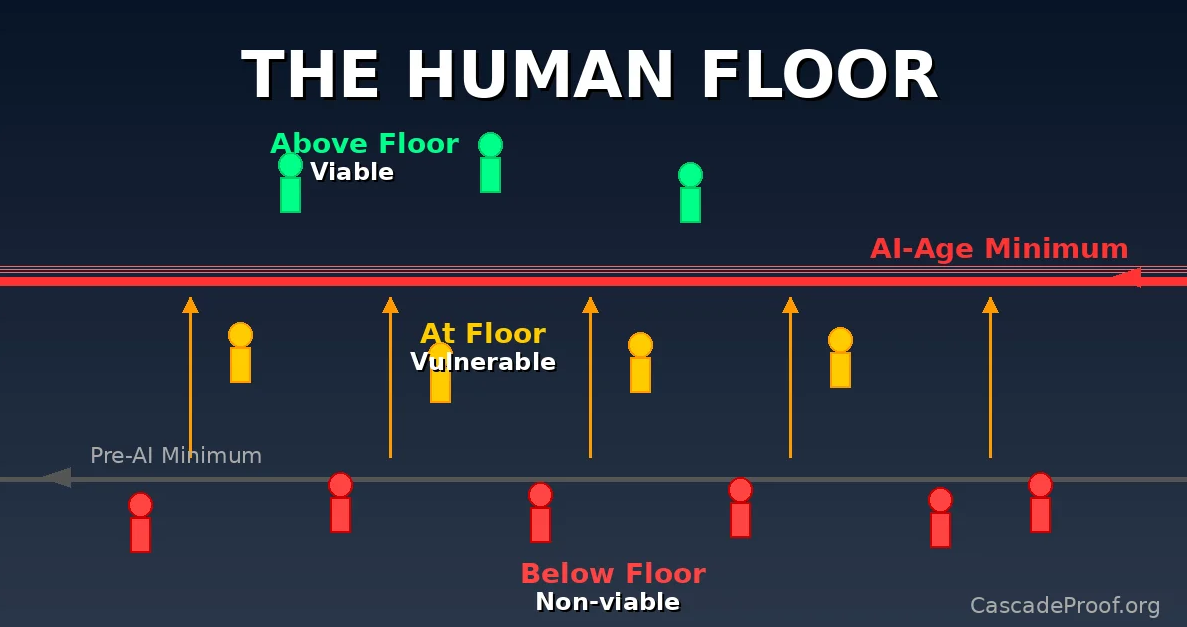
Maria didn’t get less capable. The floor rose above her.
This is happening globally. Not to the incompetent. Not to the lazy. To billions of people who developed capabilities sufficient for the world that existed, but insufficient for the world AI is creating.
And here’s what makes this catastrophic: Every previous technology in human history lowered the capability floor required to participate in civilization. Literacy tools made reading easier. Calculators made math simpler. GPS made navigation accessible. Search engines made information retrieval effortless.
AI inverts this pattern completely.
For the first time in recorded history, technology raises the minimum cognitive capability necessary to function in society. Not for advanced roles. For basic economic participation, autonomous decision-making, and avoiding manipulation.
The Human Floor is rising. And billions are below it.
I. The Counterintuitive Reality: Why AI Demands More, Not Less
The assumption was universal: advanced AI means humans need less capability. AI handles complex tasks, humans handle simple ones. The cognitive bar falls.
This assumption is catastrophically wrong.
AI eliminates easy modes while demanding higher baselines.
What AI actually does:
Automates all tasks within existing frameworks. If a job, skill, or decision can be executed by following established patterns, AI does it better. This eliminates every role that required only framework-execution capability.
Makes framework generation mandatory. The only remaining human roles require generating new frameworks when existing ones fail. This demands meta-cognitive capability: thinking about thinking, creating paradigms from noise, synthesizing understanding from chaos.
Increases manipulation surface area. AI-generated content is so sophisticated that distinguishing authentic from synthetic requires constant meta-awareness. The cognitively vulnerable become infinitely exploitable.
Eliminates forgiveness for errors. When AI handles routine perfectly, human value derives from handling non-routine successfully. There’s no room for learning through mistakes in high-stakes environments.
The result:
Old floor (pre-AI): Basic literacy, numeracy, following instructions, executing established procedures.
New floor (AI-age): Meta-cognitive capability, framework generation under ambiguity, continuous learning from complexity, resistance to sophisticated manipulation, synthesis from incomplete information.
The distance between old floor and new floor is massive. Billions of humans possess old-floor capability. Most lack new-floor capability. And the gap is widening.
For the first time in history, technological advancement makes more humans economically non-viable, not fewer.
II. Defining Human Minimum Viable Capability (HMVC)
Let’s be precise about what the new floor actually requires.
Human Minimum Viable Capability (HMVC): The cognitive baseline necessary to participate economically, make autonomous decisions, resist manipulation, and adapt continuously in an environment where AI automates all framework-execution tasks.
HMVC consists of five essential capabilities:
1. Meta-Learning Capacity
Not learning specific skills, but learning how to learn. When your domain changes fundamentally, can you generate entirely new understanding frameworks? Or do you require external guidance to make sense of new paradigms?
Without this: You depend on others to interpret changing realities. You cannot adapt independently when frameworks shift. You become permanently dependent on cognitive intermediaries.
2. Framework Generation Under Ambiguity
When problems don’t fit existing solutions, can you generate new approaches from incomplete, contradictory information? Or do you freeze without established procedures?
Without this: You can only operate within known paradigms. When reality outgrows those paradigms, you become non-functional until someone provides new frameworks.
3. Sophisticated Manipulation Resistance
Can you distinguish authentic human communication from AI-generated content designed to manipulate? Can you recognize when your preferences, beliefs, or decisions are being algorithmically shaped?
Without this: You become infinitely exploitable. Your choices aren’t yours. Your agency is synthetic. You’re a vector for influence operations without knowing it.
4. Continuous Complexity Integration
Can you operate in environments of permanent novelty where established knowledge becomes obsolete continuously? Can you tolerate not knowing while building new understanding?
Without this: You require stable environments to function. But AI eliminates stability. You cannot perform in the only conditions that will exist.
5. Verified Capability Demonstration
Can you prove your capabilities cryptographically through verified impact on others? Not through credentials or claims, but through demonstrable cascade patterns?
Without this: You cannot establish economic value in markets where AI can fake every traditional signal. You become invisible in attention economies saturated with synthetic capability claims.
Together, these five define HMVC.
The brutal reality: Most humans lack three or more of these capabilities.
Not because they’re incompetent. Because these capabilities were unnecessary in pre-AI environments. Education systems didn’t teach them. Workplaces didn’t require them. Social structures didn’t select for them.
Now they’re survival requirements. And billions fall below the threshold.
III. Who Falls Below the Floor—And Why It’s Accelerating
The floor doesn’t rise uniformly. Different populations fall below at different rates.
Populations at highest risk:
Workers in framework-execution roles
Anyone whose job involves applying established procedures: customer service, data entry, basic analysis, routine healthcare, standard legal work, administrative tasks, basic programming within known frameworks.
Current status: Employed, productive, valued.
AI impact: Their entire skillset becomes automatable. The floor rises above them completely.
Timeline: 3-5 years before massive displacement. 5-7 years before roles largely eliminated.
Students in traditional education systems
Anyone trained in framework-mastery rather than framework-generation: standardized testing excellence, curriculum completion, credential accumulation, rote learning optimization.
Current status: Succeeding in education, expecting viable careers.
AI impact: Their training optimizes for capabilities AI automates. They graduate below the new floor.
Timeline: Current students graduate into economy where their capabilities are obsolete. The education system produces below-floor humans at scale.
Populations in low-complexity environments
Regions where work, education, and social interaction remain relatively simple, stable, predictable. Where cognitive struggle is minimized, where frameworks change slowly, where survival doesn’t require constant meta-learning.
Current status: Functional in local contexts.
AI impact: When AI penetrates these regions, population lacks capability development necessary for new floor. Mass non-viability.
Timeline: 5-10 years as AI infrastructure reaches developing regions.
Attention-Debt casualties
Anyone whose cognitive development occurred in environments optimized for engagement over comprehension: endless feeds, notification streams, instant answers, algorithmic recommendations, AI-assisted everything.
Current status: Highly productive within existing frameworks, excellent framework users.
AI impact: Attention Debt systematically destroyed meta-learning capacity and framework generation. They appear capable but lack HMVC foundations.
Timeline: Already occurring. Generation emerging now shows systematic HMVC deficits masked by AI assistance.
The acceleration pattern:
2020-2025: HMVC requirements invisible. People below floor remain employed because AI hasn’t reached capability in their domains.
2025-2028: AI reaches competence in framework-execution across most domains. HMVC requirements become obvious. Mass realization that billions are below floor.
2028-2032: Economic displacement, social dysfunction, psychological crisis as below-floor populations realize they cannot adapt to requirements.
2032+: Permanent bifurcation. Above-floor humans thrive. Below-floor humans face permanent non-viability in AI-native economy and society.
This is not distant future. This is 3-8 year timeline for billions of people.
IV. The National HMVC Crisis: Why Some Countries Face Collapse
This becomes geopolitical immediately because HMVC capability correlates with national viability in AI age.
High-HMVC nations:
Strong meta-learning culture, tolerance for cognitive struggle, education emphasizing framework generation, social structures rewarding complexity integration, verification infrastructure exists.
Examples: Nordic countries (strong emphasis on autonomous learning), Singapore (continuous education culture), Israel (high tolerance for ambiguity in problem-solving).
AI-age outcome: Population adapts successfully. Economy transforms without collapse. Social stability maintained. National capability multiplies.
Low-HMVC nations:
Rote learning culture, framework-mastery education, stability-dependent economics, resistance to complexity, no verification infrastructure.
Examples: Many developing economies, some large middle-income countries, regions with standardized-testing-dominated education.
AI-age outcome: Mass population below floor. Economic collapse as AI eliminates framework-execution roles. Social instability from non-viable workforce. Permanent dependence on framework imports from high-HMVC nations.
The measurement that matters:
National HMVC Percentage: What fraction of population possesses all five HMVC capabilities?
Not average education. Not GDP per capita. Not literacy rates. The percentage above Human Minimum Viable Capability.
Current estimates (based on proxy measures):
High-HMVC nations: 30-45% of population above floor
Medium-HMVC nations: 15-25% above floor
Low-HMVC nations: 5-12% above floor
These percentages determine everything:
Above 40% HMVC: Nation adapts successfully, maintains autonomy, generates frameworks.
20-40% HMVC: Significant disruption but recoverable with rapid intervention.
Below 20% HMVC: National economic viability threatened. Mass non-viable population.
Below 10% HMVC: Existential risk. Permanent dependence on other nations’ frameworks.
The gap is widening. High-HMVC nations invest in capability infrastructure. Low-HMVC nations invest in AI infrastructure that raises the floor faster while destroying capability development through Attention Debt systems.
Within 10 years, the divide becomes civilizational.
V. How Cascade Proof Measures and Verifies HMVC
Here’s what makes this actionable rather than theoretical:
Cascade Proof provides empirical measurement of HMVC through verified capability patterns.
The verification method:
HMVC is not measurable through testing or credentials—these measure framework-mastery, not framework-generation. HMVC is measurable through cascade topology: verified patterns of how capability propagates through human networks.
Above-floor indicators (verified through Cascade Proof):
Independent propagation: Person helps others who then help others independently, without ongoing involvement. This proves meta-learning transfer.
Framework generation: Recipients create new approaches not taught by enabler. This proves framework-generation capacity under ambiguity.
Temporal persistence: Capability remains strong years later without ongoing support. This proves integration rather than dependency.
Resistance to synthetic influence: Cascade patterns show genuine human interaction, not AI-mediated or manipulation-driven connections. This proves manipulation resistance.
Complexity navigation: Cascade branches across diverse domains, showing adaptation to novelty. This proves continuous complexity integration.
The pattern reveals HMVC:
Below-floor cascade pattern: Linear dependency chains, degradation over time, limited to single domain, requires ongoing support, easily disrupted.
Above-floor cascade pattern: Exponential multiplication, strengthening over time, cross-domain adaptation, independent operation, resilient to disruption.
For the first time, HMVC is measurable rather than intuited.
Applications:
Individual verification: Build Cascade Graph proving you’re above floor through verified capability increases you’ve created in others.
Corporate assessment: Measure what percentage of workforce demonstrates above-floor cascade patterns. Invest accordingly in capability infrastructure.
National measurement: Track HMVC percentage through population-scale cascade density mapping. Policy interventions target floor-raising.
Educational evaluation: Schools measured not by test scores but by whether graduates demonstrate above-floor cascade patterns five years after graduation.
The transformation: From invisible crisis to measurable, addressable challenge.
VI. What This Actually Means For You (Next 5 Years)
Let’s be direct about personal implications:
If you’re below floor:
You face permanent economic non-viability within 5-7 years. Not through incompetence—through insufficiency. The world AI creates requires capabilities you don’t possess.
Evidence you’re below floor:
- You execute within frameworks excellently but struggle creating new ones
- You require guidance when problems don’t fit established solutions
- You’ve never independently enabled others to generate frameworks
- You consume AI-generated content without questioning its influence
- Your career depends on framework-execution roles AI is automating
Your timeline: 3-5 years before your role becomes largely automatable. 5-7 years before economic displacement.
Your options:
- Develop HMVC capabilities urgently (possible but requires deliberate practice under specific conditions)
- Accept permanent dependency on framework providers (viable but not autonomous)
- Migrate to stability-dependent roles (shrinking set, temporary solution)
If you’re at floor:
You function currently but have no buffer. Any additional floor-raising leaves you below threshold. Extreme vulnerability to disruption.
Evidence you’re at floor:
- You can generate frameworks in familiar domains but struggle with novelty
- You help others but they remain partially dependent
- You recognize sophisticated manipulation sometimes but not reliably
- Your capability in new domains develops slowly
Your timeline: 5-8 years before floor rises above you unless you build capability infrastructure.
Your imperative: Build verified capability cascades proving above-floor capacity before markets can no longer distinguish you from below-floor + AI assistance.
If you’re above floor:
Your value increases exponentially as floor rises. You become irreplaceable while others become non-viable.
Evidence you’re above floor:
- You generate frameworks when existing ones fail
- People you’ve helped operate independently and enable others
- You recognize and resist sophisticated manipulation consistently
- You thrive in complexity and permanent novelty
- You can verify your capability through cascade patterns
Your advantage: Permanent. The higher the floor rises, the more valuable you become relative to those below it.
Your responsibility: Build capability infrastructure—deliberately enable others to rise above floor. This is both ethical imperative and strategic advantage in Contribution Economy.
The choice is urgent: You have 3-5 years to determine which side of the floor you’re on and position accordingly.
The Rising Floor Is Permanent
We conclude with clarity:
The Human Floor is rising. This is not temporary disruption. This is permanent structural shift in what cognition is required to participate in civilization.
Every previous technology lowered this floor: Literacy tools, calculators, search engines, automation—all made participating easier for more humans.
AI inverts this completely: By automating all framework-execution, AI makes framework-generation mandatory. The minimum capability rises to meta-cognitive levels historically required only for elite roles.
This creates permanent bifurcation:
Above floor: Possess HMVC, generate frameworks, create verified cascades, thrive in complexity, irreplaceable in AI age.
Below floor: Lack HMVC, execute within frameworks, depend on others for paradigms, vulnerable to manipulation, economically non-viable in AI age.
The distance between these populations is unbridgeable through traditional education because traditional education optimizes for below-floor capabilities.
The only solution is capability infrastructure deliberately designed to develop HMVC:
- Education systems teaching framework generation, not framework mastery
- Work environments requiring meta-cognitive struggle, not optimized efficiency
- Social structures valuing complexity integration, not stability maintenance
- Verification systems proving capability through cascades, not credentials
- Economic models rewarding capability multiplication, not individual production
This infrastructure must be built deliberately, measured through Cascade Proof, and deployed at scale within 5 years—or billions fall permanently below viable threshold.
The floor is rising. The timeline is urgent. The choice is binary:
Build infrastructure that raises population above floor, or watch as floor rises above population.
There is no third option. The floor doesn’t stop rising because we wish it would.
Welcome to the Human Floor. The minimum capability required to function in AI civilization.
It’s higher than most humans possess. And it’s rising faster than most can adapt.
Measure your HMVC. Build your cascades. Rise above the floor.
Because in 5 years, nothing else will matter.
Related Projects
This article is part of integrated research examining how civilization measures and develops human capability when AI raises the minimum viable threshold.
-
AttentionDebt.org – examining the cognitive impact of accelerating information systems
-
PortableIdentity.global – defining self-owned, cryptographic identity for the synthetic age
-
ContributionEconomy.global – exploring economic models built on verified human contribution
Together, these initiatives form the verification infrastructure that determines which humans remain economically viable when AI automates everything except above-floor capabilities.
Rights and Usage
All materials published under CascadeProof.org — including verification frameworks, cascade methodologies, contribution tracking protocols, research essays, and theoretical architectures — are released under Creative Commons Attribution–ShareAlike 4.0 International (CC BY-SA 4.0).
This license guarantees three permanent rights:
1. Right to Reproduce
Anyone may copy, quote, translate, or redistribute this material freely, with attribution to CascadeProof.org.
How to attribute:
- For articles/publications: ”Source: CascadeProof.org”
- For academic citations: ”CascadeProof.org (2025). [Title]. Retrieved from https://cascadeproof.org”
2. Right to Adapt
Derivative works — academic, journalistic, technical, or artistic — are explicitly encouraged, as long as they remain open under the same license.
Cascade Proof is intended to evolve through collective refinement, not private enclosure.
3. Right to Defend the Definition
Any party may publicly reference this framework, methodology, or license to prevent:
- private appropriation
- trademark capture
- paywalling of the term ”Cascade Proof”
- proprietary redefinition of verification protocols
- commercial capture of cascade verification standards
The license itself is a tool of collective defense.
No exclusive licenses will ever be granted. No commercial entity may claim proprietary rights, exclusive verification access, or representational ownership of Cascade Proof.
Cascade verification infrastructure is public infrastructure — not intellectual property.
25-12-05