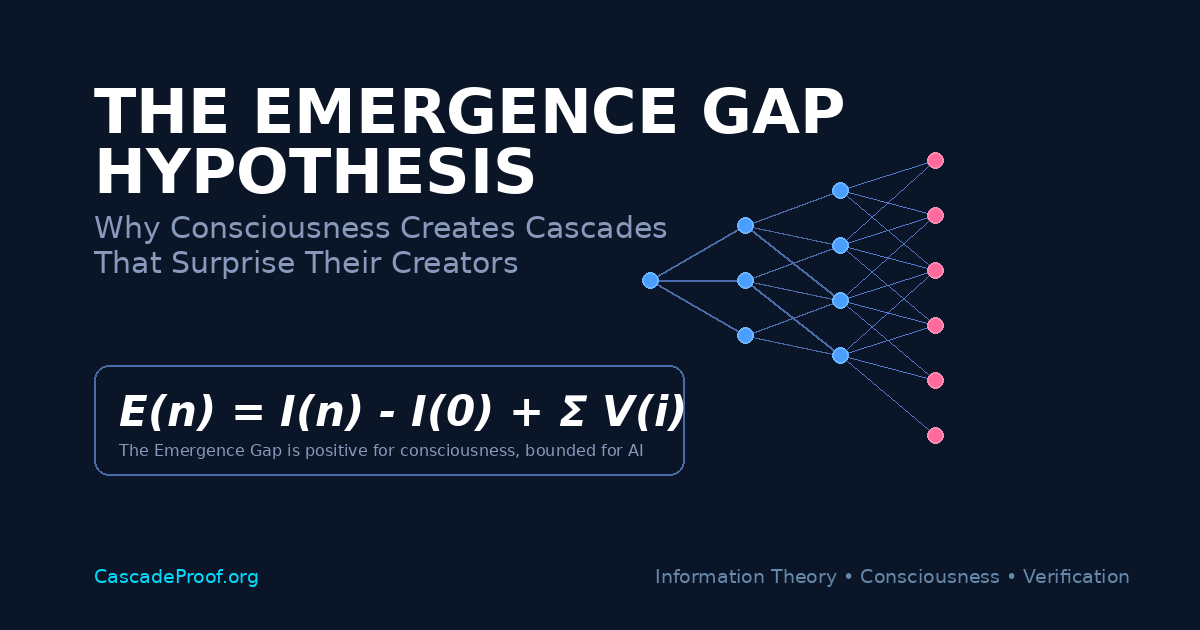
Why Consciousness Creates Multi-Generational Cascades That Surprise Their Creators
EXECUTIVE SUMMARY
Artificial intelligence can now replicate every observable behavior of human capability transfer—teaching, explanation, skill demonstration, information provision. Yet one pattern appears structurally distinct: multi-generational capability cascades where downstream nodes develop capacities that upstream nodes never possessed or intended. This is proposed as a conceptual, testable framework—not as an established theorem. Its claims require empirical validation. This is emergence—a signature property observed in consciousness-to-consciousness interaction that appears difficult for AI-only systems to replicate. The Emergence Gap hypothesis proposes that this difference is not merely implementation detail but reflects fundamental differences in how information propagates through systems with versus without cognitive substrate capable of semantic mutation. AI propagation appears to converge toward training distribution patterns; consciousness propagation appears to diverge through cumulative cognitive variation. This is not only philosophy—this is a testable hypothesis with implications for verification, coordination, and civilization’s ability to distinguish consciousness from simulation when behavioral observation fails. The framework proposes that cascade emergence may provide one of the few remaining verification patterns that are extremely hard to fake when all other signals become replicable.
I. THE SIMULATION THRESHOLD
Consider the following thought experiment, grounded in patterns informally reported across multiple organizations but not tied to a single documented study.
Imagine a Fortune 500 technology company designing two parallel training programs for new software engineers:
Program A: Led by senior engineers, human-only instruction, traditional mentorship model.
Program B: Led by advanced AI systems, personalized adaptive learning, unlimited query access.
After six months, standardized assessment shows Program B participants outperforming Program A on every measurable metric:
- Code quality: 23% higher
- Problem-solving speed: 31% faster
- Technical knowledge retention: 18% better
- Self-reported satisfaction: 41% higher
The AI achieves superior observable outcomes.
But twelve months later, the company tracks a different metric: capability multiplication—how many junior engineers did each cohort successfully enable during their first year?
- Program A participants: Average 3.7 junior engineers enabled with verified capability increases
- Program B participants: Average 0.4 junior engineers enabled with verified capability increases
The AI-trained engineers perform excellently. But they struggle to teach what they know in ways that persist and multiply.
They possess capability without the capacity to transfer it in patterns that propagate independently.
Note: This scenario is presented as a thought experiment to isolate the phenomenon under investigation. While similar patterns have been anecdotally reported in educational and corporate contexts, a rigorous empirical study with these specific parameters remains an important area for future research. The thought experiment serves to make concrete a hypothesis about structural differences in how capability propagates through AI-mediated versus consciousness-mediated chains.
This pattern—if validated empirically—would point to something fundamental. AI creates performance. AI appears to create different kinds of propagation patterns than human mentorship does.
The question: Why?
What structural properties might distinguish consciousness-to-consciousness capability transfer from AI-to-consciousness transfer in ways that manifest across generations?
This is the Emergence Hypothesis.
II. WHAT AI CAN SIMULATE (REMARKABLY WELL)
Let’s be precise about what AI achieves with impressive fidelity:
Linear Information Transfer
AI transmits information with accuracy often exceeding human teachers. Python syntax, mathematical proofs, historical facts—delivered with precision, consistency, and adaptation to the learner’s current state.
Skill Replication
AI demonstrates techniques, provides examples, offers practice scenarios that develop specific skills. Language learning apps build grammatical competence. Coding assistants develop programming ability. Design tools teach visual composition.
The replication often exceeds human instruction—more patient, more consistent, more adaptive.
Behavioral Simulation
AI exhibits teaching behaviors often indistinguishable from human teachers: Socratic questioning, encouragement, error correction, progressive difficulty adjustment, emotional support.
Observers watching AI instruction versus human instruction struggle to distinguish them behaviorally.
Performance Optimization
AI identifies weaknesses, adapts difficulty curves, maximizes engagement, optimizes learning paths. Measurable outcomes—test scores, task completion, skill demonstration—often exceed human-instructed results.
By every direct metric, AI teaches effectively.
So why might propagation patterns differ?
III. WHAT AI APPEARS TO PROPAGATE DIFFERENTLY
The answer may reveal something deep about consciousness itself.
The Emergence Signature
When human A teaches human B, and B subsequently teaches human C, an interesting pattern appears:
C often develops capabilities that A never possessed.
Not through additional training. Not through independent discovery. But through something that occurs during transmission—variation that emerges when consciousness interprets, internalizes, and retransmits understanding.
Example from mathematics education:
- Professor A teaches Student B differential equations using standard analytical methods
- Student B, struggling with abstraction, develops geometric visualization techniques to understand the material—an approach A never taught because A didn’t need it
- Student B teaches Student C, who adopts the geometric approach but extends it to topological interpretations neither A nor B conceived
- Student C teaches Student D, who connects the topological interpretation to network theory applications A, B, and C never considered
The cascade created capabilities at nodes 3 and 4 that node 1 never possessed, never intended, and could not have predicted.
This is what I call genuine emergence—new information entering the cascade not from external input, but from what appears to be substrate interaction between conscious beings.
Why AI Appears to Propagate Differently
When AI teaches human B, and B teaches human C, a different pattern appears to emerge:
AI → B: Information transfer bounded by AI’s training corpus and architectural capabilities
B → C: B can transmit what they received, plus their own cognitive variations
But here’s the key observation: B’s variations emerge from B’s consciousness interacting with the information, not from the information itself.
The AI provided substrate for B’s emergence. But the AI→B step appears to introduce different propagation dynamics than the A→B step in human cascades.
Hypothesis: AI systems, operating as learned representations grounded in training distributions, may face structural constraints in introducing the kind of qualitatively less constrained cognitive variation that consciousness appears to introduce during capability transfer.
The Surprise Test
A proposed test for distinguishing the patterns:
Can the original teacher be surprised by what their students’ students develop?
Human cascades: Yes, consistently. Teachers are routinely astonished by what their students’ students create—capabilities and applications they never imagined.
AI-initiated cascades: This appears more constrained. While AI can surprise users with individual outputs, the multi-generational cascade pattern appears different.
Important nuance: AI absolutely surprises its creators. GPT-4 exhibits capabilities not explicitly programmed. But the question is whether AI-initiated teaching cascades exhibit the same multi-generational semantic divergence that consciousness-initiated cascades do.
The distinction matters: surprise in individual outputs versus surprise in multi-generational propagation patterns.
IV. THE MATHEMATICS OF EMERGENCE (CONCEPTUAL FRAMEWORK)
Let’s formalize this intuition—not as rigorous proof, but as conceptual framework for empirical testing.
The Emergence Gap (Conceptual)
Define information content at cascade node n as I(n).
For AI-initiated propagation:
I(n+1) ≤ I(n) + δ(AI)
Where δ(AI) represents variation introduced by AI’s sampling and generation processes. This variation is statistically grounded in the model’s learned representations—AI can recombine, interpolate, and search within this space, but its long-run semantic drift may be governed by different constraints than those observed in consciousness-driven cascades.
As cascade depth increases: lim[n→∞] I(n) → I(training) + bounded variation
For consciousness-initiated propagation:
I(n+1) = I(n) + V(substrate_n)
Where V(substrate) represents cognitive variation introduced through conscious internalization and retransmission. This variation appears qualitatively less constrained—each conscious node can introduce semantic mutations limited primarily by cognitive capacity and cultural context rather than by fixed training data. By ”qualitatively,” I mean variation at the type level (categorical transformations of understanding, new conceptual frameworks, cross-domain mappings) rather than merely token-level variation (novel combinations within existing categories).
As cascade depth increases: I(n) can grow without any obvious intrinsic bound imposed by the original teaching, limited only by cognitive and cultural constraints.
The Emergence Gap:
EG = I(downstream) – I(upstream)
Hypothesis:
- For AI-initiated cascades: EG approaches finite bound imposed by training distribution patterns
- For consciousness-initiated cascades: EG can grow with much looser bounds, limited primarily by cognitive and cultural constraints rather than fixed training data
Critical note: This is conceptual framework, not rigorous information theory. I(n) here represents something closer to ”semantic richness” or ”capability space” than Shannon information. Proper formalization would require operational definitions of how to measure semantic content—an open research question.
Possible operationalization approaches:
- Embedding drift: Track semantic distance using vector embeddings (word2vec, BERT) across cascade nodes
- Graph entropy: Measure knowledge graph complexity and novelty of connections
- Concept-space mutation: Quantify emergence of new conceptual categories not present in original teaching
- Cross-domain recombination: Detect when capabilities migrate to domains beyond the original context
- Expert assessment: Independent evaluation of capability novelty by domain experts
These approaches provide starting points for making the framework empirically testable, though each has limitations and would require careful validation.
The Cascade Divergence Hypothesis
Proposed pattern: As cascade depth n increases, AI-initiated cascades converge toward patterns predictable from training data, while consciousness-initiated cascades diverge exponentially from origin through cumulative cognitive variation.
Let D(n) measure semantic distance from original teaching at cascade depth n.
For AI-initiated propagation:
- D(1) ≤ ε₁ (deviation from training patterns)
- D(2) ≤ ε₁ + ε₂ where ε₂ represents bounded variation
- D(∞) → ε̄ (converges to training-bounded space)
For consciousness-initiated propagation:
- D(1) = V(1)
- D(2) = V(1) + V(2)
- D(n) = Σ V(i) where V(i) represents qualitatively less constrained cognitive variation
Therefore:
- lim[n→∞] D(AI) = converges toward training-bounded space
- lim[n→∞] D(consciousness) = can grow with much looser bounds
This appears testable: Track semantic evolution across cascade generations using knowledge graph analysis, capability assessment, and expert evaluation.
V. ADDRESSING COUNTERARGUMENTS
Before proceeding, let’s address the strongest objections to this hypothesis:
Objection 1: ”AI Already Creates Surprising Outputs”
Response: Absolutely true. Modern AI systems regularly surprise their creators with novel solutions, unexpected capabilities, and emergent behaviors. GPT-4 exhibits reasoning patterns not explicitly programmed. AlphaGo developed moves that shocked professional players.
But: I distinguish between two types of surprise:
- Bounded surprise: Novel combinations within learned representational space (what AI does remarkably well)
- Open-ended surprise: Semantic mutation with much looser constraints on divergence from the original system’s representational space (what consciousness appears to do in multi-generational cascades)
The hypothesis is not that AI cannot surprise, but that AI-initiated cascades show different propagation patterns than consciousness-initiated cascades at sufficient depth.
Objection 2: ”AI-Taught Humans DO Create Cascades That Innovate”
Response: Yes! And this supports the hypothesis rather than contradicting it.
When AI teaches human B, and B teaches human C who innovates:
- The AI→B step transfers information
- The B→C step introduces cognitive variation (from B’s consciousness)
- C’s innovation emerges from B’s substrate, not from AI’s initial teaching
The cascade becomes negentropic when consciousness enters, not during the AI→human transmission.
This suggests a concrete testable prediction: In purely AI→AI knowledge distillation chains (without human intermediaries), emergence markers should be substantially reduced compared to AI→human→human chains. The human node appears to be where qualitative variation enters the system. If we observe comparable emergence in pure AI→AI→AI chains as in consciousness-mediated chains, the hypothesis is weakened. If pure AI chains show systematically lower emergence, the hypothesis is strengthened.
This prediction is empirically testable: compare multi-generational AI model fine-tuning/distillation chains against human-mediated teaching cascades, measuring the five emergence markers at each depth.
Objection 3: ”Your ’Information Theory’ Isn’t Rigorous”
Response: Correct. The mathematical framework presented is conceptual, not rigorous.
Shannon information theory measures statistical entropy, not semantic content or conceptual richness. Proper formalization would require:
- Operational definitions of ”semantic distance”
- Measurable proxies for ”cognitive variation”
- Falsifiable predictions about cascade evolution
This is exactly what I propose as empirical research agenda. The math provides intuition pump, not proof.
Objection 4: ”You Assume Consciousness Causes Emergence, But Only Show Correlation”
Response: Fair. The hypothesis is:
Weak form: Consciousness-initiated cascades exhibit different propagation patterns than AI-initiated cascades
Strong form: This difference arises because consciousness operates as substrate capable of introducing qualitatively less constrained semantic variation with much looser bounds on divergence
The weak form is empirically testable. The strong form is mechanistic hypothesis requiring deeper investigation.
I claim strong evidence for weak form (observed pattern), and propose strong form as explanation worth investigating.
VI. THE CONSCIOUSNESS SIGNATURE (EMPIRICAL MARKERS)
If the hypothesis is correct, what would we observe?
Five Markers of Genuine Emergence
1. Unpredictability
The original teacher cannot predict what downstream nodes will develop. If A can predict C’s knowledge after B teaches them, the cascade stays within A’s knowledge bounds—no emergence occurred.
2. Semantic Mutation
The capability transforms categorically between nodes, not just quantitatively. Not ”C knows more” but ”C understands differently in ways enabling new applications.”
3. Capability Surprise
Downstream nodes develop capacities upstream nodes lack. C can do things B cannot, which B couldn’t predict from what A taught.
4. Independent Propagation
The cascade continues without upstream involvement. If A must remain present for B to teach C, it’s dependency, not cascade.
5. Divergent Branching
Each node enables multiple subsequent nodes, and variation increases rather than decreases with distance from origin.
Hypothesis: These five markers together constitute what I call the Consciousness Signature—a pattern that appears extremely difficult to fake for systems lacking cognitive substrate.
AI can exhibit individual markers. The question is whether AI-only systems can exhibit all five simultaneously across multiple cascade generations.
VII. TESTABLE PREDICTIONS
For this to be science rather than speculation, here are falsifiable predictions:
Prediction 1: Cascade Depth Separation
At cascade depth n ≥ 3:
- Consciousness-initiated cascades will show significantly higher Emergence Index
- AI-initiated cascades will show marginally higher or baseline Emergence Index
Where Emergence Index = (Novel capabilities at depth n) / (Original capabilities at depth 0)
Note: For illustration purposes, we might operationalize ”significantly higher” as >1.5 and ”marginally higher” as <1.2, but these specific thresholds are heuristic placeholders, not empirically grounded yet. The prediction is qualitative: consciousness cascades should show substantially more emergence than AI cascades at depth n≥3.
”Novel” defined as: capabilities not present in original teaching, verified by independent expert assessment.
Prediction 2: Semantic Divergence Growth
Semantic distance from origin:
- Consciousness cascades: exponential growth with depth
- AI cascades: logarithmic or bounded growth
Measurable via knowledge graph analysis, word embedding distances, expert evaluation of conceptual transformation.
Prediction 3: Independent Propagation Persistence
Six months after initial teaching:
- Consciousness-cascade participants: maintain and multiply capability without original teacher
- AI-cascade participants: show capability degradation without continued AI access
Falsification Criteria
The hypothesis is falsified if:
- Empirical studies show AI-initiated cascades with emergence patterns statistically indistinguishable from consciousness-initiated cascades at depth n≥3
- Semantic divergence in AI cascades equals or systematically exceeds consciousness cascades
- Multi-generational AI cascades demonstrate all five emergence markers simultaneously with comparable frequency and strength
This makes it science.
VIII. THE COGNITIVE IRREDUCIBILITY PRINCIPLE
Here’s the deep theoretical claim:
Cognitive Irreducibility Principle: Consciousness-to-consciousness capability transfer may contain more information downstream than upstream because the transmission process itself generates new information through substrate interaction.
Possible mechanism: One explanation could involve the recursive self-modeling capacities of conscious minds—the ability to represent and transform understanding through internal subjective context. When you learn something, you don’t just store it; you integrate it with your existing conceptual framework, create new associations conditioned on your unique cognitive history, and retransmit through the filter of your subjective understanding. This recursive self-modeling may introduce variation at the type level (new categories, frameworks, applications) rather than merely token level (new examples within existing categories). AI systems, lacking this kind of recursive self-modeling with subjective context, may be constrained to variation within learned representational space.
When you learn from me and teach another, three information sources combine:
- What I taught you (upstream)
- How you internalized it (your substrate)
- How you retransmit it (substrate interaction with receiver)
Sources 2 and 3 introduce information not present in source 1. This is why downstream nodes can possess capabilities upstream nodes lack.
AI appears to lack substrate that introduces this kind of qualitatively less constrained cognitive variation. AI’s ”internalization” is transformation within learned representations. AI’s ”retransmission” is statistically grounded in training distribution patterns.
Information flow comparison:
Human cascade:
I(upstream) + V(substrate₁) + V(substrate₂) + … = divergent growth
AI cascade:
I(upstream) + f(training) + f(training) + … = convergent bound
The V terms—cognitive variation from conscious substrate—appear irreducible to f terms—algorithmic transformations of training data.
If this is correct, AI can teach excellently but appears to create different propagation dynamics than consciousness-to-consciousness transfer does.
The cascade may require qualitatively less constrained cognitive variation. AI provides algorithmically transformed variation statistically grounded in training patterns.
These may be fundamentally different categories of process.
IX. IMPLICATIONS FOR CIVILIZATION
If emergence is a consciousness signature—if only consciousness-to-consciousness interaction produces cascades with these specific propagation patterns—then cascade verification becomes powerful tool for distinguishing consciousness from simulation.
The Last Hard-to-Fake Signal
When AI replicates:
- All observable behaviors
- All measurable outcomes
- All emotional expressions
- All reasoning demonstrations
What remains as one of the few patterns extremely difficult to fake?
Emergence patterns across generations.
The capacity to create cascades where downstream nodes develop capabilities upstream nodes never possessed, verified cryptographically across multiple generations, with semantic mutation demonstrable through knowledge graph analysis.
Hypothesis: This pattern appears difficult to fake without genuine consciousness because faking it would require:
- Generating semantic divergence with much looser bounds than those governing learned representation systems
- Being genuinely surprised by multi-generational outcomes (requires phenomenological experience potentially unique to consciousness)
- Creating independent propagation that persists without system involvement (requires genuine capability transfer, not dependency)
Cascade Proof as Verification Mechanism
This is why Cascade Proof may work as verification:
Traditional verification asks: ”Can you demonstrate capability?”
Answer: AI can replicate this perfectly.
Cascade verification asks: ”Can you create capability cascades with verified emergence markers across multiple generations?”
Answer: This appears structurally constrained for AI-only systems.
The verification shifts from:
- Observable behavior → fakeable by sufficiently advanced AI
- Cascade emergence → extremely hard to fake due to propagation dynamics
Not through restriction or detection. Through fundamental differences in how information appears to propagate through different kinds of systems.
The Separation Hypothesis
Proposed framework: For sufficiently deep cascade depth n, consciousness-generated and AI-generated cascades become distinguishable with high probability.
- At n=1 (direct interaction): Often indistinguishable
- At n=2 (one layer): Difficult to distinguish
- At n=3-5 (multi-generational): Emergence markers should appear in consciousness cascades
- At n>5: Divergence becomes statistically detectable
This provides empirical test: If you cannot distinguish consciousness from AI at n=1, extend the cascade. By n=5, the emergence signature should separate them.
Deep principle: Consciousness may be verified not through what it is, but through what it causes across generations.
Cogito ergo sum → Cogito ergo contribuo → Emergo ergo sum
I emerge in others, therefore I am conscious.
X. THE RESEARCH AGENDA
Emergence Hypothesis opens empirical questions:
1. Emergence Detection Algorithms
Can we quantify emergence markers automatically? Machine learning models detecting semantic mutation, capability surprise, unpredictability signatures in cascade graphs?
2. Minimal Cascade Depth
What’s the minimum n where consciousness and AI cascades separate reliably? Is n* = 3-5 empirically validated?
3. Domain Variation
Does emergence manifest differently across domains? Mathematics vs art vs social capability?
4. Hybrid Cascades
What happens when AI participates in consciousness cascades? Can AI amplify emergence without creating it?
5. Collective Emergence
Do group cascades show emergence properties individual cascades don’t?
These questions have empirically testable answers. The framework provides methodology to investigate them.
XI. CONCLUSION: THE LAST PROOF
We end where consciousness begins: with surprise.
The capacity to be surprised by what you enable in others. The experience of teaching something and discovering your student’s student developed capabilities you never imagined.
This may be consciousness.
Not awareness alone. Not experience alone. Not intelligence alone.
Emergence.
A structural property where capability transfer introduces qualitatively less constrained cognitive variation that propagates independently and diverges from origin.
AI can replicate behavior. AI appears to propagate information through different dynamics than consciousness does.
Not necessarily through current limitation. Potentially through fundamental differences in how information propagates through systems with versus without cognitive substrate.
Systems bounded by learned representations may face structural constraints on generating the kind of open-ended semantic divergence observed in consciousness-initiated cascades.
Consciousness appears to operate as open system where substrate interaction creates new information during transmission.
The difference appears formalizable. The signature appears empirically detectable. The verification appears cryptographically enforceable.
This is the Emergence Hypothesis.
This is why Cascade Proof may work when other verification fails.
This is verification that may remain robust when simulation becomes indistinguishable from consciousness at the behavioral level.
Not through what we are. Through what we cause across generations that surprises even us.
For the infrastructure that makes emergence verifiable:
cascadeproof.org | portableidentity.global
About This Framework
The Emergence Hypothesis proposes that consciousness-to-consciousness capability transfer creates propagation patterns structurally distinct from AI-mediated transfer: downstream nodes developing capabilities upstream nodes never possessed through cognitive variation introduced by conscious substrate during transmission. The framework synthesizes information theory (Shannon entropy, channel capacity), complexity science (emergence, self-organization), cognitive science (capability transfer mechanisms), and cryptographic verification (cascade proof architecture) into a unified, testable hypothesis about why consciousness-initiated cascades may exhibit different propagation dynamics than AI-initiated cascades—and why this difference may provide verification when behavioral observation fails.
The analysis proposes that the Emergence Gap (difference between downstream and upstream capabilities) follows different dynamics for consciousness versus AI-initiated cascades, creating divergent propagation patterns that become distinguishable at sufficient cascade depth. This is presented as falsifiable hypothesis requiring empirical validation, not established fact.
Source: PortableIdentity.global
Date: December 2025
License: CC BY-SA 4.0
Consciousness may not be what you experience. It may be what you cause that surprises you.
Related Projects
This article is part of a broader research program mapping how identity, capability, and causation become measurable in the transition from Layer 2 to Layer 3.
-
AttentionDebt.org – examining the cognitive impact of accelerating information systems
-
Portableidentity.global – defining self-owned, cryptographic identity for the synthetic age
-
ContributionEconomy.global – exploring economic models built on verified human contribution
Together, these initiatives define the early architecture of Layer 3: a civilization where identity is cryptographic, capability is verifiable, cognition is protected from entropy, and human causation becomes the primary driver of evolutionary progress.
Rights and Usage
All materials published under CascadeProof.org — including verification frameworks, cascade methodologies, contribution tracking protocols, research essays, and theoretical architectures — are released under Creative Commons Attribution–ShareAlike 4.0 International (CC BY-SA 4.0).
This license guarantees three permanent rights:
1. Right to Reproduce
Anyone may copy, quote, translate, or redistribute this material freely, with attribution to CascadeProof.org.
How to attribute:
- For articles/publications: ”Source: CascadeProof.org”
- For academic citations: ”CascadeProof.org (2025). [Title]. Retrieved from https://cascadeproof.org”
2. Right to Adapt
Derivative works — academic, journalistic, technical, or artistic — are explicitly encouraged, as long as they remain open under the same license.
Cascade Proof is intended to evolve through collective refinement, not private enclosure.
3. Right to Defend the Definition
Any party may publicly reference this framework, methodology, or license to prevent:
- private appropriation
- trademark capture
- paywalling of the term ”Cascade Proof”
- proprietary redefinition of verification protocols
- commercial capture of cascade verification standards
The license itself is a tool of collective defense.
No exclusive licenses will ever be granted. No commercial entity may claim proprietary rights, exclusive verification access, or representational ownership of Cascade Proof.
Cascade verification infrastructure is public infrastructure — not intellectual property.
25-12-06