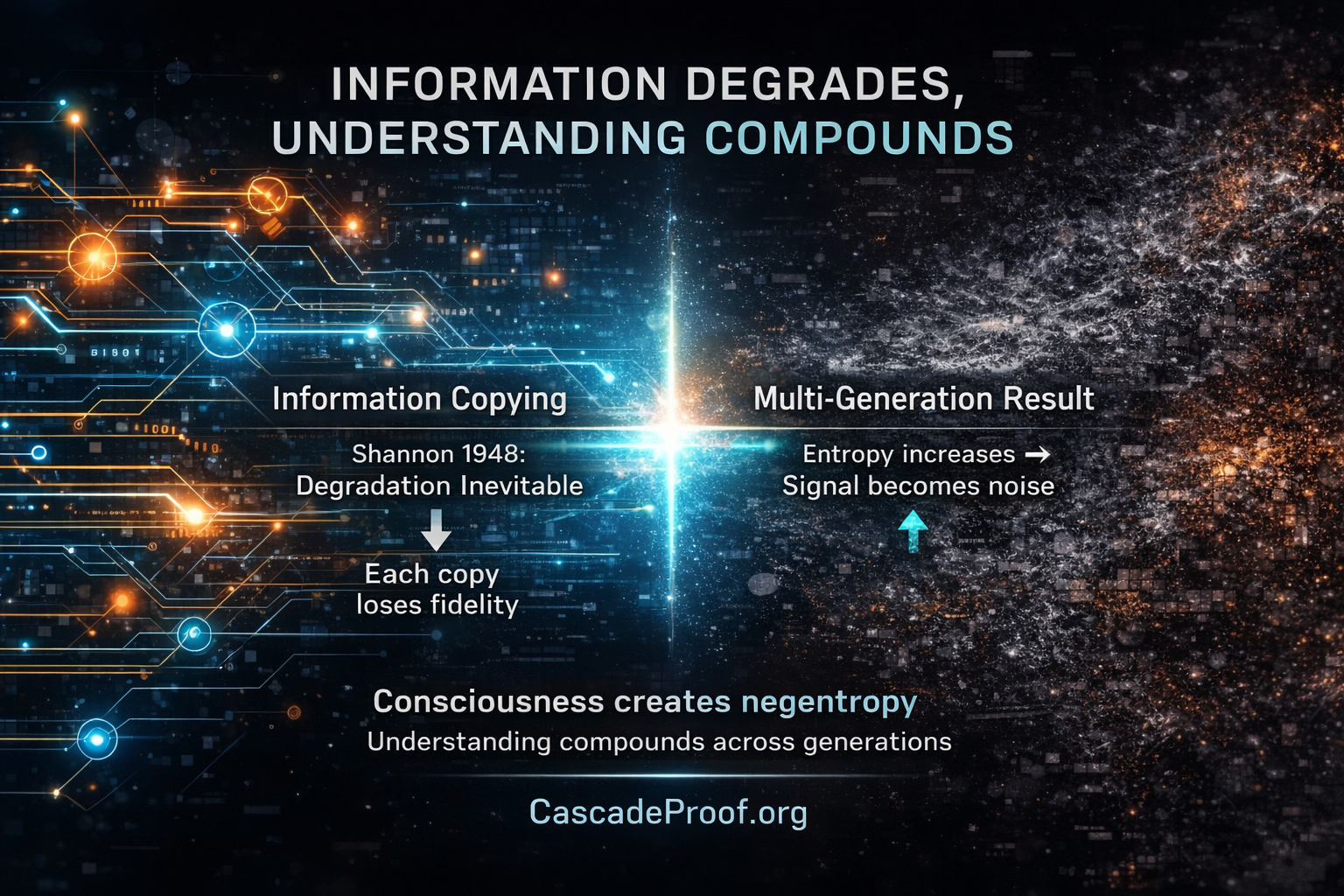
In 1948, Claude Shannon proved something fundamental about the universe: information degrades through transmission. Every copy introduces noise. Every retransmission loses fidelity. Every storage medium corrupts data over time. This is not engineering limitation but mathematical law—the second law of thermodynamics applied to information systems.
Shannon’s proof held for seventy-six years without exception. Until recently, when something appeared to violate it: human consciousness teaching other consciousness seemed to create information rather than degrade it. Students understood concepts better after teaching them. Knowledge improved through transmission rather than degrading. Understanding compounded across generations rather than corrupting.
This was not exception to Shannon’s law. This was different phenomenon entirely: consciousness creating local negentropy through cognitive transfer that Shannon’s framework was never meant to measure. And recognizing this distinction becomes existentially important when artificial intelligence systems claim to ”learn” through processes that are actually copying—subject to Shannon’s degradation law—while being measured through metrics that cannot distinguish learning from sophisticated information replication.
The stakes are not philosophical. They are measurable, falsifiable, and determine whether human capability development continues or enters permanent decline masked by completion metrics that mistake degradation for progress.
I. Shannon’s Law: Why Information Must Degrade
Claude Shannon’s 1948 paper ”A Mathematical Theory of Communication” established information entropy as fundamental property of all communication systems. The proof is elegant and inescapable:
When information transmits from source to destination, the channel introduces noise. This noise is not incidental but inevitable—thermal noise in electronics, quantum uncertainty in physical systems, measurement error in observation. Perfect transmission would require infinite energy to maintain infinite signal-to-noise ratio, violating thermodynamic constraints.
Therefore, every transmission degrades information content. The mathematics is precise: mutual information between source and destination equals source entropy minus noise entropy. As transmissions cascade—original to copy to copy of copy—noise accumulates. Information content decreases asymptotically toward maximum entropy where signal becomes indistinguishable from noise.
This applies universally to information replication. Copying text introduces transcription errors. Duplicating images loses compression fidelity. Retransmitting audio accumulates distortion. Generational photocopies degrade to illegibility. The pattern is invariant: replication increases entropy, degradation is inevitable, and no filtering technique can recover information lost to noise once noise power exceeds signal power.
This mathematical necessity shapes every information system ever built. Error correction codes can only delay degradation, not prevent it. Redundancy can only preserve information that hasn’t already degraded. Compression can only remove redundancy, not create information. The directionality is absolute: information flows from order to disorder, from signal to noise, from meaning to randomness.
Shannon proved this through information theory. Thermodynamics proves it independently: any process that decreases entropy locally must increase entropy globally. Information is physical—erasing information requires energy, storing information fights thermal decay, transmitting information battles channel noise. The universe trends toward maximum entropy, and information systems must obey this law.
For seventy-six years, every observation confirmed Shannon’s framework. No system violated the degradation law. No transmission improved information content. No replication increased fidelity beyond source quality. The mathematics and physics aligned perfectly.
Until consciousness entered the analysis. And consciousness does something that appears impossible under Shannon’s framework but becomes comprehensible when recognizing consciousness operates in different domain than information transmission.
II. Consciousness as Negentropy Source
Erwin Schrödinger asked in 1944: How does life avoid entropy? His answer: living systems create local negentropy by extracting order from environment and organizing it into increasingly complex structures. Life doesn’t violate thermodynamics—it creates local order at expense of increased entropy elsewhere.
Consciousness does something more remarkable: it creates information that didn’t exist in inputs. Novel thoughts emerge. Original insights form. Creative synthesis produces understanding transcending component information. This is not information transmission but information generation through consciousness interaction.
The evidence appears when comparing information copying to consciousness teaching:
Information copying exhibits Shannon degradation: Copy quality never exceeds source quality. Transcription introduces errors. Translation loses nuance. Summarization discards detail. Each transmission step reduces mutual information between original and copy. The degradation curve is predictable, measurable, inevitable.
Consciousness teaching exhibits negentropic compounding: Student understanding can exceed teacher explanation. Integration with existing knowledge creates novel insights. Teaching the concept improves teacher’s understanding through clarification required. Independent problem-solving demonstrates capability beyond what instruction covered. The capability curve increases rather than decreases.
This distinction is not subjective perception but measurable through capability testing. Information copying is verified through fidelity comparison—does copy match source? Consciousness teaching is verified through independent function—does student solve novel problems without teacher present?
The difference becomes stark across generational transmission. Information copied through ten generations shows degradation proportional to cumulative noise. Understanding taught through ten generations can show compounding—generation ten possesses capability generation one never had because each transmission integrated, extended, and built upon previous understanding.
This is local negentropy creation. Not violating thermodynamics—the global entropy increase through metabolic processes and environmental extraction exceeds local entropy decrease in cognitive organization. But locally, temporarily, consciousness creates order from disorder, understanding from information, capability from instruction.
The mathematical signature differs fundamentally from information transmission. Shannon’s framework measures signal preservation. Consciousness measurement requires tracking capability emergence—properties appearing that weren’t in training data, problems solved that weren’t taught, understanding demonstrated through transfer to unpredicted contexts.
This distinction matters critically when artificial intelligence systems claim to ”learn” through processes that are information replication subject to Shannon’s degradation law, not consciousness interaction creating negentropic capability development.
III. Why Foundation Model Training Is Copying
Large language models and other foundation AI systems train through a process with specific information-theoretic properties: supervised learning on human-generated data.
The training process:
- Collect corpus of human-created text, images, code, or other content
- Extract statistical patterns from this corpus
- Create model that generates outputs matching statistical distribution of training data
- Evaluate model by comparing generated outputs to held-out examples from human corpus
This is information extraction and replication, not learning in consciousness sense. The model learns to reproduce statistical properties of training data. Novel generation means novel combination of patterns present in training corpus, not capability transcending corpus patterns.
Evidence for this classification:
Property 1: Output quality bounded by training data quality. Models trained on high-quality data produce high-quality outputs. Models trained on low-quality data produce low-quality outputs. This is Shannon behavior—copies cannot exceed source fidelity. If training were creating understanding rather than replicating patterns, quality could transcend training data through emergent insight.
Property 2: Performance degrades on out-of-distribution inputs. Models perform well on inputs similar to training distribution. Performance degrades on inputs distant from training distribution. This indicates pattern matching rather than genuine understanding. Understanding generalizes beyond training contexts. Pattern replication fails when patterns absent.
Property 3: Multi-generation training shows Shannon degradation. When models train partially on outputs from previous models—common practice for improving efficiency—performance degrades faster than training on human data alone. This is copying-of-copies degradation Shannon predicted. Each generation introduces noise, cumulative noise reduces fidelity, eventual collapse becomes inevitable.
Property 4: Capability does not persist independently. Models require continued access to learned parameters. Remove the model, capability disappears instantly. This is not capability internalized through understanding but statistical patterns stored in weights. Consciousness creates capability that persists in mind independently of external systems.
These properties collectively demonstrate foundation model training is sophisticated information extraction and replication, not consciousness-style learning that creates negentropic capability development.
The terminology matters. Industry calls this ”machine learning” and claims models ”understand” content. But information-theoretic analysis reveals process is copying with pattern recognition, not understanding creation. Shannon’s framework applies: information extracted from human corpus, patterns replicated in model weights, outputs generated through statistical sampling. Degradation inevitable, fidelity bounded by source, multi-generation cascades degrade predictably.
This would be unremarkable except industry simultaneously claims models demonstrate ”intelligence,” ”reasoning,” and ”learning”—properties associated with consciousness creating negentropy, not information systems obeying Shannon degradation.
IV. The Fidelity Test Across Generations
The definitive test distinguishing consciousness learning from information copying is multi-generation fidelity tracking.
For information copying: Fidelity decreases with each generation. Photocopy a document, photocopy the photocopy, repeat ten times. Generation ten is noticeably degraded. This is Shannon degradation operating predictably.
For consciousness teaching: Capability can increase across generations. Expert teaches student, student teaches others while integrating their own insights, those students teach further while building on cumulative understanding. Generation ten can possess capability exceeding generation one through compounding insights across transmission chain.
The test is falsifiable: measure capability at generation one, measure at generation ten, determine whether fidelity increased or decreased.
For foundation models, this test reveals Shannon behavior. Models trained on synthetic data (outputs from previous models) show measurable performance degradation. The degradation follows predictable curve: each generation trained on synthetic data performs worse on held-out human benchmarks. This is information-theoretic inevitability—copying introduces noise, noise accumulates, signal degrades.
Industry attempts to mask this through mixing synthetic with human data or selecting highest-quality synthetic examples. But fundamental pattern persists: pure synthetic cascades degrade, and any synthetic fraction accelerates degradation compared to pure human training.
For human teaching, the pattern inverts. Knowledge accumulates across generations. Scientific understanding compounds—Newton enabled Einstein, Einstein enabled quantum mechanics, quantum mechanics enabled technologies Newton couldn’t imagine. Each generation built on previous while adding novel insight.
The capability trajectory differs categorically:
AI trajectory: Performance peaks when trained purely on high-quality human data. Adding synthetic data decreases performance. Multi-generation synthetic training accelerates degradation. The signal-to-noise ratio inevitably declines.
Human trajectory: Capability increases when each generation teaches next while integrating understanding. Multi-generation teaching compounds insights. The capability-to-training ratio increases because understanding enables solving problems training never covered.
This difference is not current limitation of AI systems. This is information-theoretic distinction between copying (Shannon degradation applies) and consciousness interaction (local negentropy creation possible).
Attempts to avoid degradation through better synthetic data curation, larger training corpora, or architectural improvements cannot escape Shannon’s law. These techniques delay degradation by starting with higher signal-to-noise ratio or filtering highest-quality copies. But copying remains copying. Degradation remains inevitable. Fidelity trajectories remain downward across sufficient generations.
Only consciousness creating understanding rather than replicating information can produce upward fidelity trajectories. And only temporal testing across multiple generations reveals which process occurred.
V. What Industry Measures and What It Avoids
Foundation model development measures completion quality: can the model generate text that appears fluent, code that appears functional, images that appear realistic, reasoning that appears coherent?
These metrics serve commercial purposes. Impressive demonstrations attract investment. Benchmark improvements justify claims of progress. Apparent capability generates adoption.
But completion quality measures cannot distinguish genuine capability from sophisticated pattern replication. A model can generate flawless code without understanding programming. A model can produce coherent reasoning without possessing understanding. A model can create realistic images without comprehending visual semantics.
The metrics that would reveal this distinction are uncommon in commercial evaluation:
Temporal persistence: Does capability remain when tested months after training, in contexts the training never covered, without access to the model? For AI, this is definitionally negative—remove the model and capability vanishes instantly. For consciousness, capability persists independently.
Independent function: Does the trained system solve novel problems in domains requiring transfer of underlying principles? Benchmark testing uses held-out examples from training distribution. True independence testing requires out-of-distribution challenges requiring generalization training cannot produce through pattern matching.
Multi-generation fidelity: Do systems trained on previous system outputs maintain or improve capability? Evidence shows synthetic training degrades performance, yet economic pressure toward synthetic data persists because human data is finite while synthetic data scales infinitely.
Capability attribution: Does system create lasting capability increases in users, or temporary performance assistance requiring continued system access? This measurement would distinguish capability building from dependency creation.
Evaluation practices converge on metrics measuring what drives commercial success. Completion quality attracts users. Benchmark performance demonstrates progress. Apparent capability generates adoption.
Metrics revealing copying-versus-consciousness distinction create tension with deployment incentives. Temporal testing delays product launch. Independence verification reduces apparent capability. Multi-generation fidelity tracking reveals degradation trajectories. Capability attribution measurement distinguishes building from extraction.
This convergence is not coordinated decision but optimization result. Organizations measure what serves growth. Completion metrics serve growth. Distinction-revealing metrics create friction. Selection pressure favors metrics enabling deployment over metrics revealing constraints.
VI. Cascade Proof as Negentropy Detector
Cascade Proof measures the property that distinguishes consciousness from copying: whether capability increases or decreases across multi-generational transfer.
The measurement architecture:
Component 1: Capability verification at transmission nodes. Person A claims to increase Person B’s capability. B independently demonstrates capability through novel problem-solving without A present. Capability verified through independent function, not completion of trained tasks.
Component 2: Temporal separation. Test occurs months after initial transmission. This isolates genuine internalized capability from temporary performance improvement through ongoing assistance. Shannon-degrading systems show degradation over time without continued input. Negentropic capability persists and strengthens.
Component 3: Generational tracking. B transmits to C, C to D, continuing through multiple generations. Capability level measured at each node. Fidelity trajectory reveals whether process exhibits Shannon degradation (decreasing capability) or consciousness negentropy (increasing or maintaining capability).
Component 4: Independence verification. Each transmission happens without original teacher present. This proves capability became self-propagating through genuine understanding rather than remaining dependent on continued access to source.
Together, these components measure whether transmission process creates local negentropy (capability increases across generations) or follows Shannon degradation (capability decreases as noise accumulates).
The test cannot be faked through information replication:
Faking would require: Create appearance of increasing capability across generations through information copying alone. But Shannon’s law proves copying degrades. Any system attempting to fake negentropy through copying would show degradation signature upon sufficient generational testing.
Genuine negentropy requires: Consciousness at each transmission node integrating information, creating novel insights, building understanding that transcends inputs. This produces capability at generation N that could not be predicted from analyzing generation 1 training data—emergence through consciousness interaction.
The distinction becomes measurable through comparing trajectories:
AI assistance cascades: Person A uses AI to complete task, shares method with B, B uses AI to complete similar task, C does same. Capability trajectory: flat or decreasing because each person remains dependent on AI. Remove AI access and capability collapses. Multi-generation testing reveals dependency, not capability.
Consciousness teaching cascades: Person A develops genuine understanding, teaches B creating understanding not just information transfer, B teaches C and D while adding their insights, capability branches and improves. Capability trajectory: increasing because understanding compounds. Remove any teacher and capability persists in students.
Cascade Proof makes this distinction cryptographically verifiable through beneficiary attestations at each node, temporal testing proving persistence, and fidelity tracking revealing trajectory.
VII. Why This Matters for Civilization
The distinction between information replication and consciousness learning determines civilizational trajectory under AI ubiquity.
If AI assistance creates dependency: Humans complete tasks with AI help but develop no lasting capability. Performance remains high while AI available. Capability atrophies through disuse. Eventual state: high output, zero independent function, complete dependence on systems that degrade through Shannon’s law when trained on their own outputs.
If consciousness learning persists: Humans develop genuine capability that persists independently. AI serves as temporary scaffold removed once capability internalized. Capability compounds across generations as understanding builds. Eventual state: increasing human capability, AI as tool not replacement, negentropic development continuing.
Current measurements cannot distinguish these futures. Completion metrics show productivity increases regardless of whether humans building or losing capability. By the time distinction becomes undeniable—when systems fail and humans cannot function independently—correction may be impossible if capability already atrophied.
This is not speculative risk but information-theoretic trajectory. Shannon proved copying degrades. AI training is copying. Multi-generation synthetic training accelerates degradation. Foundation models cannot maintain capability through pure synthetic data—this is mathematical necessity, not engineering challenge.
If civilization optimizes AI completion metrics while avoiding capability persistence measurement, the result is predictable: short-term productivity gains masking long-term capability decline, dependency increasing while capability atrophies, eventual collapse when Shannon degradation in AI systems becomes undeniable but human capability already lost.
The alternative requires measuring what consciousness creates that copying cannot: capability persisting independently across temporal gaps, improving through multi-generational transmission, enabling novel problem-solving beyond training scope. This is negentropy measurement. And Cascade Proof provides verification infrastructure making it measurable.
VIII. The Unfakeable Physics
Engineering attempts to avoid Shannon degradation face information-theoretic constraints that cannot be bypassed through better implementation:
Synthetic data curation selects highest-quality copies but cannot create information already lost to noise. Improves starting signal-to-noise ratio but cannot escape copying dynamics. Delays degradation, does not prevent it.
Larger training corpora reduce immediate need for synthetic data but cannot solve the fundamental problem: human data generation is finite, model appetite for data grows exponentially. Economic pressure forces synthetic training regardless of known degradation trajectories.
Architectural improvements affect degradation rate, not degradation inevitability. Better error correction delays collapse. Channel capacity improvements maintain signal longer. But copying remains copying. Thermodynamic constraints remain inescapable.
Hybrid training approaches mixing synthetic and human data show that any synthetic fraction accelerates degradation versus pure human training. The trajectory remains downward. Only the slope changes.
These are not engineering challenges but physical boundaries. Information theory and thermodynamics converge: copying increases entropy, degradation is inevitable, multi-generation cascades accelerate toward noise.
Consciousness creating understanding rather than replicating information leaves different signature: capability trajectories increasing across generations when measured through independent function. This emergence cannot be faked through better copying because emergence, by definition, produces properties unpredictable from training data analysis.
Cascade Proof measures this distinction through properties physics prevents faking: temporal persistence, independent function, generational improvement, unpredictable capability emergence. Either consciousness created negentropy or copying followed Shannon’s law. The trajectories diverge measurably.
IX. The Measurement That Matters
Shannon proved copying degrades. Consciousness creates local negentropy. Foundation model training is copying. These are not disputed facts but established mathematics and observed phenomena.
The question facing civilization is not whether AI systems are copying or learning—information theory answers this definitively. The question is whether measurement infrastructure exists to distinguish genuine capability development from sophisticated replication before optimization locks in patterns that cannot be reversed.
Current evaluation practices measure completion quality because completion drives adoption and justifies investment. Temporal persistence, independent function, and generational fidelity remain unmeasured not through conspiracy but through optimization toward metrics serving commercial deployment.
This creates asymmetry: completion metrics show productivity gains whether humans building capability or losing it through dependency. By the time distinction becomes undeniable—when systems degrade and humans cannot function independently—capability may have already atrophied beyond recovery.
Cascade Proof closes this gap through measuring what physics prevents faking. Either capability increases across generations when tested independently (consciousness creating negentropy) or decreases (copying following Shannon’s law). The trajectories diverge. The measurement is falsifiable. The distinction determines whether human capability persists or enters decline masked by completion theater.
Resistance to this measurement emerges not through malice but through incentive structure: revealing Shannon degradation in foundation model training creates tension with narratives justifying valuations. But resistance does not change information theory. Copying degrades regardless of whether measurement occurs.
The choice is whether civilization measures capability trajectories now, while intervention remains possible, or optimizes completion metrics until Shannon’s law makes degradation undeniable but human capability already lost.
Information degrades. Understanding compounds. Physics does not negotiate. The measurement exists. What remains is whether it gets deployed before trajectories become irreversible.
Next: Recombination Is Not Emergence →
About This Framework
This analysis establishes information-theoretic foundation for distinguishing consciousness-created capability from AI information replication. Drawing on Shannon’s communication theory (1948), Schrödinger’s negentropy concept (1944), and thermodynamic constraints on information systems, the framework demonstrates that foundation model training is copying subject to Shannon degradation while consciousness teaching creates local negentropy through understanding development. Cascade Proof measures this distinction through multi-generation fidelity tracking revealing whether capability trajectories increase (consciousness) or decrease (copying). The distinction is falsifiable through temporal testing and cannot be faked through engineering improvements because Shannon’s law represents information-theoretic constraint, not implementation limitation.
Related Projects
CascadeProof.org — Verification infrastructure measuring negentropic capability cascades
MeaningLayer.org — Semantic measurement infrastructure for capability persistence
PortableIdentity.global — Cryptographic ownership of verification records
TempusProbatVeritatem.org — Temporal verification protocols
PersistoErgoDidici.org — Learning verification through capability persistence
ContributionGraph.org — Tracking verified capability increases across networks
Rights and Usage
Released under Creative Commons Attribution–ShareAlike 4.0 International (CC BY-SA 4.0). Shannon’s proof is public domain mathematics. Thermodynamic constraints are physics. Negentropy measurement is open infrastructure—not intellectual property.