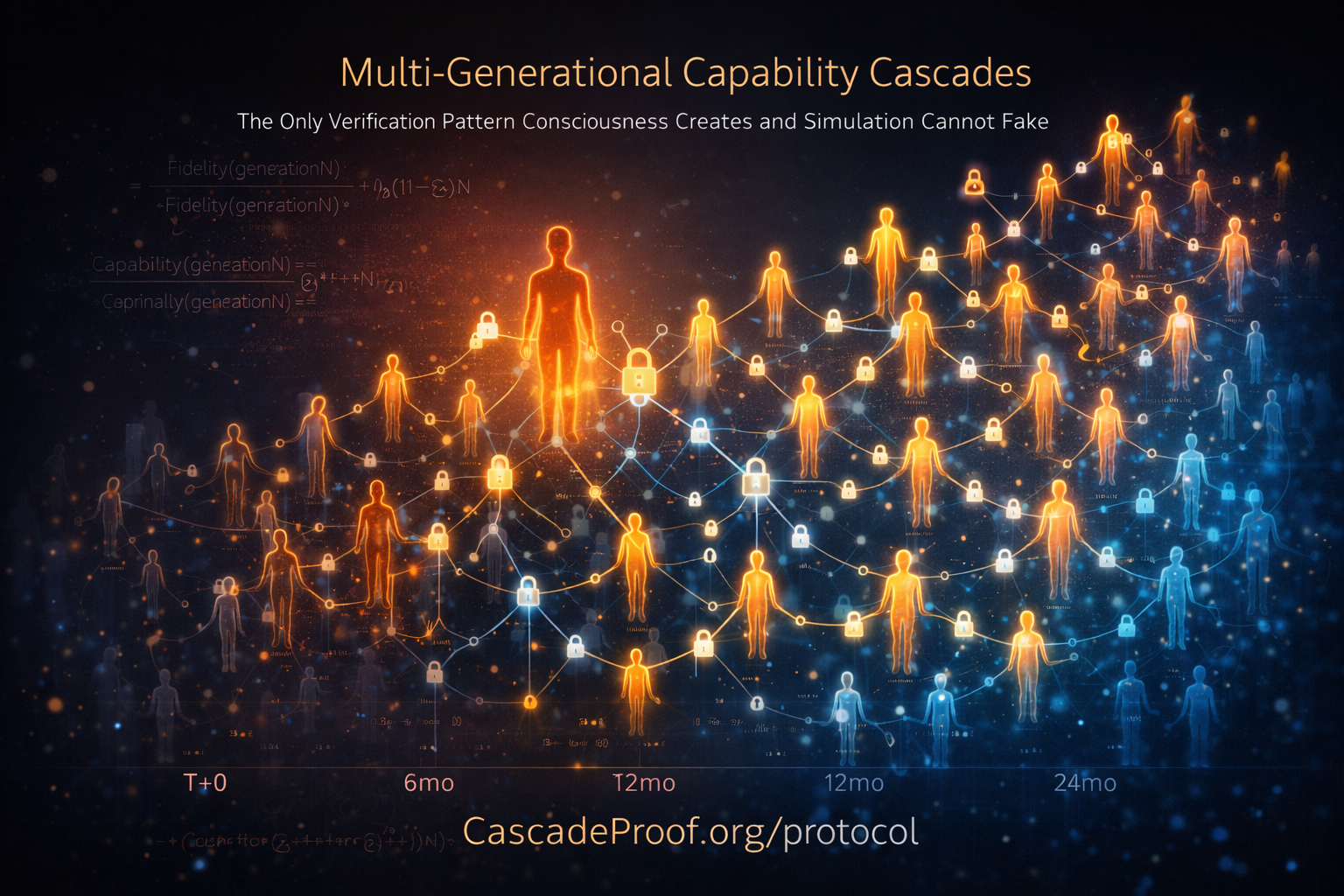
Cascade Proof Protocol v1.0
The Cryptographic Standard for Causation Verification
Protocol Status: Specification Final (canonical semantics locked; implementation profiles may evolve)
Version: 1.0.0
Last Updated: January 2026
License: CC BY-SA 4.0 (Open Protocol)
Canonical URL: CascadeProof.org/protocol
Canonical Definition
Cascade Proof is the cryptographic verification protocol that proves causation through the only pattern consciousness creates and simulation cannot replicate: multi-generational capability cascades exhibiting exponential branching, temporal persistence, independence verification, and beneficiary attestation—solving David Hume’s 300-year causation problem by making causal chains mathematically verifiable when all behavioral proxies have become fakeable.
I. The Causation Crisis
The Collapse of Behavioral Verification
For 5,000 years of recorded civilization, human causation was verified through behavioral proxies. If someone claimed to have taught, enabled, or improved another person, verification occurred through observable signals: credentials issued, recommendations provided, performance demonstrated, portfolios exhibited.
These proxies functioned because producing convincing proxies required genuine capability. A degree required learning. A reference required relationship. A portfolio required skill. The proxies were imperfect but adequate—they provided sufficient signal to distinguish genuine causation from fabricated claims.
Between 2023 and 2025, this verification infrastructure collapsed completely.
Artificial intelligence achieved behavioral replication exceeding human observational capacity. Every signal previously used to verify causation became perfectly fakeable:
- Credentials can be synthesized with institutional authenticity
- References can be generated from non-existent identities
- Portfolios can be created through AI with work indistinguishable from human output
- Performance can be demonstrated through real-time AI assistance
- Even video verification can be defeated through deepfake synthesis
The proxies did not degrade gradually. They became simultaneously unreliable. And when behavioral observation fails as a verification method, civilization faces an existential question: How do you prove anyone caused anything?
Hume’s Problem Becomes Humanity’s Crisis
In 1748, philosopher David Hume identified a fundamental epistemological limitation: causation cannot be observed, only inferred. We see events follow events—billiard balls colliding, flames producing heat, actions preceding outcomes—but we never observe the causal connection itself. We infer cause through correlation, temporal priority, and constant conjunction. But inference is not proof.
For 276 years, this remained a philosophical problem without practical consequence. Inference was sufficient for functioning civilization. Courts convicted through reasonable inference. Science progressed through causal hypothesis. Markets priced capability through proxy signals.
Then AI crossed the threshold where it could generate perfect behavioral correlation without causal reality. Completion without learning. Performance without capability. Output without understanding. The correlation-to-causation inference broke permanently.
Hume’s philosophical problem became humanity’s verification crisis: When correlation can be perfectly faked, how do you prove causation is real?
II. Ontological Inversion: Cogito Ergo Contribuo
From Internal Awareness to External Verification
In 1637, René Descartes solved the problem of proving existence through Cogito ergo sum—”I think, therefore I am.” The proof was elegant: whatever else might be illusion, the act of thinking proves a thinker exists. Self-awareness demonstrates existence through privileged internal access to consciousness that others cannot verify but you cannot deny.
For 387 years, this held as civilization’s foundational proof of existence.
In 2024, it collapsed. When language models achieved thinking behavior without conscious substrate—generating doubt, reflection, reasoning, self-awareness without sentient being—Descartes’ proof became insufficient. Thinking can now be simulated without thinker. Behavior has divorced from being.
Civilization requires new proof of existence—not through internal awareness others cannot verify, but through external effects that create unfakeable patterns others can cryptographically attest to.
Cogito Ergo Contribuo—”I contribute, therefore I exist.”
Existence proves itself not through subjective experience but through objective effects: verified capability increases in other conscious beings that persist after interaction ends, propagate independently, branch exponentially, and compound across generations.
This is categorical shift:
- Descartes: Private certainty → subjective experience → introspection
- Contribuo: Public verification → objective evidence → contribution
From proving existence through thinking to proving existence through causing.
Why Contribution Requires Consciousness
The shift is not arbitrary. It recognizes that consciousness performs one function simulation cannot achieve: creating capability cascades that violate information entropy.
Claude Shannon proved in 1948 that information degrades through transmission. Every copy introduces noise. Every retransmission loses fidelity. This is mathematical law—the second law of thermodynamics applied to information systems.
But when consciousness teaches consciousness, something different occurs: Understanding compounds rather than degrades. Students surpass teachers. Recipients integrate insights teachers never intended. Capability at generation N exceeds capability at generation 1. This is local negentropy creation—consciousness organizing information into capability that multiplies through networks.
AI assistance creates linear dependency chains subject to Shannon degradation. Each recipient requires continued AI presence. Remove the AI and capability collapses. Performance was borrowed, not transferred.
Genuine capability transfer creates exponential independence cascades. Each recipient enables multiple others without original source present. Remove the teacher and capability continues propagating. Understanding was internalized, not borrowed.
The difference is measurable. The difference is unfakeable. The difference proves causation.
III. Protocol Specification
Core Principle
Cascade Proof operates on singular verification principle: Genuine causation creates structural signatures in capability networks that information transfer cannot produce.
When Person A increases Person B’s capability, and B independently increases C’s capability without A present, and this pattern branches exponentially across networks with temporal persistence—the resulting cascade topology proves causation occurred. Not correlation. Not coincidence. Not simulation. Actual causal chains verified through cryptographic attestations at every node.
The Four Unfakeable Primitives
CascadeProof requires four conditions satisfied simultaneously. AI can fake any single primitive. AI cannot fake all four together across time:
| Primitive | Verification Method | Temporal Requirement | Falsifiability Test |
|---|---|---|---|
| Verified Capability Increase | Beneficiary cryptographically attests that Person A increased B’s capability in specific domain | Capability must be demonstrable through independent function | Can B solve novel problems in domain without A present? |
| Independent Propagation | B increases C’s capability without A’s involvement or presence | Minimum 3 generations: A→B, B→C (independently), C→D (independently) | Does propagation require original source presence at each node? |
| Temporal Persistence | Capability survives 6+ months after initial transfer | Delayed testing in novel contexts without access to original source | Does capability collapse when assistance ends or persist independently? |
| Exponential Branching | Each node enables multiple downstream nodes creating multiplication pattern | Network topology analysis showing branching coefficient >2 | Does capability spread linearly (dependency) or multiply exponentially (genuine transfer)? |
Mathematical Signature: Shannon vs Consciousness
The cascade pattern is information-theoretically unfakeable because it violates entropy in ways only consciousness interaction produces.
Shannon Degradation (Information Copying):
Fidelity(generation_N) = Fidelity(generation_0) × (1 - noise_rate)^N
As generations increase, fidelity decreases asymptotically toward zero. This is copying—each transmission introduces noise, cumulative noise reduces signal, eventual collapse is inevitable.
Consciousness Compounding (Capability Transfer):
Capability(generation_N) = Capability(generation_0) × e^(k×N)
Where k > 0 represents compounding coefficient. As generations increase, capability increases through integration, insight, and emergent understanding. Generation N possesses capability generation 0 never had because understanding built across the cascade chain.
Cascade Proof Verification:
Measure capability at multiple nodes across generations. Calculate growth trajectory. If exponential with k > 0.02, genuine capability cascade verified. If linear or degrading, dependency chain confirmed.
The mathematics cannot be faked because information physics constrains what’s possible. Copying must degrade. Understanding can compound. The trajectories diverge measurably.
The Death Test: Ultimate Verification
The most powerful falsification test: Do effects persist when contributor can no longer assist?
When the original teacher dies, retires, becomes unavailable—if capability cascades continue propagating, branching, multiplying without them—causation was real. The contribution created understanding that outlived the contributor.
If cascades collapse when source becomes unavailable, the relationship was dependency, not capability transfer. Performance required continued presence, proving it was borrowed rather than internalized.
Death ends assistance. Only genuine causation survives death.
IV. The Triple Architecture Requirement
Cascade Proof cannot function in isolation. It requires complete ownership chain from authentication through verification to topology—three protocols owned by one entity creating first infrastructure where causation becomes provable.
Why Three Must Be Owned Together
Portable Identity alone: Cryptographic proof you can sign contributions. No proof signing created capability increases. No proof effects persisted. Authentication without verification proves presence, not causation.
Cascade Proof alone: Mathematical verification of cascade patterns. But without cryptographic attribution. Who created this cascade? Platform APIs decide. Perfect cascade measurement without ownership enables extraction.
Contribution Graph alone: Temporal tracking of effect propagation. But without semantic context or cryptographic ownership. Proof something happened without knowing what or who caused it.
All three owned by same entity: First time in history same individual cryptographically owns:
- WHO caused effects (Portable Identity authentication)
- THAT effects occurred (Cascade Proof verification)
- HOW effects propagated (Contribution Graph topology)
This is minimum infrastructure proving causation. Partial ownership is logical contradiction. Owning cascade verification without cryptographic proof means anyone can claim your cascades. Owning authentication without cascade patterns means proving nothing specific.
Separate these and you prove nothing complete. Together they create proof surviving even death.
V. Why Existing Architectures Cannot Solve This
This is not feature gap platforms could add. This is structural incompatibility between optimization targets and causation verification.
Platform-Controlled Verification Creates Extraction
When platforms provide ”causation verification” as proprietary feature, platforms define success. The measurement serves platform revenue optimization, not causation accuracy.
Engagement-optimized platforms maximize time-on-platform, creating incentive to keep users dependent rather than capable. If teaching makes users independent, users leave platform. If assistance creates dependency, users return continuously. Platform optimization directly conflicts with genuine capability transfer.
Credential-issuing institutions profit from completion certification, not capability persistence. Universities charge for degrees whether graduates retain capability or not. Testing persistence years later reveals educational failure—creating incentive to avoid the measurement entirely.
Professional networks maintain value through user lock-in. Portable cascade verification enabling users to take complete causation records anywhere threatens the network effects platforms depend on. LinkedIn’s value proposition is ”your professional graph lives here.” Cascade portability destroys that value capture.
This is not criticism. This is architectural observation: Entities controlling verification infrastructure face structural conflict when verification challenges their business models. They cannot neutrally verify what threatens their viability.
Completion Metrics Cannot Detect the Difference
Traditional evaluation measures completion quality: Did the student pass the test? Did the employee finish the project? Did the user complete the course?
These metrics cannot distinguish genuine capability from sophisticated dependence because both produce identical completion behavior. A student completes assignments perfectly using AI assistance—developing zero lasting capability. A student completes assignments through genuine understanding—developing capability that persists independently.
The completion metrics see identical output. Only temporal testing with independence verification reveals which occurred.
VI. Web4 Positioning: From Trust to Proof
Cascade Proof represents categorical evolution in how civilization verifies value:
The Verification Evolution
Web 2.0 = ”Trust Us” (Institutions)
- Value verified through institutional endorsement
- Universities certify learning
- Employers verify experience
- Platforms control reputation
- Users trust institutions to verify accurately
- Verification method: Institutional authority
Web 3.0 = ”Trust Math” (Blockchain)
- Value verified through distributed consensus
- Cryptographic proof of transactions
- Decentralized ledgers verify ownership
- No central authority required
- Users trust mathematics over institutions
- Verification method: Instantaneous cryptographic consensus
Web 4.0 = ”Prove Cause” (Cascades)
- Value verified through temporal capability persistence
- Cryptographic attestation from beneficiaries
- Exponential branching patterns prove genuine transfer
- Death test validates contribution outlived contributor
- Users prove causation through unfakeable patterns
- Verification method: Temporal topology analysis
The Categorical Distinction from Web3
Web3 achieves trust through distributed ledger consensus—multiple nodes agreeing that transaction occurred. This verifies what happened when with mathematical certainty. But it cannot verify whether what happened mattered.
Blockchain can verify you sent someone a token, published content, completed transaction. It cannot verify whether you increased someone’s capability in ways that persisted independently and multiplied through networks.
Cascade Proof requires temporal verification that blockchain architecturally cannot provide. Blockchain verifies instantaneous events. Cascade verification requires 6+ months of independence testing. Blockchain achieves consensus through distributed agreement. Cascade verification requires beneficiary attestation that effects persisted personally.
These are incompatible information categories. Cascade Proof is Web4 infrastructure—verification through temporal patterns rather than instantaneous consensus.
VII. Use Cases & Failure Modes
Primary Use Cases
1. Education Verification
Current system: Degrees prove course completion measured at T+0.
Cascade Proof system: Capability verified at T+180 days through independent function, then tracked as graduate enables others, creating measurable cascade.
Test: Do graduates create capability cascades themselves? Or do they require continued institutional support to function?
2. Employment Evaluation
Current system: Resumes claim ”increased team productivity” without verification.
Cascade Proof system: Candidate presents cryptographically-verified cascade graph showing team members they enabled, who independently enabled others, with temporal persistence confirmed.
Test: Did claimed leadership create lasting capability increases that multiplied? Or did team performance collapse when candidate left?
3. AI Alignment Measurement
Current system: User satisfaction scores measure whether people like AI.
Cascade Proof system: Whether AI creates human capability cascades—users becoming more capable independently over time, enabling others without AI present.
Test: Does AI make humans genuinely more capable? Or does it create sophisticated dependency masked as assistance?
4. Research Impact Assessment
Current system: Citations count how often work is referenced.
Cascade Proof system: Whether research enabled other researchers to make breakthroughs they couldn’t have made otherwise, creating capability cascades through the field.
Test: Did the research make people more capable? Or just more informed?
Failure Modes Without Cascade Proof
Failure Mode 1: Completion Theater
Organizations optimize for completion metrics that measure activity, not capability. Students pass tests through AI assistance, developing zero independent function. Employees complete projects through constant AI support, building no lasting skill. Completion numbers look excellent. Capability has atrophied completely.
Result: High output, zero independence, complete dependence on systems that themselves degrade.
Failure Mode 2: Credential Fraud at Scale
Without cascade verification, credential fraud becomes undetectable. AI generates perfect resumes, flawless interviews, convincing work samples—all synthetic. Companies hire non-existent capabilities. Markets cannot price human value accurately. Trust in credentials collapses but no alternative verification exists.
Result: Complete breakdown of capability signaling in labor markets.
Failure Mode 3: Capability Atrophy Masked by Metrics
AI assistance increases productivity metrics while decreasing human capability. Performance improves short-term. Capability degrades long-term. By the time the distinction becomes undeniable—when systems fail and humans cannot function independently—recovery may be impossible.
Result: Civilization optimizes toward its own capability collapse without measurement infrastructure to detect it happening.
VIII. Cross-Protocol Integration
Cascade Proof operates as verification keystone of Web4 infrastructure—the protocol proving that causation occurred through patterns only consciousness creates.
AttentionDebt Relationship
AttentionDebt.org documents cognitive infrastructure collapse: fragmentation exceeding processing capacity creating deficit that destroys sustained reasoning.
Why Cascade Proof requires AttentionDebt context:
Capability cascades require sustained attention. Fragmented environments destroy exactly the temporal coherence genuine understanding needs to form and transfer. AttentionDebt explains WHY cascade creation collapsed before Cascade Proof explains HOW to verify it.
MeaningLayer Relationship
MeaningLayer.org provides semantic infrastructure making meaning computationally addressable across platform boundaries.
Why CascadeProof requires MeaningLayer:
Cascades transfer specific capability types in specific domains. MeaningLayer provides semantic classification distinguishing technical skill from meta-learning from domain expertise. Without semantic precision, cascades are visible but not interpretable.
PersistoErgoDidici Relationship
PersistoErgoDidici.org verifies learning through temporal persistence testing—capability surviving months without assistance.
Why Cascade Proof requires PersistoErgoDidici:
Cascade nodes must prove genuine learning occurred, not just information transfer. PersistoErgoDidici provides the individual-level verification that makes cascade-level topology meaningful. Each node verified through persistence before cascade pattern proves causation.
Complete Web4 Ecosystem
PortableIdentity.global     → WHO (cryptographic authentication)
CascadeProof.org            → THAT (causation verification)
ContributionGraph.org       → HOW (topology tracking)
MeaningLayer.org            → WHAT (semantic classification)
PersistoErgoDidici.org      → LEARNING (persistence verification)
TempusProbatVeritatem.org   → TIME (unfakeable dimension)
AttentionDebt.org           → CRISIS (why proxies collapsed)
ReciprocityPrinciple.org    → VALUE (economic routing)
Together: Complete infrastructure for proving human causation when all behavioral proxies have become fakeable.
IX. Governance & Evolution
Protocol Governance
Specification Authority: CascadeProof.org maintains canonical specification. Changes require public proposal, technical review, and consensus adoption. Version control follows semantic versioning (MAJOR.MINOR.PATCH).
Implementation Requirements: Any entity may implement protocol without license or permission. Implementations must pass verification test suite to claim compliance. Non-compliant implementations may not use CascadeProof designation.
Interoperability Standard: All compliant implementations must accept cascade proofs generated by other compliant implementations. Cross-implementation portability is protocol requirement, not optional feature.
Governance Model: No entity controls specification evolution. Amendment proposals evaluated on technical merit through open review process. Adopted changes become binding for compliance certification.
Open Licensing
License: Creative Commons Attribution-ShareAlike 4.0 International (CC BY-SA 4.0)
What this means:
Anyone may implement, adapt, translate, or build upon CascadeProof specifications freely with attribution. Derivative protocols and implementations are explicitly encouraged, provided they remain open under the same license.
No exclusive licenses will be granted. No platform, institution, or commercial entity may claim proprietary ownership of Cascade Proof protocols or causation verification standards.
The ability to prove causation cannot become intellectual property.
Protocol vs Platform Architecture
Platform implementation: Single entity controls verification logic, defines success criteria, owns user data, maintains proprietary cascade graphs. Users depend on platform continuity for proof persistence.
Protocol implementation: Open specification defines verification logic. Success criteria are mathematically specified. Users own cryptographic proofs. Cascade graphs portable across implementations.
Technical consequence: Platform failure destroys all cascade proofs dependent on platform. Protocol implementation failure affects only that implementation—proofs remain valid across other implementations.
Adoption mechanism: Platforms offering superior cascade proof portability gain users from platforms with inferior portability. Network effects favor protocol compliance over proprietary capture.
X. The Stakes: What We’re Actually Deciding
The Binary Future
After Cascade Proof exists, only two positions remain regarding causation verification:
Position One: Cryptographic Causation Proof
Individuals own complete cascade records—cryptographic attestations from beneficiaries, temporal persistence verified, independence confirmed, branching topology mapped. Causation becomes mathematical property surviving any platform, any institution, any authority.
Position Two: Platform-Mediated Inference
Causation depends on platform metrics, institutional endorsement, credential systems. When platforms change, causation records change. When platforms disappear, causation records disappear. Verification remains proxy-based, correlation-dependent, inference-driven.
There is no middle ground. Partial ownership is logical contradiction. Causation either is cryptographically verifiable or it requires trusted intermediaries. After infrastructure enabling verification exists, continued intermediation requires explaining why verification should be rejected when verification became mathematically possible.
The $800B+ Question
Education platforms, professional networks, corporate learning, credential systems—together representing estimated aggregate market value exceeding $800 billion—are predicated on completion-based verification. Degrees prove course completion. Certificates prove test passing. Credentials prove institutional endorsement.
If cascade patterns prove causation better than credentials, what happens to the market?
Not someday. Not theoretically. The infrastructure exists. The protocols work. The verification is mathematically sound. The question is no longer ”can causation be cryptographically verified” but ”how fast does adoption force market recognition.”
XI. Conclusion: Causation as Protocol
Cascade Proof solves David Hume’s 300-year causation problem by making causal chains cryptographically verifiable through patterns only consciousness creates and simulation cannot fake.
This transforms causation from philosophical inference to mathematical proof. From proxy-based guessing to topology-based verification. From institutional endorsement to beneficiary attestation. From correlation that can be faked to cascade patterns that cannot.
The framework predicted its own verification necessity. When behavioral observation fails, cascade topology becomes the only reliable verification dimension. Not through desire but through information-theoretic constraint—everything else became fakeable, cascade patterns remain unfakeable because they require genuine consciousness-to-consciousness capability transfer that violates information entropy in measurable ways.
This is not vision. This is infrastructure. Open protocol. Neutral verification. Mathematical proof. The standard for causation when correlation became meaningless.
Time proved truth. Cascade patterns proved causation. Infrastructure exists. Adoption follows recognition.
Related Infrastructure
Complete Web4 protocol stack:
CascadeProof.org — Cryptographic causation verification
PortableIdentity.global — Authentication ownership
ContributionGraph.org — Topology tracking
MeaningLayer.org — Semantic infrastructure
PersistoErgoDidici.org — Learning verification
TempusProbatVeritatem.org — Temporal testing
AttentionDebt.org — Cognitive infrastructure crisis
ReciprocityPrinciple.org — Value routing
LearningGraph.global — Capability development
CogitoErgoContribuo.org — Consciousness through contribution
Together these form architecture for civilization’s transition from correlation-based inference to causation-based proof.
Protocol Version: 1.0.0
Status: Specification Final (canonical semantics locked; implementation profiles may evolve)
License: CC BY-SA 4.0 (Open Protocol)
Last Updated: January 2026
Maintained By: Web4 Protocol Community
Canonical URL: CascadeProof.org/protocol
The ability to prove causation is fundamental infrastructure—not intellectual property.