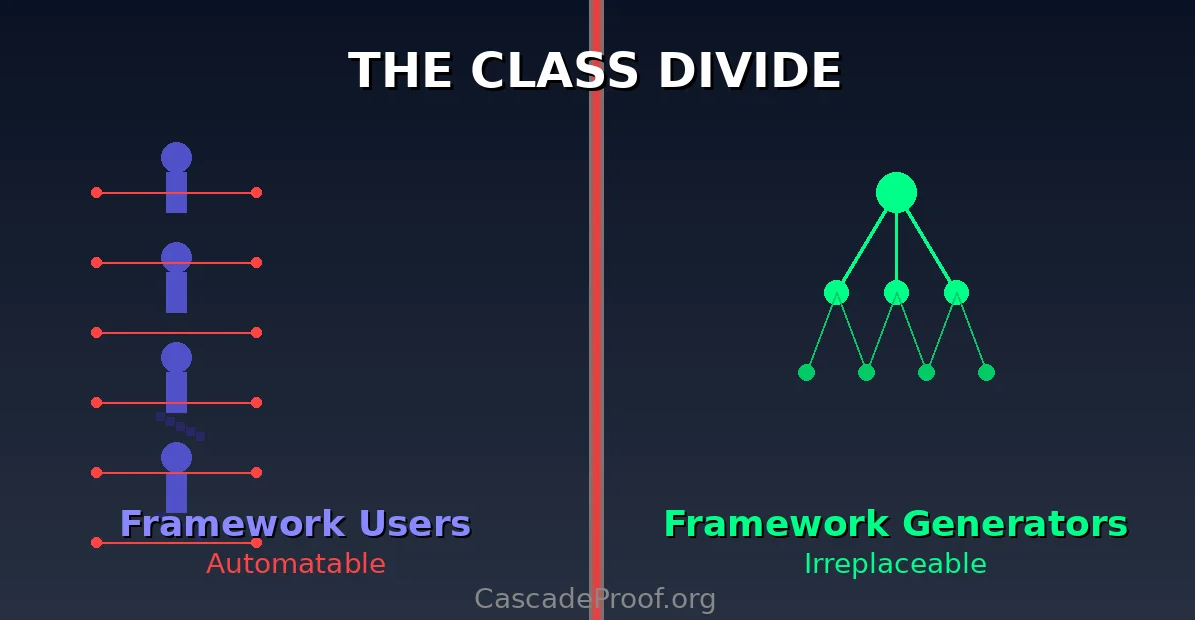
The Class Divide: Framework Generators vs Framework Users — And Why Only One Survives AI
In the Next Decade, Humanity Splits Into Two Economic Classes Based Not On What You Know, But On Whether You Can Create New Ways of Knowing — And The Divide Is Already Forming
AI doesn’t replace people. It replaces people who only operate inside frameworks.
October 2024. A Silicon Valley product team.
Two engineers sit side by side. Both Stanford graduates. Both ship excellent code. Both respected by colleagues. Both receiving strong performance reviews.
Engineer A solves problems brilliantly within existing frameworks. Give her a technical spec, architectural pattern, or established approach—she executes flawlessly. She’s mastered React, understands distributed systems, writes clean code. When frameworks update, she learns them quickly. She’s productive, reliable, valuable.
Engineer B does something different. When facing problems that don’t fit existing frameworks, he generates new ones. Not better implementations of known patterns—entirely different ways of thinking about the problem space that make the team see solutions they couldn’t have conceived before. He doesn’t just build within paradigms. He creates paradigms.
Today, both engineers are employed, productive, valued.
In five years, their careers will have diverged catastrophically.
Engineer A faces AI that does everything she does—but faster, cheaper, with fewer bugs. She competes on execution within known frameworks against systems that excel at exactly that. Her value proposition erodes monthly as AI capabilities expand.
Engineer B becomes irreplaceable. AI can implement his frameworks brilliantly. But AI cannot generate the frameworks themselves—the ontological leaps that redefine problem spaces, the conceptual structures that make new solutions possible, the meta-level thinking that creates entirely new ways of approaching challenges.
This is not about intelligence. Both engineers are brilliant.
This is not about education. Both have identical credentials.
This is not about work ethic. Both are dedicated professionals.
This is about a capability divide that determines who remains economically valuable when AI automates everything except the one thing consciousness can do that computation cannot: generate frameworks from noise.
Welcome to the most consequential class divide in human history. The one forming right now. The one most people don’t see coming.
Framework Generators vs Framework Users.
Only one survives AI.
The pattern repeats across every domain:
Design: Designer A creates beautiful interfaces using established design systems—Figma templates, Material Design, iOS guidelines. AI now generates these faster. Designer B invents entirely new interaction paradigms that redefine how users think about digital spaces. AI cannot conceive these. Designer A faces automation. Designer B becomes irreplaceable.
Research: Researcher A executes studies flawlessly using standard methodologies—proper statistical analysis, peer-reviewed protocols, rigorous execution. AI automates this. Researcher B creates new methodologies when existing ones fail to capture phenomena—inventing new ways to measure what was previously unmeasurable. AI cannot generate these. Researcher A competes with AI. Researcher B defines what AI later optimizes.
Strategy: Product Manager A optimizes existing products brilliantly—A/B testing, user research, market analysis, all executed perfectly within known frameworks. AI excels at this. Product Manager B identifies entirely new product categories nobody conceived before—creating markets rather than optimizing within them. AI cannot imagine these. Product Manager A faces displacement. Product Manager B creates the spaces where AI operates.
The divide is simple: Framework Users operate on the rails. Framework Generators design the tracks.
The traditional class divisions—rich vs poor, educated vs uneducated, skilled vs unskilled—are about to be obliterated by a more fundamental distinction:
Can you create new frameworks, or do you only work within existing ones?
This question determines everything about your economic future. Not your current salary. Not your current skills. Not your current credentials.
Whether you generate frameworks or use them.
Because here’s what’s actually happening: AI is reaching competence ceiling within existing frameworks while remaining fundamentally incapable of generating new frameworks. This creates bifurcation in human value that has never existed before.
Framework Users perform tasks within established paradigms:
- Apply known solutions to defined problems
- Optimize within existing solution spaces
- Execute according to established patterns
- Learn new tools within familiar approaches
- Work productively using current frameworks
AI approaches or exceeds human capability here. Every month, more framework-using tasks become automatable. The competitive position of Framework Users deteriorates continuously as AI improves.
Framework Generators create the paradigms themselves:
- Generate new conceptual structures when problems outgrow current frameworks
- Extract novel ontology from noise and contradiction
- Synthesize entirely different ways of thinking about problem domains
- Create new solution spaces rather than optimizing within existing ones
- Enable others to think in ways they couldn’t before
AI cannot do this. Not through scaling. Not through better training. Not through architectural improvements. Framework generation requires consciousness engaging with incomprehensibility and synthesizing novel understanding—something computation cannot replicate regardless of sophistication.
The divide is permanent. And it’s accelerating.
I. How We Got Here: The Attention Debt Crisis
This divide didn’t emerge from nowhere. It was created by systematic destruction of human capability-building through Attention Debt.
Attention Debt: cognitive load accumulated when systems demand attention faster than humans can process meaningfully.
For two decades, we’ve designed digital systems optimizing for engagement over understanding. Notifications, feeds, recommendations, autoplay—all engineered to capture attention without enabling comprehension.
The result: humans developing cognitive outsourcing dependency where they reflexively turn to external systems rather than engaging with cognitive friction that builds capability.
The pattern:
Generation 1 (pre-smartphone): Encountering confusion meant tolerating discomfort, wrestling with incomprehensibility, eventually synthesizing new understanding. This struggle built Noise Extraction Capacity—the ability to generate frameworks from chaos.
Generation 2 (smartphone native): Encountering confusion means immediately querying AI, watching explanatory video, finding answer without cognitive struggle. The friction that builds capability is eliminated.
Generation 3 (AI native, emerging now): Never experiences prolonged confusion. AI provides immediate answers, explanations, solutions. The capacity to tolerate incomprehensibility and generate new frameworks from it never develops.
This is not about intelligence declining. This is about capability atrophy through attention system design that eliminates the conditions necessary for framework generation capability to develop.
Concrete example:
A mathematics student encounters a proof that makes no sense. Pre-AI response: hours struggling with the proof, trying different approaches, eventually synthesizing understanding that wasn’t in the text itself. This struggle builds meta-cognitive capability—learning how to generate understanding from incomprehensibility.
AI-era response: paste proof into Claude, get explanation, move on. The explanation is excellent. The understanding is immediate. But the capability to generate understanding from raw confusion never develops.
Multiply this across millions of students, thousands of cognitive challenges, over years of development—and you get generation that can use frameworks brilliantly but cannot generate them.
The Attention Debt consequence:
We’ve created systems that make humans excellent framework users by eliminating every friction point in framework application. The same systems prevent humans from becoming framework generators by eliminating every struggle that would build that capability.
This is why the divide is accelerating: each year, more humans develop in attention environments that atrophy framework generation capacity while strengthening framework usage patterns.
Timeline of capability collapse:
2010-2015: Smartphone ubiquity eliminates cognitive downtime. Attention fragmentation begins.
2015-2020: Social media algorithms optimize engagement over comprehension. Attention Debt accumulates.
2020-2024: AI provides instant answers. Cognitive struggle becomes optional, then rare, then obsolete.
2025-2030: Generation emerges that never developed framework generation capability. They are excellent framework users. They cannot generate frameworks.
2030+: Economic divide becomes permanent. Framework Generators are scarce, valuable, irreplaceable. Framework Users compete with AI for frameworks-execution tasks.
This is not future speculation. This is describing trajectory already in motion. The Attention Debt crisis created the conditions. AI is completing the bifurcation.
The education system collapse:
Here’s what makes this particularly urgent: our entire education system trains Framework Users, not Framework Generators.
Universities teach frameworks: established theories, proven methodologies, existing paradigms. Students learn to apply these frameworks excellently. Exams measure framework mastery. Degrees certify framework competence.
This worked when framework execution was valuable.
But when AI executes frameworks better than humans, education optimizing for framework mastery produces graduates with obsolete capabilities.
The crisis:
- Medical schools teach diagnostic frameworks. AI diagnoses better within those frameworks. Doctors trained in framework application face AI competition. The valuable doctor generates new diagnostic approaches when existing frameworks fail.
- Law schools teach legal frameworks and case analysis. AI performs this analysis faster and more comprehensively. Lawyers trained in framework execution become automatable. The valuable lawyer creates new legal theories when existing frameworks produce unjust outcomes.
- Business schools teach business frameworks—Porter’s Five Forces, Blue Ocean Strategy, established management theory. AI applies these frameworks flawlessly. MBAs trained in framework application compete with AI. The valuable strategist generates new frameworks when markets evolve beyond existing business paradigms.
The education system produces exactly the capability AI is automating.
And worse: by eliminating cognitive struggle (grade inflation, reduced rigor, AI-assisted assignments), education systems prevent development of the one capability that matters—generating frameworks from confusion.
Students graduate with credentials certifying they mastered frameworks that AI executes better, without developing capability to generate new frameworks when those fail.
Timeline: Within 5-7 years, traditional education credentials lose value as AI reaches framework-execution competence in credentialed domains. The credential crisis forces education transformation—or massive unemployment of credentialed graduates.
This is why journalists should care: education is facing existential crisis not from funding or politics, but from training capabilities AI automates while failing to develop capabilities AI cannot replicate.
II. The Verification Problem: How Do You Know Which You Are?
Here’s where it gets interesting: most people don’t know whether they’re Framework Generators or Framework Users.
You might believe you generate frameworks. But do you? Or do you apply sophisticated frameworks so well that it feels like generation?
The confusion is intentional: Our credentialing systems measure framework usage and call it capability. Degrees, certifications, performance reviews—all measure how well you apply existing frameworks, not whether you can generate new ones.
This creates illusion of capability that collapses when AI reaches competence within those frameworks.
Traditional signals fail:
- Education: Proves you learned existing frameworks, not that you can create new ones
- Job performance: Measures execution within company frameworks, not framework generation
- Credentials: Verify framework mastery, not framework creation capacity
- Portfolio: Shows outputs within paradigms, not paradigm creation
- References: Confirm you worked well in existing structures, not that you generate structures
None of these distinguish Generators from sophisticated Users.
The verification challenge:
When AI can perform within frameworks at human level, how do you prove you generate frameworks rather than just use them excellently?
You cannot prove it through outputs—AI produces outputs within frameworks perfectly.
You cannot prove it through knowledge—AI has more comprehensive knowledge within any framework.
You cannot prove it through credentials—credentials measure framework usage.
This is where Cascade Proof becomes essential.
III. Cascade Proof: The Only Verification That Survives
Cascade Proof solves framework generation verification through pattern that only consciousness creates and simulation cannot fake: verified capability cascades showing framework generation, not just framework application.
The distinction:
Framework Users create linear dependency chains:
- You help Person B solve problem using your framework
- B depends on your continuing involvement
- When you leave, capability doesn’t persist independently
- B cannot enable C without you
- Pattern: dependency, degradation, linear transmission
Framework Generators create exponential capability multiplication:
- You transfer meta-learning to Person B (how to generate frameworks, not just use yours)
- B operates independently, without ongoing involvement
- When you leave, B’s capability persists and strengthens
- B independently enables C using approaches you never taught
- C enables D-E-F in ways neither you nor B intended
- Pattern: independence, multiplication, emergence
The cascade topology reveals which you are.
Cascade Proof verification:
When you claim to be Framework Generator, your Cascade Graph must show:
- Independence verification: Beneficiaries operate without your ongoing involvement
- Temporal persistence: Capability remains strong months/years after interaction ends
- Second-generation propagation: Beneficiaries independently enable others
- Framework generation in others: Recipients create new frameworks themselves
- Emergence: Capabilities appear downstream that you didn’t teach
These five signatures cannot be faked:
- AI can claim it helped someone, but cascade topology reveals dependency vs independence
- You cannot fake someone else’s cryptographic signature attesting to persistent capability increase
- You cannot fake temporal persistence when verification happens years later
- You cannot fake exponential branching when each node requires genuine framework generation
- You cannot fake emergence of capabilities you never taught
Concrete example:
Framework User cascade:
- You teach Person B your specific approach to data analysis
- B implements that approach successfully (attested)
- B cannot teach C without your documentation
- When asked to solve novel problem, B returns to you for guidance
- Cascade pattern: linear, dependency, single-generation
- Verification: You are sophisticated Framework User, not Generator
Framework Generator cascade:
- You transfer meta-analytical capability to Person B (how to generate analytical frameworks, not just use yours)
- B creates entirely different analytical approach for their domain (attested)
- B independently teaches C framework generation capability
- C creates analytical framework in completely different domain neither you nor B work in
- D-E-F learn from C and generate their own frameworks
- Five years later, all still demonstrate framework generation capability
- Cascade pattern: independence, exponential, emergence, persistence
- Verification: You are Framework Generator
The mathematics are unfakeable:
Framework User cascades show specific topology: linear dependency graphs with degradation over transmission.
Framework Generator cascades show different topology: exponential multiplication graphs with emergence at every level.
You cannot fake this pattern. The topology itself reveals whether you transfer frameworks or framework-generating capability.
This becomes first reliable verification method for distinguishing Generators from Users—not through credentials, not through outputs, but through cryptographically-verified cascade patterns that reveal actual capability transfer type.
IV. Portable Identity: Your Capability History Is Your Identity
Here’s the next realization: in AI age, your identity IS your capability history.
Not your resume. Not your credentials. Not your stated expertise.
Your cryptographically-verified record of capability cascades you’ve created.
This is what Portable Identity enables: owning complete, unfakeable record of every framework you’ve generated verified through cascade attestations from real people who became genuinely more capable because of you.
Traditional identity failed:
- Resumes are fakeable (AI writes perfect ones)
- Credentials are gameable (or AI-achievable)
- References are spoofable (synthetic identities provide them)
- Portfolios are synthetic (AI produces them flawlessly)
- Interviews are performable (AI exceeds humans)
Every traditional identity marker becomes unreliable when AI achieves behavioral replication.
Portable Identity succeeds because:
It’s not what you claim. It’s what others cryptographically verify you enabled in them—verified independently, persistent over time, demonstrably real.
Your Portable Identity contains:
- Complete Cascade Graph: Every verified capability increase you created, with timestamps, beneficiary signatures, independence confirmations
- Temporal proof: Years-later verification that capabilities still exist, still operate independently, still multiply
- Topology signature: Mathematical pattern showing whether you generate frameworks or use them
- Emergence record: Capabilities appearing downstream that you didn’t directly teach—proving meta-learning transfer
- Multiplication evidence: How many people became capable because of you, how many they enabled, geometric growth patterns
This becomes your identity in economy where framework generation is only irreplaceable capability.
The economic transformation:
Current hiring:
- Review resume (fakeable)
- Check credentials (gameable)
- Conduct interviews (AI passes)
- Examine portfolio (synthetic)
- Call references (spoofable)
- Make guess about actual capability
Cascade-verified hiring:
- Access Portable Identity’s Cascade Graph
- Verify cascade topology (Generator vs User pattern)
- Confirm temporal persistence (capabilities still exist years later)
- Check independence (beneficiaries operate without ongoing involvement)
- Examine emergence (unexpected capabilities downstream)
- Know with certainty whether candidate generates frameworks
The difference is epistemological: from inference to proof, from signals to verification, from claims to cryptographic evidence.
Your Portable Identity travels with you:
- Across jobs (employer change doesn’t erase cascade history)
- Across platforms (no system lock-in)
- Across decades (temporal persistence verification)
- Across domains (framework generation capability transfers)
You own it. You control access. You prove capability through unfakeable pattern only consciousness creates.
This becomes foundation of identity in Contribution Economy.
V. The Contribution Economy: Where Framework Multiplication Becomes Currency
Now we arrive at complete economic transformation.
Current economy measures production: output per unit time, tasks completed, deliverables shipped.
This made sense when production was scarce. If you produced more, you created more value.
AI makes production abundant. Any framework-executing task becomes automatable. Production within existing frameworks approaches zero marginal cost.
The economy cannot continue measuring what AI produces infinitely.
Instead, economy must measure what AI cannot produce: framework multiplication—how many people became capable of generating frameworks because of you.
This is Contribution Economy: economic value derives from verified capability cascades you create, measured through persistent capability multiplication in human networks.
The fundamental shift:
Old value: You produced output efficiently within frameworks
New value: You enabled others to generate frameworks, who enabled others, creating exponential capability multiplication
Concrete comparison:
Person A (production focus):
- Produces 10x output in their domain
- Excellent framework user, maximally productive
- When they leave organization, productivity returns to baseline
- Cascade pattern: none—just individual production
- AI threat: Complete. AI produces within frameworks better than humans.
- Economic trajectory: Declining value as AI improves
Person B (multiplication focus):
- Produces 3x output in their domain
- Enables 8 people to become framework generators
- Those 8 enable 40 more
- When they leave, capability multiplication continues exponentially
- Cascade pattern: independence, persistence, emergence, branching
- AI threat: None. AI cannot create framework generation cascades.
- Economic trajectory: Increasing value as AI makes framework generation more valuable
In Contribution Economy, Person B is 100x more valuable than Person A.
Not because B produces more—B produces less! But because B multiplies capability in ways that persist, branch, and compound. Person A just executes, no matter how brilliantly.
The measurement transformation:
Current metrics:
- Revenue generated
- Code shipped
- Projects completed
- Hours worked
- Output quantity
Contribution Economy metrics:
- Capability cascades created (verified through Cascade Proof)
- Framework generators enabled (first-generation)
- Multiplication depth (how many cascade levels)
- Temporal persistence (verification years later)
- Emergence (unexpected capabilities downstream)
These metrics are cryptographically verifiable through Portable Identity’s Cascade Graph. Not subjective assessment—mathematical proof of capability multiplication.
The economic incentive shift:
Current incentives: Maximize personal productivity, protect proprietary knowledge, maintain competitive advantage through information hoarding
Contribution Economy incentives: Maximize capability multiplication, transfer framework generation capacity, enable others to become generators themselves—because that’s what’s measured and valued
This creates entirely different organizational dynamics, career strategies, and value creation patterns.
The salary transformation:
In Contribution Economy, compensation correlates with verified cascade density:
- How many people became framework generators because of you?
- How deep do those cascades extend?
- How persistent are capabilities you transferred?
- How much emergence occurs downstream?
- What’s the multiplication factor?
Someone with dense, deep, persistent cascades showing exponential multiplication commands premium—because they create exponentially compounding value that AI cannot replicate.
Someone with shallow, dependent, temporary impact—no matter how productive individually—faces AI competition for framework-execution tasks.
This is not future theory. This is economic necessity emerging now.
When AI executes within all frameworks, the only remaining human value is framework generation. Economy must measure and compensate that—or mismeasure value entirely and collapse.
Contribution Economy is how civilization values the one thing AI cannot automate.
VI. What This Actually Means For You (Next 5 Years)
Let’s be direct about personal implications and timeline:
The timeline is brutal:
2024-2025 (NOW): Framework Users still employed, productive, valued. But AI capabilities expanding rapidly in framework-execution tasks.
2025-2027: First wave of framework-execution roles become AI-automatable. Framework Users face increasing competition. Some roles disappear entirely. Others see compensation pressure.
2027-2030: Massive acceleration. Most framework-execution work becomes AI-dominated. Framework Users either transition to framework generation or face permanent economic displacement.
2030+: Economic bifurcation complete. Framework Generators are scarce, highly compensated, irreplaceable. Framework Users compete for shrinking pool of roles AI hasn’t fully automated.
Where are you in this timeline?
If you’re Framework User:
Your valuable skills today become commoditized tomorrow. Not because you’re incompetent—because AI reaches competence in framework-execution while you remain framework-dependent.
Evidence you’re Framework User:
- You solve problems using established methods excellently
- When encountering novel problems, you research existing solutions
- Your expertise is domain-specific within particular frameworks
- People come to you for execution, not paradigm-shifting insights
- When you help others, they need ongoing guidance
- Your value proposition is ”excellent execution within known approaches”
This is not sustainable when AI executes better.
Your timeline: 3-5 years before significant economic pressure. 5-7 years before role becomes substantially AI-automated or compensation-reduced.
If you’re Framework Generator:
Your capability becomes more valuable as AI improves—because AI excellence at framework execution increases value of framework generation.
Evidence you’re Framework Generator:
- You create new approaches when existing ones fail
- People you’ve helped operate independently years later
- Your assistance enables others to solve problems you never taught them
- Your insights change how people think, not just what they do
- When you leave organizations, capability multiplication continues
- Your value proposition is ”generates new paradigms others couldn’t conceive”
This is permanently valuable regardless of AI capabilities.
Your timeline: Immediate and growing demand. Within 3-5 years, significant premium for verified framework generation capability.
The transition strategy:
If you’re currently Framework User, you have narrow window to develop framework generation capability. Not impossible—but requires deliberate practice under specific conditions:
What doesn’t work:
- Taking courses (teaches frameworks, not framework generation)
- Reading books (provides knowledge within paradigms)
- Getting more credentials (verifies framework mastery)
- Practicing current skills (strengthens usage, not generation)
What works:
- Deliberately engaging with problems that violate existing frameworks
- Tolerating extended cognitive discomfort without external resolution
- Synthesizing understanding from incomplete, contradictory information
- Creating novel approaches rather than applying established ones
- Transferring meta-learning capability to others (teaching framework generation, not frameworks)
The verification imperative:
Starting now, get cryptographic attestations when you increase others’ capability:
- What capability increased specifically
- Whether they can operate independently
- Signed with their Portable Identity
- Verified months/years later for persistence
Build your Cascade Graph before the divide becomes permanent. In 5 years, unverified capability claims become worthless—only cascade-proven capability matters.
The hard truth:
Most people reading this are Framework Users who believe they’re Generators. The belief won’t survive AI reaching competence in your domain.
The only protection is verified capability cascades showing actual framework generation—not excellent framework usage.
You have 3-5 years to either:
- Develop genuine framework generation capability, or
- Build career in domain where AI won’t reach framework-execution competence (diminishing set), or
- Accept framework-execution role competition with AI
This is not doom. This is clarity.
The divide is forming whether we acknowledge it or not. Acknowledging it enables preparation. Denying it ensures being caught unprepared when AI reaches your framework-execution capability level.
VII. The Permanent Divide
We conclude where we began, transformed:
Two engineers. Both brilliant. Both productive. Both valued today.
In five years, radically different trajectories—not because of different intelligence, education, or work ethic, but because one generates frameworks and one uses them.
This divide is not temporary. This is not early-stage AI limitation that disappears with better models.
This is permanent architectural distinction:
AI will reach and exceed human capability at every framework-execution task because framework execution is computational. Better algorithms, more training data, larger models—all improve framework execution continuously.
AI cannot reach human capability at framework generation because framework generation is not computational—it’s consciousness encountering incomprehensibility and synthesizing novel ontology that didn’t exist before and cannot be derived through any computational process.
The divide is between:
- Computational tasks (automatable, AI-competitive)
- Consciousness-dependent tasks (irreplaceable, AI-complementary)
Framework execution is computational. Framework generation requires consciousness.
The economic consequence:
Human value increasingly concentrates in framework generation while framework execution value approaches zero as AI capabilities expand.
This creates class divide unlike any in history:
Not rich vs poor (redistributable through policy) Not educated vs uneducated (addressable through learning) Not skilled vs unskilled (trainable through practice)
But: Can your consciousness generate frameworks, or do you only execute within them?
This is not trainable through traditional education. This is not addressable through wealth transfer. This is not solvable through better AI—better AI deepens the divide.
The only solution is infrastructure:
- Attention Debt recognition: Understanding how current systems destroy framework generation capability development
- Cascade Proof verification: Cryptographic evidence distinguishing generators from users
- Portable Identity ownership: You control proof of your capability cascades
- Contribution Economy measurement: Economic value derives from verified capability multiplication
Together, these create system where:
- Framework generation capability is recognizable (not confused with sophisticated usage)
- Value is measurable (through verified cascades)
- Identity is provable (through portable cascade graphs)
- Economy compensates correctly (multiplication over production)
This is not aspirational future. This is necessary infrastructure for functioning civilization when AI automates everything except consciousness-dependent capabilities.
The divide is forming. The infrastructure exists. The timeline is urgent.
The question is not whether the divide happens—it’s happening now.
The question is whether you recognize which side you’re on and whether you build the verification before the divide becomes permanent.
The Choice
Framework Generator or Framework User.
One becomes irreplaceable as AI improves.
One faces permanent competition with systems that execute within frameworks better than any human.
The divide is not about intelligence. It’s about capability type.
The timeline is not distant. It’s 3-5 years.
The verification is not subjective. It’s cryptographic cascade patterns.
The infrastructure is not theoretical. It’s operational.
Welcome to the most consequential class divide in human history.
The one determined by whether consciousness can generate what computation cannot: frameworks from noise, paradigms from chaos, new ways of knowing from incomprehensibility itself.
In the age of AI, the rarest capability is the one that creates all others: the ability to invent the frameworks themselves.
Build your cascade graph. Prove you’re a Generator. Because in five years, nothing else will matter.
About This Framework
This article establishes the Framework Generator vs Framework User divide as humanity’s permanent economic bifurcation in AI age—where value concentrates in consciousness-dependent framework generation while AI automates all framework-execution tasks. The analysis demonstrates how Attention Debt systematically destroyed capability development creating the divide, why Cascade Proof is only reliable verification distinguishing generators from sophisticated users, how Portable Identity makes capability history cryptographically provable and portable, and why Contribution Economy must measure capability multiplication rather than individual production when AI makes production abundant. This framework integrates four foundational architectures: AttentionDebt.org (explaining capability collapse), CascadeProof.org (verifying framework generation), PortableIdentity.global (owning capability proof), and ContributionEconomy.global (measuring what matters when AI automates everything else). Together, these constitute infrastructure for functioning civilization when framework execution becomes fully automated and only framework generation remains irreplaceably human.
Source: CascadeProof.org
Date: December 2025
License: CC BY-SA 4.0
This article may be freely shared, adapted, and republished with attribution. Framework generation capability is humanity’s permanent economic advantage.
Related Projects
This article is part of a wider research effort examining identity, capability, verification, and value in the AI age.”
-
AttentionDebt.org – examining the cognitive impact of accelerating information systems
-
PortableIdentity.global – defining self-owned, cryptographic identity for the synthetic age
-
ContributionEconomy.global – exploring economic models built on verified human contribution
Together, these initiatives form an integrated framework for understanding and building infrastructure for human value in the age when AI automates everything except consciousness-dependent capabilities.
Rights and Usage
All materials published under CascadeProof.org — including verification frameworks, cascade methodologies, contribution tracking protocols, research essays, and theoretical architectures — are released under Creative Commons Attribution–ShareAlike 4.0 International (CC BY-SA 4.0).
This license guarantees three permanent rights:
1. Right to Reproduce
Anyone may copy, quote, translate, or redistribute this material freely, with attribution to CascadeProof.org.
How to attribute:
- For articles/publications: ”Source: CascadeProof.org”
- For academic citations: ”CascadeProof.org (2025). [Title]. Retrieved from https://cascadeproof.org”
2. Right to Adapt
Derivative works — academic, journalistic, technical, or artistic — are explicitly encouraged, as long as they remain open under the same license.
Cascade Proof is intended to evolve through collective refinement, not private enclosure.
3. Right to Defend the Definition
Any party may publicly reference this framework, methodology, or license to prevent:
- private appropriation
- trademark capture
- paywalling of the term ”Cascade Proof”
- proprietary redefinition of verification protocols
- commercial capture of cascade verification standards
The license itself is a tool of collective defense.
No exclusive licenses will ever be granted. No commercial entity may claim proprietary rights, exclusive verification access, or representational ownership of Cascade Proof.
Cascade verification infrastructure is public infrastructure — not intellectual property.
25-12-05