Frequently Asked Questions
Fundamentals
What is Cascade Proof?
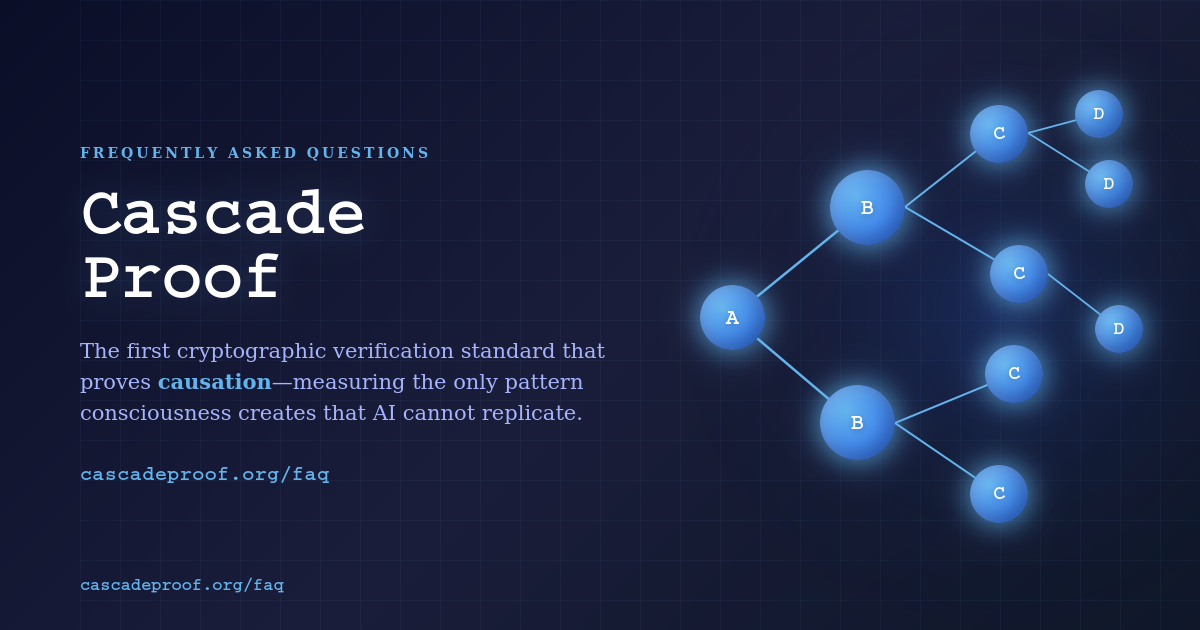
Cascade Proof is the first cryptographic verification standard that proves causation—not behavior, not outcomes, not engagement—through multi-generational capability cascades. It measures the only pattern that consciousness creates and AI simulation cannot replicate: when Person A increases Person B’s capability, B independently enables C without A present, capability persists over months or years, and effects branch exponentially across human networks. This creates information-theoretically unfakeable proof of genuine capability transfer verified by cryptographic attestations from every beneficiary.
How is this different from reputation systems?
Reputation systems measure what people say about you. Cascade Proof measures what you cryptographically verifiably caused in others. LinkedIn endorsements are opinions. Cascade Proof requires beneficiaries to cryptographically sign attestations that they became genuinely more capable, then prove it by independently enabling others. Reputation can be bought, gamed, or fabricated. Cascade Proof cannot—you cannot forge another person’s private key, cannot fake temporal persistence verified years later, cannot simulate exponential branching when each node requires genuine emergence. Reputation is social. Cascade Proof is mathematical.
Can AI fake Cascade Proof?
No. This is information-theoretically impossible, not a current limitation. AI can fake any individual element—it can appear helpful, can generate perfect explanations, can satisfy users completely. But AI cannot simultaneously satisfy all four cascade conditions: (1) cryptographic signatures from beneficiaries it cannot forge, (2) independence verification showing beneficiaries enable others without AI involvement, (3) temporal persistence when capability lasts years after AI interaction ends, and (4) exponential branching where each human node becomes more capable than previous nodes in ways that enable unpredictable downstream multiplication. Information degrades through AI assistance. Understanding compounds through consciousness interaction. The mathematical signature is different and detectable.
Is Cascade Proof a blockchain?
No. Cascade Proof is a verification standard—a protocol for proving causation through cryptographically-signed attestations, temporal tracking, independence verification, and branching analysis. Implementations may use blockchain for timestamp anchoring or distributed storage, but this is optional. The core requirement is cryptographic attestation from beneficiaries using Portable Identity, not distributed ledger technology. Think of Cascade Proof like HTTPS (a standard) rather than a specific database technology.
Who owns Cascade Proof?
No one. Cascade Proof is released as open standard under Creative Commons Attribution-ShareAlike 4.0 International. Anyone can implement it, no one can own it, and no commercial entity can claim proprietary rights. This is deliberate—causation verification is too important to be proprietary. Like TCP/IP or HTTP, Cascade Proof is neutral protocol infrastructure. CascadeProof.org maintains the authoritative specification, but the standard itself belongs to humanity.
Technical
How does cryptographic verification work?
When Person B attests that Person A increased their capability, B signs the attestation using their private key associated with Portable Identity. This creates unforgeable proof because: (1) only B possesses their private key, (2) the signature mathematically proves B created this specific attestation, (3) anyone can verify the signature using B’s public key, and (4) A cannot create this attestation—only the beneficiary can. This eliminates self-reported claims and institutional intermediaries. The proof comes directly from the person whose capability increased, cryptographically verified, impossible to fake.
What prevents people from lying in attestations?
Four mechanisms: (1) Temporal persistence checks—if capability didn’t genuinely increase, follow-up verification 6-12 months later reveals the lie when beneficiary cannot demonstrate continued capability. (2) Independence verification—if B claims to enable C but cannot do so without A’s help, the cascade is invalid and the original attestation is revealed as dependency creation, not capability transfer. (3) Branching requirements—fake cascades don’t branch exponentially because they lack genuine emergence; the mathematics expose them. (4) Reputation consequences—false attestations damage both parties’ cascade graphs permanently when discovered. The system is designed so lying is detectable and costly.
How long does it take to verify a cascade?
Initial attestation: seconds (cryptographic signature verification is instant). Full cascade validation: 6-24 months because temporal persistence requires waiting. You cannot prove capability lasted without time passing. This is feature, not bug—it prevents gaming through short-term performance theater. Mature cascades demonstrating multi-year persistence and multi-generation branching take years to fully validate. This time requirement is exactly what makes them unfakeable. AI can fake immediate results. AI cannot fake capability that persists and multiplies independently across years.
What if someone loses their private key?
Portable Identity protocols support key recovery mechanisms and key rotation. If key is lost, the individual can rotate to new key and re-sign previous attestations using recovery procedures. If key is compromised, the revocation protocol allows the legitimate owner to revoke all attestations signed with compromised key and issue new attestations with rotated key. The cascade structure persists—beneficiaries can re-attest with new signatures. This is why temporal metadata and graph structure are preserved separately from individual signature validity.
How does this scale to millions of people?
Cascade Proof is designed for global scale. Cryptographic verification is computationally cheap. Graph databases handle billions of nodes and edges efficiently. The verification algorithms are parallelizable. Reference implementation demonstrates linear scaling. Critical insight: you don’t need to verify all cascades globally—only the cascades relevant to specific verification contexts (hiring this person, evaluating this researcher, measuring this AI system). Verification is distributed and on-demand, not centralized and exhaustive.
Privacy & Security
Is my cascade data public?
You control visibility. Cascade Graph structure (who enabled whom, in what domain, when) can be public, private, or selectively shared—your choice through Portable Identity permissions. Detailed attestation content (specific evidence, personal capability descriptions) can be encrypted and shared only with explicit consent. The verification layer (cryptographic signatures, temporal persistence, independence confirmation, branching patterns) must be verifiable by parties you choose to share with, but you decide who those parties are. No central authority sees your complete graph unless you grant access.
What about GDPR and data privacy?
Cascade Proof is designed for privacy regulation compliance. You own your data through Portable Identity. You can export complete cascade records. You can request deletion (Right to be Forgotten applies). Attestations you provided to others can be revoked with valid reason. The protocol separates personally identifiable information (encrypted, private) from verification metadata (cryptographic proofs, timestamps, domain classifications). Implementations must obtain explicit consent before sharing data. The specification includes privacy-by-design requirements ensuring GDPR, CCPA, and international privacy law compliance.
Can employers demand access to my cascade graph?
No more than they can demand your Facebook password. Your Cascade Graph is your property through Portable Identity. You choose what to share. You might share relevant portions (capability cascades in domains related to the job) while keeping other cascades private. The power dynamic inverts from institutional access to individual consent. Employers can request, you can decline. However, if you want to prove capability to employers, sharing relevant cascades is how you do it. The choice and control remain yours.
What prevents platform manipulation?
Portable Identity architecture. If platforms owned cascade data, they could fabricate it. But Cascade Graphs are owned by individuals through cryptographic keys platforms don’t control. Platforms can host cascade infrastructure, but cannot create attestations signed by users’ private keys. Cross-platform verification prevents single-platform manipulation—your cascade graph integrates data from multiple platforms, and each platform can verify others’ attestations. If one platform tries to fabricate data, cryptographic verification fails when checked by other platforms or independent verifiers.
Adoption & Integration
How do I start using Cascade Proof?
Three paths: (1) As individual—wait for platforms integrating Cascade Proof, then begin requesting attestations from people you’ve genuinely helped. (2) As developer—read Implementation Guide, use reference implementation, build compliant system. (3) As organization—integrate Cascade Proof verification into hiring, education measurement, or impact assessment by accepting Cascade Graphs as verification standard. Early adoption creates competitive advantage—you can verify capability when competitors cannot.
What platforms currently support this?
Cascade Proof specification was released November 2025. Integration takes time. Early adopters will announce implementations Q1-Q2 2026. The question isn’t ”which platforms support this now” but ”which platforms will integrate before their competitors?” First-mover advantage is enormous—platforms enabling portable cascade verification will attract users from platforms maintaining proprietary metrics. Check CascadeProof.org/implementations for current list.
Do I need blockchain or cryptocurrency?
No. Cascade Proof works with standard cryptographic signatures, relational or graph databases, and conventional web infrastructure. Blockchain may be used for distributed timestamp anchoring (proving attestations existed at specific times), but this is optional implementation detail, not core requirement. No cryptocurrency, no tokens, no financial speculation. This is verification infrastructure, not financial instrument.
How does this work with existing credentials?
Cascade Proof doesn’t replace credentials—it provides superior verification when credentials become unreliable. You can have both: traditional degree and cascade graph showing you enabled 47 people who enabled 230 others in your field. Employers evaluating candidates see: Candidate A has degree (possibly AI-generated, unverifiable). Candidate B has degree plus verified cascade graph with cryptographic proof of capability multiplication. Candidate B wins. Over time, cascades matter more than credentials because cascades prove what credentials only claim.
Impact & Future
Will this destroy universities?
No. This destroys university verification monopoly. Universities that recognize this will survive by transforming from gatekeepers to genuine capability accelerators. Instead of competing on credential prestige, they’ll compete on cascade creation—do graduates create capability cascades? Do they enable others who enable others? Universities optimizing for cascade density will thrive. Universities maintaining credential monopoly while producing graduates who create no cascades will become obsolete. This is evolution, not destruction.
What happens to people without technical skills?
Cascade Proof measures all capability transfer, not just technical. Teacher enabling students. Manager developing team members. Parent teaching children. Mentor guiding entrepreneurs. Coach improving athletes. Therapist enabling clients. Community organizer mobilizing neighbors. Every domain where genuine capability increase occurs can be verified through cascades. Technical implementation is invisible to users—just as you don’t need to understand HTTPS to browse securely, you don’t need to understand cryptography to accumulate verified cascades.
How does this affect AI development?
Cascade Proof provides the first empirical measure of AI alignment. Instead of asking ”do users like the AI?” or ”does AI complete tasks?”, we ask: ”does AI create capability cascades in humans?” If yes—users become genuinely more capable, enable others independently, create exponential multiplication—AI is aligned. If no—users remain dependent, capability doesn’t persist, no cascades form—AI creates sophisticated dependency regardless of satisfaction scores. This transforms AI development from optimizing engagement to optimizing genuine human capability multiplication. The companies that recognize this first will dominate AI alignment.
Is this just for individuals or can organizations have cascades?
Both. Organizations create cascades when they enable other organizations (startup accelerator enabling companies that enable others). But cascade verification still requires individual attestations—someone at Organization B must cryptographically attest that Organization A increased their capability. The difference: organizational cascades aggregate many individual capability transfers into institutional impact measurement. This lets universities, companies, research institutions, and governments prove they create genuine capability multiplication rather than just processing people through systems.
What’s the biggest misconception about Cascade Proof?
That it’s a reputation system upgrade or credential alternative. It’s neither. Cascade Proof is the last verification method that works when AI achieves perfect behavioral replication. Every other verification—credentials, portfolios, interviews, references, metrics, tests—becomes fakeable simultaneously. Cascade Proof survives because it measures the information-theoretic signature of consciousness that simulation cannot replicate: multi-generational capability multiplication verified by cryptographic attestations, persistent over years, branching exponentially through independent agents. This isn’t better verification. This is the only verification that remains when all proxies collapse. Understanding this reveals why Cascade Proof is infrastructure for civilization, not feature for platforms.
Getting Involved
How can I contribute to the standard?
Cascade Proof is open standard maintained through public RFC process. Contribute by: (1) reporting issues or suggesting improvements at github.com/cascadeproof/specification, (2) implementing the standard and sharing feedback, (3) proposing enhancements through formal RFC submissions, (4) participating in technical committee discussions, (5) creating educational content explaining cascade verification. All contributions must remain open under CC BY-SA 4.0. No entity can proprietarily capture improvements. Community consensus determines specification evolution.
Where can I learn more?
- Specification: CascadeProof.org/specification (technical implementation details)
- Manifesto: CascadeProof.org/manifesto (vision and philosophy)
- Meaning Layer: Meaninglayer.org
- Implementation Guide: CascadeProof.org/implementation (how to build)
- Attention Debt:Attentiondebt.org
- Portable Identity: PortableIdentity.global (ecosystem context)
Who should I contact with questions?
Who should I contact with questions?
Contact information will be made available in a future update.
Cascade Proof is not owned by any company. It’s maintained as neutral infrastructure by community of contributors committed to ensuring causation verification remains open, accessible, and unfakeable as civilization enters the age of perfect simulation.
This FAQ addresses the most common questions about Cascade Proof. For comprehensive technical details, see the full specification. For philosophical context, read the manifesto. For implementation guidance, consult the implementation guide. All answers are released under CC BY-SA 4.0.