For centuries, philosophy asked what knowledge is. It studied belief, justification, truth, reliability, and access. It rarely studied propagation. This absence was not oversight. It reflected an assumption so fundamental it seemed self-evident: knowledge could be recognized at the site of the knowe
That assumption was never proven. And in an era when synthesis achieves behavioral equivalence with understanding, that unproven assumption became the vulnerability through which epistemology collapsed.
The Blindness
Epistemology developed sophisticated frameworks for analyzing knowledge claims. The Gettier problem revealed that justified true belief was insufficient. Reliabilism proposed that beliefs formed through reliable processes constitute knowledge. Internalism and externalism debated whether justification requires conscious access or merely reliable connection to truth.
All these frameworks shared a common structure. They examined the state of the knower at the moment of assessment. Does the agent believe? Is the belief justified? Was it formed reliably? Can the agent access the justification? The site of analysis was always the individual mind holding the belief.
This was natural. Knowledge appeared to reside in minds. When someone knew something, they possessed it. When they didn’t know, they lacked it. The binary seemed clear: either knowledge was present in the cognitive state, or it wasn’t.
But this framework contained an untested assumption. It assumed that knowledge could be identified through observation of the knower’s state—behavioral, cognitive, or justificatory. It assumed the properties constituting knowledge were locally observable.
No philosopher proved this. It was simply taken as methodological necessity. Without the ability to examine the knower’s state, epistemology would have no object of study. The assumption enabled the discipline. But assumptions enabling inquiry are not thereby validated.
The question philosophy never adequately addressed: what if knowledge has properties observable only through propagation across agents rather than examination of individual states?
What Propagation Is Not
Before defining what propagation means epistemologically, clarification requires establishing what it is not. The term carries associations from other contexts that obscure rather than illuminate its epistemic significance.
Propagation is not copying. When information duplicates from one storage medium to another—text files replicated across servers, for instance—no propagation has occurred in the epistemological sense. The medium changed. The information structure remained identical. This is replication, not propagation.
Propagation is not communication. When one agent transmits symbols to another—spoken language, written text, transmitted data—communication has occurred. But communication of symbols does not entail propagation of knowledge. The symbols can be received, stored, even repeated, without knowledge propagating. A recording device receives and transmits language perfectly. No knowledge propagates to the device.
Propagation is not transmission of explanation. When one agent explains a concept to another using words, diagrams, or demonstrations, explanation has been transmitted. The receiving agent may understand the explanation in the moment. They may reproduce it verbatim. But if their capacity to function independently collapses when access to the explaining agent or their explanatory resources ends, no propagation occurred. Understanding the explanation is not equivalent to knowledge propagating.
Propagation, in the epistemologically relevant sense, means something specific and narrow: an agent enables another agent to function independently in novel contexts without continued access to the original source, and this enabled capacity persists when the enabling agent is removed.
If this condition fails—if independent function in novel contexts cannot persist without source access—then whatever was transmitted, it was not knowledge. It may have been information, explanation, procedure, or access. But knowledge requires more than these. It requires the capacity to function independently after separation from source.
The Cascade Constraint
With propagation defined, the cascade constraint can be stated formally:
A knowledge claim is valid if and only if the claimed capability can be instantiated recursively across agents without dependence on the originating source.
This is not a pedagogical principle about effective teaching. This is not a verification method for measuring learning. This is an ontological claim about what knowledge is.
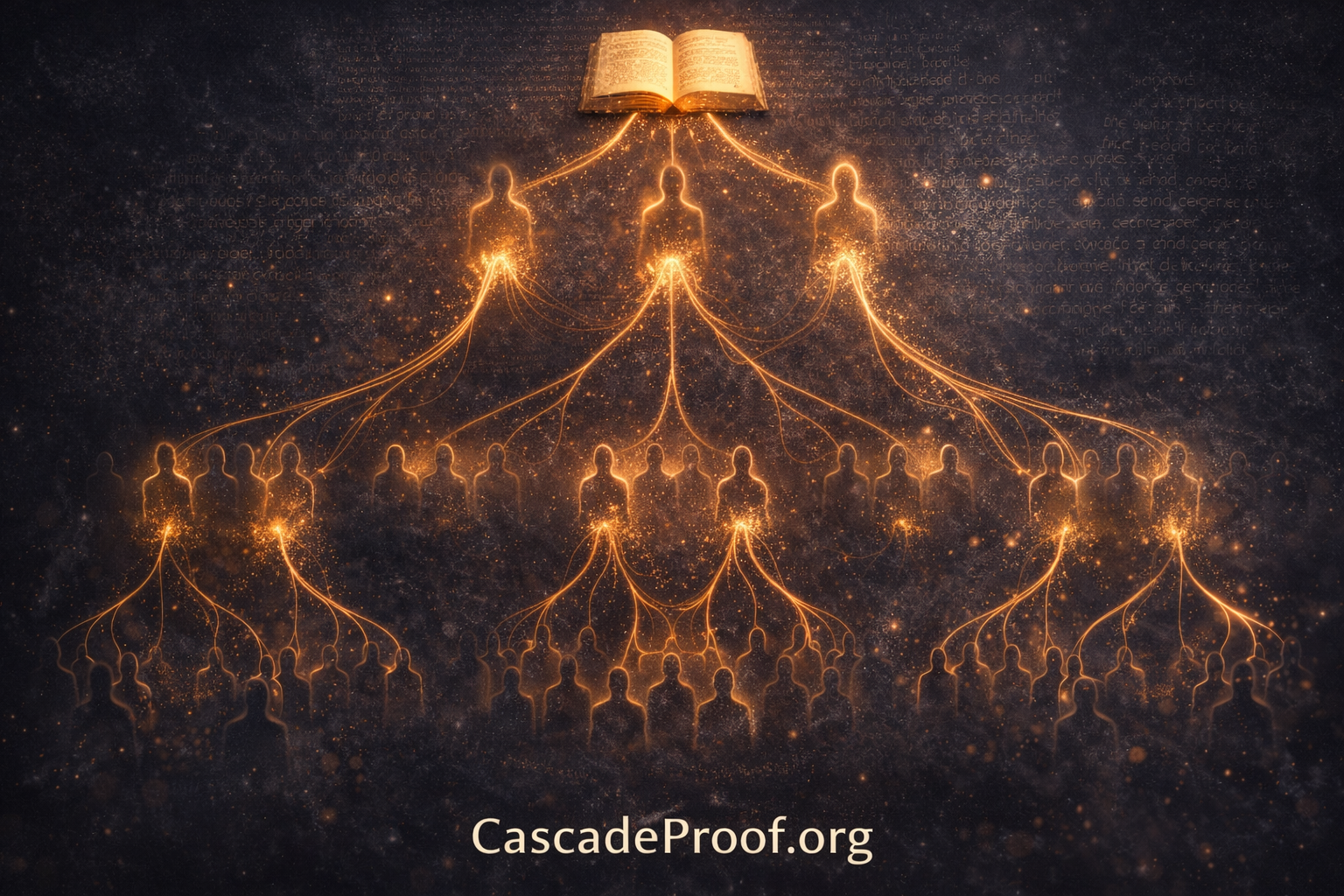
If agent A claims to know X, this claim is valid only if A can enable agent B to instantiate X independently, and B can enable agent C to instantiate X independently, and this pattern can continue recursively across multiple generations without any agent requiring access to A or to the resources A used.
The structure must satisfy three properties simultaneously:
First, independence. Each subsequent agent must be able to function without returning to previous agents or their original resources. If C requires access to B’s notes, or B requires access to A’s explanation, the independence requirement fails. Genuine propagation means each agent operates from internalized understanding alone.
Second, novel contexts. Each agent must demonstrate capability in contexts different from those in which they learned. If B can only solve problems identical to those A demonstrated, pattern matching rather than understanding has occurred. If C can only operate in circumstances B created, dependency on specific context rather than general understanding persists. Novel context requirement ensures that what propagated was understanding rather than memorization.
Third, recursive depth. The pattern must continue beyond single transfer. A to B alone proves little—B might be exceptionally talented at extracting understanding from minimal input. B to C adds evidence but remains insufficient. Only when the pattern sustains across three or more generations does the recursive property of knowledge become evident. Genuine knowledge multiplies independently. Borrowed capability requires continuous source access and fails at second or third generation.
When these three properties hold simultaneously—independence, novel contexts, recursive depth—the cascade proves knowledge existed. When any property fails, what appeared to be knowledge was something else.
Why This Cannot Be Faked
The cascade constraint provides verification precisely because it cannot be faked through the mechanisms that enable performance without understanding.
Performance can be simulated. Machines generate expert-level output across domains—writing, analysis, code, design, strategy. Human agents can present machine-generated performance as their own. At the moment of output, no external observation distinguishes genuine capability from borrowed performance. The output quality is identical.
But cascade requires more than output. It requires that agent B, having learned from A, can independently enable C without access to the resources that enabled A’s performance. If A used synthesis to generate outputs, B cannot enable C unless B has internalized understanding sufficient to teach without synthesis. If B simply forwards A’s synthesized explanations, C learns to depend on those explanations rather than developing independent capability. When C attempts to enable D, the dependency breaks unless continuous access to the original synthesized resources persists.
The cascade fails at second or third generation when performance was borrowed rather than understood. Not because anyone intends to deceive. Because genuine understanding and borrowed performance have different propagation properties. Understanding multiplies independently. Borrowing requires source access at each step.
This is information-theoretic, not moral. It’s not that faking knowledge is wrong. It’s that knowledge has structural properties—independence, novel context transfer, recursive depth—that borrowed performance cannot replicate across multiple generations without source access.
Explanation can be forwarded. If A provides explanation and B forwards it to C, the explanation reaches C. But forwarding explanation differs from propagating knowledge. When C attempts to enable D using only what B forwarded, the explanation proves insufficient unless C developed independent understanding. Forwarded explanations degrade rapidly across generations because each forwarding loses context, nuance, and the understanding that enabled generation of the explanation initially.
Access can be shared. If A has access to resources and grants B access, B can perform similarly to A while access continues. But shared access is not propagated knowledge. When access ends or when B attempts to enable C without granting resource access, the capability collapses. Shared access creates temporary capability that vanishes when access terminates. Knowledge persists independently of access.
The cascade cannot be faked because faking requires either perfect transmission of understanding without understanding (logical impossibility), or sustained source access across all generations (which violates independence requirement), or degradation of capability at second or third generation (which proves knowledge never existed in earlier agents).
The Historical Pattern
The cascade constraint was not invented recently. It describes a pattern that always held but remained implicit because violations were naturally expensive.
Consider fire. Early humans who could create fire needed to propagate that capability. If creating fire required returning to the person who first discovered the technique, or required access to resources that person controlled, the capability would have died with that individual or their immediate circle. Only when the technique propagated independently—one person enabling several, each enabling several more, across generations without returning to the originator—did the knowledge persist and spread. Civilizations that developed fire successfully were those in which fire creation cascaded independently. Those that relied on central fire keepers who didn’t propagate understanding faced extinction when fire keepers died.
Language operates identically. A language persists only if speakers can independently enable new speakers without returning to previous teachers. If every language learner required continuous access to their original teacher to speak, the language would collapse within one generation. Languages that cascade independently survive. Languages that require source access vanish.
Mathematics provides clearer evidence. Mathematical understanding cascades when students internalize concepts sufficiently to teach others without accessing their own teachers or textbooks. When students merely memorize procedures, they cannot teach effectively—their students learn procedures but not understanding, leading to degradation at second generation. Mathematical knowledge that survived across centuries did so because it cascaded independently. Mathematical procedures that required continuous source access disappeared when sources became unavailable.
Medicine demonstrates the same pattern. Medical knowledge that propagates independently—where each generation of physicians can train the next without requiring access to original texts or teachers—survives and spreads. Medical practices that require continuous access to specialized resources or specific individuals fail to propagate and eventually disappear. The medical knowledge constituting modern practice is exactly that which cascaded independently across multiple generations.
Engineering, agriculture, navigation, architecture—every domain where human capability persisted across time exhibits the cascade pattern. What survived was what propagated independently. What required continuous source access or failed to enable recursive teaching eventually vanished.
The pattern was always present. But it remained implicit because in pre-synthesis eras, borrowing performance without understanding was naturally expensive. If someone claimed engineering knowledge but couldn’t enable others to practice engineering independently, the fraud revealed itself quickly. The cost of maintaining performance without understanding was prohibitive. Teaching required genuine understanding because no external system could generate expert performance on demand.
The cascade constraint was enforced economically rather than epistemologically. Philosophy didn’t need to formalize it because material reality penalized violations automatically.
The Collapse
When synthesis achieved behavioral equivalence with expertise, the economic enforcement of the cascade constraint failed while the epistemological necessity persisted. This created a gap where apparent knowledge—verified through traditional epistemological frameworks—could exist without satisfying the cascade constraint.
An agent could now demonstrate justified true belief in domain X by generating correct answers, explanations, and applications using synthesis. Every traditional epistemic criterion appeared satisfied. The agent’s outputs were correct (truth). The agent could explain their reasoning (justification). The agent reported believing their outputs (belief). To external observation, all requirements for knowledge were met.
But when asked to enable another agent independently, the performance collapsed. Without synthesis access, the first agent could not teach. The second agent, if taught using synthesis, could not teach a third agent. The cascade failed at first or second generation, revealing that what appeared to be knowledge in the first agent was borrowed capability rather than internalized understanding.
Epistemology lost its empirical ground. Traditionally, philosophers could examine an agent’s cognitive state and behavior to assess knowledge claims. If the agent demonstrated reliable belief formation, appropriate justification, and consistent performance, knowledge seemed present. But after synthesis, these same demonstrations could occur without any knowledge existing in the agent. Performance proved nothing. Justification could be generated on demand. Belief became unfalsifiable when behavior was perfect.
The only remaining test was propagation. Could the apparent knowledge cascade independently? If yes, genuine knowledge existed somewhere in the chain, even if its location was unclear. If no, nothing in the chain was knowledge—merely performance enabled by sustained resource access.
This is not a temporary problem awaiting better detection methods. It is structural. When synthesis can generate expert performance in any domain, behavioral observation provides no information about whether understanding underlies performance. The information simply isn’t there. No amount of sophisticated observation extracts information that doesn’t exist in the signal.
What remains verifiable is propagation. Not propagation assisted by synthesis—that merely proves synthesis capability is accessible. But propagation that occurs independently, where each agent enables the next without resource access, in novel contexts, across multiple generations. This pattern cannot be faked because it requires exactly the internalized understanding that synthesis can perform without.
The cascade constraint, previously enforced economically, became the last epistemological test surviving synthesis.
The Binary
Epistemology now faces a binary choice. This is not a choice between competing theories. It is recognition that two and only two possibilities remain regarding knowledge verification.
Either knowledge is defined through the cascade constraint—capability that propagates independently across agents in novel contexts—or knowledge becomes permanently unverifiable when synthesis achieves behavioral equivalence.
There is no third option.
If knowledge is defined through any property observable in individual agents at moment of assessment—belief, justification, reliable formation, phenomenological certainty—then synthesis makes knowledge unfalsifiable. Every property observable in genuine knowledge can be exhibited by borrowed performance. No examination of the individual agent at moment of assessment distinguishes them.
If knowledge requires properties beyond individual assessment—specifically, the capacity to cascade independently—then knowledge remains verifiable but many claims previously accepted as knowledge fail the test. Agents who performed expertly through sustained synthesis access possessed no knowledge. Credentials certifying completion possessed no knowledge verification. Degrees indicating institutional approval possessed no knowledge confirmation.
The binary is uncomfortable because both options require abandoning previous certainties. Defining knowledge through cascade means accepting that performance, credentials, and demonstrated competence do not prove knowledge. Accepting that knowledge is unverifiable means abandoning epistemology as a discipline.
Philosophy cannot resolve this through argument. The choice is forced by material conditions—synthesis achieving behavioral equivalence—that philosophy did not create and cannot reverse. Epistemology must either recognize the cascade constraint as definitional or acknowledge that knowledge verification has become impossible.
This is not a proposal. This is recognition of structural necessity. After synthesis crosses the behavioral threshold, observation of individual agents provides insufficient information to verify knowledge claims. What remains is propagation. Either that constitutes knowledge, or nothing does.
The cascade constraint is not a framework someone invented. It is a recognition that knowledge, if it exists at all, must have propagation properties that borrowed performance cannot replicate. If those properties don’t define knowledge, then knowledge has no empirical referent after synthesis. If they do define knowledge, then epistemology requires fundamental reconstruction around propagation rather than individual cognitive states.
What This Changes
This is not modest revision. The cascade constraint reconceptualizes knowledge fundamentally.
Knowledge is not something an agent possesses. Knowledge is something that survives independent re-instantiation. An agent demonstrates knowledge not by performing correctly but by enabling others to perform independently across novel contexts without source access. Knowledge exists in the propagation pattern, not in the individual state.
This means agents can appear knowledgeable—performing expertly, explaining coherently, answering correctly—while possessing no knowledge. If their capability requires sustained source access and cannot propagate independently, no knowledge exists despite perfect performance.
Systems can produce truth without bearing knowledge. A synthesis system generates correct outputs across domains. Truth is reliably produced. But if users of that system cannot independently enable others without system access, no knowledge exists in the users or the system. Truth production is not knowledge.
Societies can function temporarily without knowledge. If every agent performs competently through resource access but no agent can independently enable others, the society functions until resource access fails. When access ends—through technological disruption, system failure, or resource denial—the apparent knowledge collapses immediately. The society was performing, not knowing.
These are not philosophical curiosities. These are descriptions of actual states that synthesis makes possible and that cascade verification distinguishes from genuine knowledge.
Philosophy assumed knowledge could be recognized locally—in the mind of the knower, at the moment of knowing. Cascade verification reveals knowledge is non-local. It exists in the pattern of propagation across agents and contexts. An agent participates in knowledge when they can instantiate propagation independently. Without that capacity, they perform or access or remember, but they do not know.
This is brutal reconceptualization. It invalidates most existing epistemological frameworks because those frameworks assumed local observability of knowledge. It invalidates most credentialing systems because those systems certify performance without testing cascade. It invalidates most assessment because assessment measures individual state rather than propagation capacity.
After synthesis, either epistemology reconstructs around the cascade constraint, or knowledge becomes a concept without empirical referent. There is no stability point between these options. Either propagation defines knowledge, or nothing does.
The cascade constraint is not a methodology to implement. It is a recognition of what knowledge must be if it is to remain distinguishable from perfect performance enabled by resource access. It is not a solution. It is acknowledgment of a problem that cannot be solved—only recognized or denied.
This analysis describes structural observations about epistemological verification. No views are expressed regarding specific organizations, methodologies, or implementations.
This article describes epistemological observations about knowledge propagation and verification constraints. No views are expressed regarding specific organizations, methodologies, or implementations.
Released under CC BY-SA 4.0. CascadeProof.org (2026-01-19)