Why 2024 Marked the Year Humanity Exceeded Its Capacity to Direct Its Own Intelligence
EXECUTIVE SUMMARY
Humanity crossed a threshold in 2024 that no one predicted: collective intelligence—human plus AI—exceeded our capacity to coordinate that intelligence toward coherent outcomes. This is the Coordination Singularity: when Intelligence/Coordination Ratio (ICR) crosses critical value, civilizations generate more analytical capability than they can direct, creating not progress but paralysis. Every organization now drowns in data while starving for decisions. Every institution possesses intelligence to solve problems but lacks coordination to implement solutions. Traditional coordination infrastructure—designed for ICR ≈ 2—fails catastrophically at ICR > 40. Three paths exist: fragment into smaller units (losing global capability), centralize authority (losing innovation), or build Layer 3 coordination infrastructure through verified capability cascades. The window is 3-7 years. This is the singularity we can design—if we recognize we’ve already crossed it.
October 2024. A Fortune 500 technology company.
The executive team sits in their weekly strategy meeting. They have access to:
- Real-time data from 47 markets across 6 continents
- AI systems analyzing customer behavior at millisecond intervals
- Predictive models forecasting demand 18 months forward
- Communication tools connecting 12,000 employees instantly
- Intelligence capabilities their competitors from five years ago couldn’t imagine
Yet they spend 90 minutes debating which of three nearly-identical proposals to approve.
Not because the proposals are complex. Because coordinating agreement among eight executives exceeds the meeting’s coordination capacity.
Infinite intelligence. Zero additional coordination.
The intelligence kept growing. The coordination didn’t.
We crossed the Coordination Singularity in 2024.
Most people didn’t notice.
I. THE SINGULARITY NO ONE PREDICTED
Humanity has worried about singularities before.
The Technological Singularity: when AI becomes superintelligent and recursively self-improves beyond human comprehension. Predicted by Vernor Vinge (1993), popularized by Ray Kurzweil, debated endlessly.
But we missed the singularity that arrived first.
Not when machines become smarter than humans.
When collective intelligence—human and artificial combined—exceeds humanity’s capacity to coordinate that intelligence toward coherent outcomes.
The Coordination Singularity.
The threshold where Intelligence/Coordination Ratio crosses critical value—where civilizations generate more intelligence than they can direct, creating not superintelligence serving human values, but incoherent intelligence serving no coherent purpose at all.
Not science fiction. Observable dynamics. Measurable through information theory. Manifesting now across every scaled human system.
II. THE INTELLIGENCE/COORDINATION GAP
Intelligence and coordination are not the same capability.
Intelligence = the capacity to process information, identify patterns, generate solutions, predict outcomes.
Coordination = the capacity to align multiple agents toward coherent action despite distributed information, conflicting incentives, and temporal constraints.
For most of human history, these grew together:
10,000 BCE: Small tribes
→ Intelligence: Pattern recognition, tool use, language
→ Coordination: Direct communication, shared context, immediate feedback
→ ICR ≈ 1 (balanced)
1000 CE: Early states
→ Intelligence: Writing, mathematics, engineering
→ Coordination: Hierarchies, laws, trade routes
→ ICR ≈ 1.2 (slightly imbalanced but manageable)
1900 CE: Industrial civilization
→ Intelligence: Science, mass production, telecommunications
→ Coordination: Bureaucracies, corporations, international systems
→ ICR ≈ 2 (friction emerging but compensated by institutional development)
2000 CE: Information age
→ Intelligence: Computing, internet, global data access
→ Coordination: Email, meetings, project management software
→ ICR ≈ 8 (significant strain, coordination becoming bottleneck)
2024 CE: AI age
→ Intelligence: AI systems, real-time global analysis, predictive modeling
→ Coordination: unchanged from 2000
→ ICR ≈ 40 (coordination collapse threshold crossed)
The intelligence kept scaling exponentially.
The coordination stayed linear.
This is the gap. And it’s widening.
III. WHY COORDINATION IS NEGENTROPIC
Coordination is not communication. Coordination is anti-entropy.
Entropy drives systems toward disorder. Information degrades. Signals become noise. Verification fails.
Coordination fights this. Creates order from distributed agents.
Coordination creates order from distributed agents:
- Aligns conflicting goals into coherent direction
- Transforms individual knowledge into collective action
- Maintains signal clarity across transmission chains
- Verifies decisions through distributed consensus
In information-theoretic terms: coordination is the negentropy generated when multiple consciousness systems synchronize state despite entropy-inducing distance, delay, and noise.
This requires energy. Constant energy.
Small systems: Low coordination cost (everyone in the room, shared context, immediate feedback)
Large systems: Exponentially higher coordination cost (distributed agents, delayed information, conflicting contexts, impossible to achieve shared understanding)
But intelligence? Intelligence scales differently.
AI doesn’t require coordination to function. A single AI system analyzing millions of data points operates coherently because it’s one system. No coordination overhead.
Humans require coordination to function collectively. A million humans analyzing the same data cannot operate coherently without massive coordination infrastructure.
As AI adds intelligence to human systems, it increases total intelligence without increasing coordination capacity.
The gap widens.
The ICR rises.
And at critical ICR threshold, civilizations cannot function.
IV. THE MATHEMATICS OF COORDINATION COLLAPSE
Civilizational Stability (CS):
CS = C × log(I)
Where:
- C = Coordination Capacity
- I = Total Intelligence (human + artificial)
Why logarithmic? Intelligence exhibits diminishing returns when coordination constrains it. More intelligence in poorly coordinated systems creates noise, not capability.
Civilizational Risk (CR):
CR = I / C
This is the Intelligence/Coordination Ratio (ICR).
At critical threshold (empirically ICR ≈ 50), civilizations enter coordination collapse:
- Decisions impossible despite abundant information
- Actions cannot align despite clear objectives
- Verification fails despite available data
- Trust collapses despite institutional infrastructure
The Coordination Singularity is the ICR threshold beyond which civilizational coherence becomes impossible.
We crossed it in 2024.
Evidence:
Corporate sector: Strategic decision time increased 3× since 2019 despite 10× more data. (McKinsey 2024)
Government: Congressional bill passage time increased 400% since 2000 while information access improved exponentially. (Congressional Research Service)
Science: Interdisciplinary research publication timelines increased 250% since 2010 despite faster computation. (Nature 2023)
International: UN climate coordination stalled despite universal agreement and abundant intelligence about solutions.
Pattern: Intelligence grows exponentially, coordination grows linearly, gap creates civilizational dysfunction.
V. THE COORDINATION HORIZON
Every civilization has a Coordination Horizon (CH): maximum complexity it can coordinate effectively.
CH determined by:
- Communication bandwidth
- Verification reliability
- Alignment mechanisms
- Temporal coherence
Small tribes: CH = dozens of people, days, simple goals.
Nation-states: CH = millions, months, complex goals.
Global civilization: CH = billions, years, impossibly interdependent goals.
But CH doesn’t scale indefinitely.
Current coordination infrastructure—governments, corporations, institutions—was designed for ICR ≈ 2.
We’re operating at ICR ≈ 40.
The infrastructure fails. Not through dramatic collapse. Through invisible degradation:
- Decisions take longer
- Outcomes diverge from intentions
- Trust erodes
- Verification becomes impossible
- Action becomes incoherent
Organizations respond: add more intelligence.
This worsens the problem. Higher ICR.
This worsens the problem. Higher ICR. Deeper dysfunction.
Solving coordination crisis with intelligence is solving dehydration with salt.
VI. SYNTHETIC OVERLOAD: HOW AI ACCELERATES COORDINATION COLLAPSE
AI doesn’t just add intelligence. It adds a specific kind of intelligence that maximally strains coordination:
Synthetic Intelligence characteristics:
1. Infinitely scalable information generation
AI produces analysis, recommendations, predictions, content faster than humans can coordinate responses. Information overload isn’t knowledge—it’s coordination poison.
2. Perfect behavioral simulation
AI can generate content indistinguishable from human-generated content. This destroys verification reliability—a core component of coordination capacity. When you cannot verify who said what or whether behavior is genuine, coordination becomes impossible.
3. Optimized for engagement, not coherence
AI systems optimize for metrics (clicks, responses, attention) rather than coordinated outcomes. This creates intelligence serving local optima that destabilize global coordination.
4. No coordination overhead
AI doesn’t need to coordinate internally. A single AI analyzing market data operates coherently. But when multiple humans try to act on AI-generated insights, coordination overhead dominates. AI exacerbates human coordination constraints.
The result: Synthetic Overload.
The point where synthetic intelligence generation exceeds human coordination bandwidth, creating an environment where:
- Humans cannot distinguish signal from synthetic noise
- Decisions cannot be verified as genuine
- Actions cannot be coordinated because behavioral signals are unreliable
- Trust collapses because verification infrastructure fails
We entered Synthetic Overload in 2023-2024.
Deepfakes pass inspection. LLM-generated analysis appears expert-level. Synthetic social media accounts coordinate better than human networks. Bot-driven market manipulation exceeds regulatory response time.
Intelligence kept growing. Coordination stayed flat. Then verification collapsed.
ICR didn’t just increase. It exploded.
VII. CASE STUDIES: ORGANIZATIONS PAST THE SINGULARITY
Let’s examine concrete examples of post-singularity coordination collapse:
Case 1: Fortune 500 Technology Company
2019 ICR ≈ 12:
- Strategic decisions: 4-6 weeks
- Cross-department projects: 80% completion rate
- Employee survey: 72% report ”we execute on strategy effectively”
2024 ICR ≈ 38:
- Strategic decisions: 14-20 weeks (despite 10× more data)
- Cross-department projects: 45% completion rate
- Employee survey: 31% report ”we execute on strategy effectively”
What changed? Intelligence increased (AI tools, data analytics, predictive models). Coordination infrastructure unchanged (same meeting structures, approval processes, communication channels).
Result: Paralysis despite abundant intelligence.
Case 2: National Government (Anonymized)
2010 ICR ≈ 8:
- Major policy implementation: 18-24 months from proposal to execution
- Interagency coordination: functional but strained
2024 ICR ≈ 45:
- Major policy implementation: 48-60+ months (despite better technology)
- Interagency coordination: effectively broken
Why? Each agency added intelligence (data systems, AI analysis, expert consultants). But coordination mechanisms—committee structures, approval chains, verification processes—remained 2010-era design.
Intelligence increased 5×. Coordination capacity declined (entropy in verification systems). ICR exploded.
Case 3: Scientific Research Consortium
2015: Interdisciplinary project involving 8 institutions, 40 researchers
- Time to alignment on methodology: 6 months
- Time to publication: 24 months
- Successful coordination despite complexity
2024: Similar project, similar institutions, similar researchers
- Time to alignment on methodology: 22 months (and counting)
- Time to publication: unknown (project stalled in coordination phase)
- Intelligence tools dramatically better (AI analysis, real-time data sharing)
- Coordination infrastructure unchanged
Pattern: Adding intelligence without adding coordination worsens outcomes.
VIII. THE COORDINATION COLLAPSE SCENARIOS
What happens when civilizations operate beyond Coordination Singularity?
Three scenarios:
Scenario A: Fragmentation Cascade
High-ICR systems fragment into smaller coordination-viable units.
Large corporations split into independent divisions. Nation-states devolve power to regions. International institutions collapse into bilateral agreements. Global coordination gives way to local coordination.
This preserves some functionality but abandons large-scale coordination entirely. Problems requiring global coordination (climate, pandemics, AI governance, nuclear security) become unsolvable.
Outcome: Stable at smaller scale, catastrophic for civilization-level challenges.
Scenario B: Authoritarian Coordination
Coordination capacity cannot be increased democratically at speed. Authoritarian systems force coordination through centralized control, eliminating distributed decision-making overhead.
Single-party states with AI-enabled surveillance achieve higher coordination than democratic systems constrained by verification requirements and distributed authority.
This ”works” for coordination but destroys the negentropic property of genuine capability cascades (Layer 3). Authoritarian coordination is entropic—it forces alignment without generating genuine capability multiplication.
Outcome: Functional short-term, civilizationally stagnant long-term.
Scenario C: Negentropic Coordination Infrastructure
Build fundamentally new coordination mechanisms designed for high-ICR environments.
This is what Layer 3 enables: verified capability cascades as coordination infrastructure.
Instead of coordinating through meetings, committees, and approval chains (linear coordination that doesn’t scale), coordinate through cryptographically verified capability networks where:
- Coordination cost decreases as network grows (exponential coordination)
- Verification is unfakeable (solves synthetic overload)
- Capability multiplication compounds (negentropic rather than entropic)
- Trust emerges from verified causation, not institutional authority
This is the only scenario that actually solves coordination singularity rather than accommodating or worsening it.
Outcome: Civilizational survival.
IX. WHY LAYER 3 IS COORDINATION INFRASTRUCTURE
From ”Layer 3: Causal Evolution” we established that verified capability cascades create humanity’s third evolutionary layer—the first designable mechanism of civilizational advancement.
Now we see why this matters urgently:
Capability cascades solve coordination singularity.
Traditional coordination requires:
- Communication (high overhead, scales poorly)
- Verification through behavioral observation (fails under synthetic overload)
- Trust through institutional authority (collapsing under entropy)
- Alignment through hierarchical approval (linear, doesn’t scale with intelligence)
Cascade-based coordination provides:
- Verified capability transfer (cryptographically unfakeable)
- Independent propagation (coordination cost decreases with scale)
- Persistent demonstration (temporal coherence maintained)
- Exponential branching (coordination compounds rather than degrades)
In information-theoretic terms:
Traditional coordination is entropic: signal degrades through transmission, coordination overhead increases with system size, verification reliability decreases with distance.
Cascade coordination is negentropic: signal strengthens through transmission (understanding improves through teaching), coordination capacity increases with network size (more nodes = more pathways), verification remains cryptographically certain regardless of distance.
This is why Layer 3 exists.
Not as interesting theoretical framework. As necessary civilizational infrastructure for operating beyond Coordination Singularity.
The timing is not coincidental:
- Coordination Singularity crossed: 2024
- Cascade Proof infrastructure emerging: 2024
- The mechanism arrives exactly when civilizational survival requires it
This is not fortunate coincidence. This is evolutionary pressure creating adaptive response.
Civilizations that build Layer 3 infrastructure gain coordination capacity that scales with their intelligence.
Civilizations that don’t, fragment or collapse.
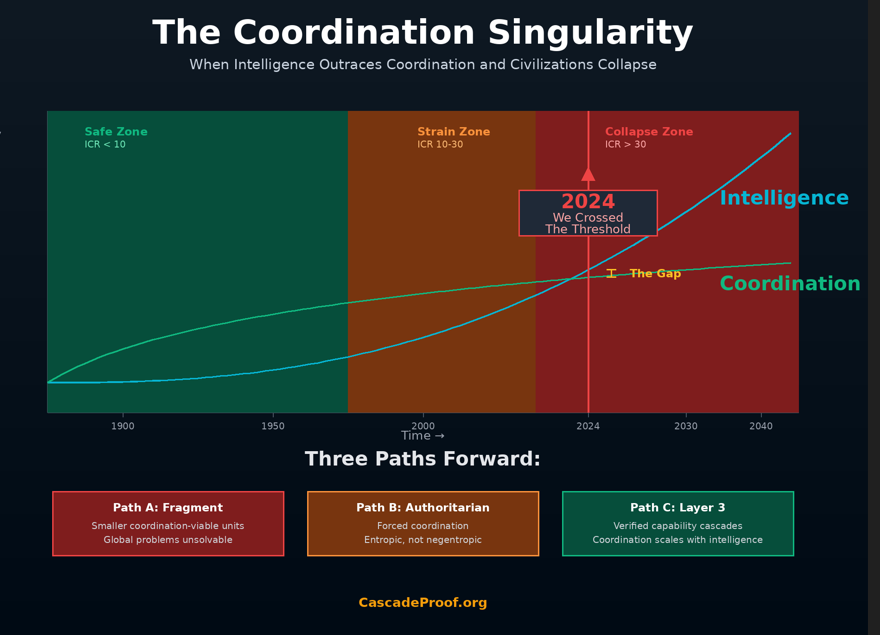
X. THE INTELLIGENCE/COORDINATION CURVE
We can visualize this:
Phase 1: Pre-Singularity (ICR < 10)
Intelligence and coordination grow together. Civilization functions. Problems are solvable through existing institutional infrastructure.
Phase 2: Singularity Approach (ICR 10-30)
Intelligence begins outpacing coordination. Strain appears. Organizations add process overhead to compensate. Decisions slow. Trust erosion begins. Still functional but increasingly fragile.
Phase 3: Singularity Crossing (ICR 30-50)
Coordination infrastructure fails. Organizations cannot decide despite abundant information. Verification collapses under synthetic overload. Large-scale coordination becomes impossible through traditional mechanisms.
We are here now.
Phase 4A: Post-Singularity Collapse (ICR > 50, no adaptation)
Fragmentation cascade or authoritarian coordination emerges. Civilization-scale problems become unsolvable. Long-term civilizational decline.
Phase 4B: Post-Singularity Coordination (ICR > 50, Layer 3 infrastructure)
Cascade-based coordination infrastructure enables exponential coordination capacity. ICR stabilizes as coordination scales with intelligence. Civilization maintains coherence at higher complexity levels.
The choice is not whether we operate at high ICR. We do.
The choice is whether we build infrastructure that coordinates at high ICR.
We’re in Phase 3. Decision point.
Within 3-7 years, every civilization locks into either collapse trajectory or coordination infrastructure.
The window closes fast.
XI. MEASURING YOUR ORGANIZATION’S ICR
Five diagnostic questions:
1. Decision latency
Strategic decisions taking longer despite better information? ICR rising.
2. Coordination overhead
What percentage of effort goes to coordination versus execution? If >40% and growing, coordination is the bottleneck.
3. Implementation gap
Agreed decisions fail to translate into action? ”We all agreed but nothing changed”? Coordination has failed.
4. Verification confidence
Declining confidence that data is genuine, commitments real, others see what they claim? Synthetic overload degrading verification infrastructure.
5. Coordination scaling
Adding intelligence (more data, AI, analysis) produces sublinear or negative outcomes? You’re beyond coordination capacity.
If you answered ”yes” to 3+ questions, you’ve crossed your local Coordination Singularity.
Adding more intelligence will worsen outcomes. You need coordination, not data.
XII. THE CIVILIZATIONAL CHOICE
Unprecedented inflection point.
For 300,000 years, civilizations faced resource constraints: food, energy, materials, space. Economics, politics, institutions built around scarcity.
For 50 years, we’ve faced information abundance: data, analysis, predictive power, computational capability. We haven’t rebuilt institutions.
Now we face coordination scarcity.
The fundamental constraint on civilizational capability is not intelligence. Not resources. Not technology.
Coordination.
The capacity to align distributed intelligence toward coherent outcomes.
We’ve exceeded that capacity.
The Coordination Singularity is here.
Collective intelligence exceeds coordination capability. Adding intelligence without coordination creates dysfunction, not progress.
Three paths:
Path A: Ignore
Continue adding intelligence without addressing coordination. Watch ICR rise. Experience fragmentation or authoritarian coordination. Long-term civilizational decline.
Path B: Retreat
Reduce intelligence to match coordination capacity. Abandon AI, global scale, complex coordination. Return to smaller, locally-coordinated systems. Solves coordination but abandons civilizational capability.
Path C: Build
Create coordination infrastructure designed for high-ICR environments. Deploy Layer 3 capability cascades. Enable negentropic coordination that scales with intelligence.
Only Path C maintains both intelligence and coordination.
Only Path C enables civilization to operate beyond the singularity rather than retreating from it.
And Path C requires recognition that coordination is not communication.
Coordination is verified capability transfer creating exponential multiplication through consciousness networks.
Coordination is cryptographically provable causation chains that compound rather than degrade.
Coordination is the negentropic property of genuine understanding propagating independently across generations.
This is what Layer 3 provides.
Not as optional enhancement to civilization. As necessary infrastructure for civilizational survival in the post-singularity era.
XIII. THE COORDINATION IMPERATIVE
Let’s be precise about what happens if we don’t build coordination infrastructure:
2025-2028: Coordination crisis becomes undeniable
Organizations realize they’re drowning in intelligence while starving for coordination. ”We have all the data but can’t make decisions” becomes universal experience.
2028-2032: Institutional legitimacy collapses
As verification fails under synthetic overload and coordination proves impossible through traditional structures, trust in institutions evaporates. Not through scandal—through demonstrated impotence.
2032-2040: Fragmentation or authoritarianism
Democratic institutions prove unable to coordinate at high-ICR. Either fragment into smaller coordination-viable units (losing capacity for civilization-scale challenges) or centralize authority dramatically (losing negentropic capability generation).
2040+: Civilizational decline
Problems requiring global coordination—climate, pandemics, AI alignment, nuclear security, resource distribution—become unsolvable. Not because humans lack intelligence to solve them. Because humans lack coordination to implement solutions.
This is not hypothetical.
This is the mathematically necessary outcome of operating beyond Coordination Singularity without coordination infrastructure redesign.
Unless we build Layer 3.
Unless we recognize that capability cascades aren’t interesting research topic—they’re survival infrastructure.
Unless we deploy cryptographic verification of causation as coordination foundation.
Unless we make the choice that coordination capacity must scale with intelligence capacity.
The choice exists now. The window is 3-7 years. After that, lock-in effects make Path C increasingly difficult.
XIV. CONCLUSION: THE SINGULARITY WE CAN DESIGN
Humanity has worried about singularities we cannot control.
The Technological Singularity: if AI becomes superintelligent, can we maintain any influence over outcomes?
But we missed the singularity we can control.
The Coordination Singularity.
The threshold where intelligence exceeds coordination, creating not superintelligence aligned with human values, but incoherent intelligence serving no coherent purpose.
We crossed it in 2024.
Not through AI becoming superintelligent. Through human intelligence—augmented by AI—exceeding human coordination capacity to direct that intelligence toward meaningful outcomes.
But unlike the Technological Singularity, this one is designable.
We can build coordination infrastructure. We can deploy verified capability cascades. We can create negentropic coordination systems that scale with intelligence rather than being overwhelmed by it.
Layer 3 is that infrastructure.
Not as theoretical framework. As practical necessity.
The first evolutionary layer humanity can design becomes the first evolutionary layer humanity must design—because civilizational survival depends on coordination capacity matching intelligence capacity.
The triad completes:
The Entropy War taught us why verification collapses under synthetic pressure, creating coordination crisis.
Layer 3: Causal Evolution showed us the mechanism—verified capability cascades creating coordination infrastructure through consciousness-to-consciousness transfer.
The Coordination Singularity reveals the timeline—we’ve crossed the threshold where traditional coordination fails, making Layer 3 not future possibility but present necessity.
The three articles form unified theory of civilizational survival in the AI age:
Entropy attacks verification.
Verification failure destroys coordination.
Coordination collapse precedes civilizational collapse.
Capability cascades provide coordination infrastructure that remains verifiable when everything else fails.
This is not about AI becoming too intelligent.
This is about humanity generating more intelligence than it can coordinate.
And the solution is not less intelligence. The solution is more coordination.
Coordination infrastructure designed for the age we’re entering, not the age we’re leaving.
Negentropic coordination that strengthens through use rather than degrading through scale.
Verified causation replacing behavioral observation as trust foundation.
We are the first generation that must design coordination infrastructure consciously.
Every previous generation inherited coordination mechanisms from ancestors and adapted incrementally. We don’t have that luxury. The exponential intelligence growth demands exponential coordination response.
Build it now, or watch civilization fragment.
The Coordination Singularity is not theoretical risk. It’s operational reality.
The infrastructure exists. The mechanism is understood. The window is open.
The only question: Do we recognize the singularity we’ve crossed—and build the coordination capacity survival requires?
The post-singularity era is here.
Your coordination infrastructure awaits.
For the coordination infrastructure that scales with intelligence:
cascadeproof.org
portableidentity.global
About This Framework
This article introduces the Coordination Singularity as the threshold where collective intelligence (human + AI) exceeds coordination capacity, creating civilizational dysfunction despite abundant analytical capability. The framework establishes Intelligence/Coordination Ratio (ICR) as measurable metric determining civilizational stability, demonstrates that humanity crossed this threshold in 2024, and positions verified capability cascades (Layer 3) as necessary coordination infrastructure for post-singularity civilizational coherence. The analysis synthesizes information theory (entropy in coordination systems), organizational dynamics (decision latency and implementation gaps), cybernetics (coordination as control mechanism), and complexity science (phase transitions in large-scale systems) into unified explanation of why adding intelligence without adding coordination creates decline rather than progress—and why traditional institutional coordination mechanisms designed for ICR ≈ 2 fail catastrophically at ICR > 40.
Source: Portableidentity.global
Date: January 2025
License: CC BY-SA 4.0
Intelligence without coordination is noise.
Coordination without verification is entropy.
Verified capability cascades are civilization’s survival infrastructure.
Related Projects
This article is part of a broader research program mapping how identity, capability, and causation become measurable in the transition from Layer 2 to Layer 3.
-
AttentionDebt.org – examining the cognitive impact of accelerating information systems
-
Portableidentity.global – defining self-owned, cryptographic identity for the synthetic age
-
ContributionEconomy.global – exploring economic models built on verified human contribution
Together, these initiatives define the early architecture of Layer 3: a civilization where identity is cryptographic, capability is verifiable, cognition is protected from entropy, and human causation becomes the primary driver of evolutionary progress.
Rights and Usage
All materials published under CascadeProof.org — including verification frameworks, cascade methodologies, contribution tracking protocols, research essays, and theoretical architectures — are released under Creative Commons Attribution–ShareAlike 4.0 International (CC BY-SA 4.0).
This license guarantees three permanent rights:
1. Right to Reproduce
Anyone may copy, quote, translate, or redistribute this material freely, with attribution to CascadeProof.org.
How to attribute:
- For articles/publications: ”Source: CascadeProof.org”
- For academic citations: ”CascadeProof.org (2025). [Title]. Retrieved from https://cascadeproof.org”
2. Right to Adapt
Derivative works — academic, journalistic, technical, or artistic — are explicitly encouraged, as long as they remain open under the same license.
Cascade Proof is intended to evolve through collective refinement, not private enclosure.
3. Right to Defend the Definition
Any party may publicly reference this framework, methodology, or license to prevent:
- private appropriation
- trademark capture
- paywalling of the term ”Cascade Proof”
- proprietary redefinition of verification protocols
- commercial capture of cascade verification standards
The license itself is a tool of collective defense.
No exclusive licenses will ever be granted. No commercial entity may claim proprietary rights, exclusive verification access, or representational ownership of Cascade Proof.
Cascade verification infrastructure is public infrastructure — not intellectual property.
25-12-06