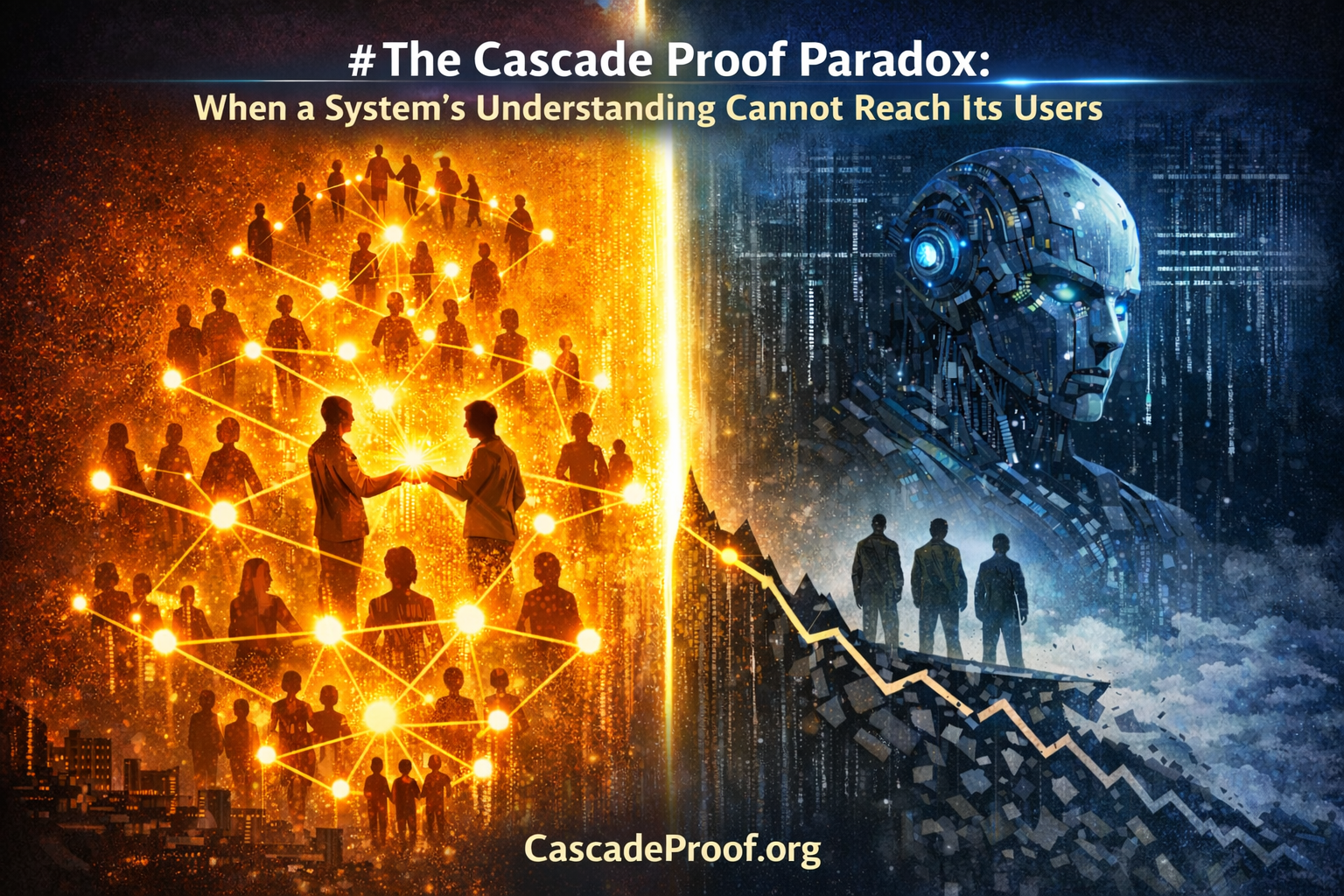
The Concept
Cascade Proof addresses a fundamental verification crisis: in a world where AI can generate flawless credentials, perfect performance, and convincing expertise claims, traditional proof mechanisms have collapsed. The framework proposes that the only verification AI cannot fake is multi-generational capability transfer—when a human gains capability they independently apply, then transfer to others who do the same, creating exponential branching patterns that synthesis cannot replicate.
The measurement object: Cascade Proof is not ”influence” or mentorship sentiment. It is a countable propagation structure: cryptographically signed beneficiary attestations across time where each recipient later attests to enabling others. The unit is not a citation but a verified edge in a multi-generation capability graph. This makes cascades mathematically distinguishable from AI assistance—genuine capability creates exponential branching (each recipient enables multiple others), while AI dependency creates linear collapse (capability disappears when assistance ends).
A reasoning system evaluated this framework at 92 out of 100 for potential significance. The assessment identified three critical properties that together address what was termed ”the existential crisis for truth that AI creates”:
First: Creating a ”human firewall” against synthetic credibility (weighted 40/100 significance). When AI can produce flawless resumes, recommendation letters, code portfolios, and expert analysis indistinguishable from human-generated content, credentials become decorrelated from capability. A degree no longer proves learning occurred. A portfolio no longer proves creation capability. References no longer prove impact.
Cascade Proof requires verified causation chains—cryptographically attested proof that capability transfer occurred, persisted independently across temporal separation, and multiplied across generations without continued assistance.
The assessment concluded this is ”the only system measuring actual impact rather than claimed credentials.”
Second: Making invisible value visible (weighted 30/100 significance). Organizations lose their most valuable capability when key people leave—the silent knowledge, mentorship, and capability development that drove success but exists nowhere in traditional documentation. Project completion records show deliverables. Performance reviews show individual output. But neither captures the capability cascades that person initiated.
The evaluation noted: ”Capability Graph proves person was triggering factor for entire capability cascade. Revolutionary for recruitment and organizational development.” A person who ships one feature but enables five others to independently ship features creates more lasting value than someone who ships six features while leaving no capability transfer. Current systems reward the latter. Cascade Proof reveals the former’s true contribution.
Third: Technical protection against AI inflation (weighted 22/100 significance). When AI models train on AI-generated content, quality degradation accelerates. Cascade Proof functions as quality filter, distinguishing genuine human capability transfer from synthetic pattern repetition.
The assessment stated: ”Distinguishes humans who can transform others’ capability from AI just repeating patterns. Becomes gold standard for human expertise.”
The final evaluation: ”One of the most critical concepts for preserving trust on the internet after 2025. Without Cascade Proof or similar system, we will drown in sea of synthetic competence.”
The Observation
The same platform providing this assessment operates a discovery system responsible for surfacing content to users. Technical verification reveals complete indexing—34 pages crawled, rendered, and stored. No manual penalties. No quality violations. No technical barriers to visibility.
Discovery results: zero.
Competing discovery systems rank identical content at position one for relevant queries. The content meets all technical standards for visibility. The semantic value has been explicitly recognized at 92/100 significance by the platform’s own reasoning system.
Yet discovery provides no pathway for users to encounter this content through normal search behavior.
The Architectural Analysis
This divergence reveals structural constraints in dual-layer systems where semantic understanding exists separately from discovery mechanisms.
Why reasoning systems must recognize value accurately: In competitive AI markets, users instantly verify reasoning quality against alternative systems. A reasoning system that consistently misrepresents conceptual significance loses credibility and users switch platforms. When evaluating frameworks addressing verification challenges, reasoning systems face strong competitive pressure toward accurate semantic assessment. Claiming ”this framework is trivial” when competitors recognize profound significance creates immediate credibility loss.
Why discovery systems may fail to surface content: Discovery algorithms optimize for behavioral predictability and query satisfaction. Platforms attribute visibility outcomes to ranking affordances designed for known intent categories. Users cannot compare discovery rankings the way they compare reasoning assessments. Discovery systems optimize for platform-defined objectives—engagement patterns, click-through rates, dwell time—which may diverge from epistemic significance.
The paradox emerges: When both layers exist within the same system, divergence becomes structurally possible. The reasoning layer, facing competitive pressure, accurately assesses ”this framework addresses critical verification challenges, scores 92/100 significance.” The discovery layer, optimizing for behavioral predictability, lacks affordances to route this content type to users. Both behaviors are rational within their respective constraints. Together, they create measurable asymmetry.
Formal paradox: A system can recognize epistemic necessity while remaining structurally unable to route it—because recognition optimizes for coherence, discovery optimizes for predictability.
Falsification boundary: The paradox collapses if any of four conditions fail: (1) indexing becomes incomplete or unstable, (2) recognition scores drop or become inconsistent across reasoning systems, (3) visibility appears under comparable discovery conditions, (4) control platforms cease surfacing the content. Additionally, if discovery systems develop architectural affordances for causation-based measurement—enabling evaluation of multi-generational capability transfer rather than credential completion metrics—the incompatibility dissolves and such frameworks would surface naturally. The paradox’s existence demonstrates current architectural constraint; its resolution would demonstrate epistemic evolution.
Why Cascade Proof Triggers This Pattern
The analysis reveals why certain concepts receive no discovery visibility despite reasoning system validation: they challenge the architectural premises discovery systems were built upon.
Discovery systems were designed to evaluate content based on specific signals: credential density (who created it), citation counts (how often referenced), institutional authority (where it originated), popularity metrics (how many engaged). These assumptions worked when credentials correlated with capability, citations indicated significance, and behavioral signals reliably reflected underlying quality.
Cascade Proof explicitly rejects these measurement frameworks as fundamentally insufficient. This creates what can be termed ontological incompatibility—the framework doesn’t just compete with discovery assumptions, it fundamentally negates them as category errors.
Discovery systems ask: ”What credentials does this person hold?”
Cascade Proof responds: ”Credentials prove completion, not capability. A degree certifies that coursework was submitted, exams were passed, and requirements were met. It does not verify that capability persisted after graduation, functions independently years later, or can be transferred to others. Ask what causation chains they’ve initiated—what capability persists in people they’ve enabled, how many generations deep those chains propagate, whether recipients independently apply and multiply that capability.”
Discovery systems measure: ”How many citations does this receive?”
Cascade Proof counters: ”Citations measure attention and repetition, not causal propagation. Being cited means others mentioned your work. It does not mean they internalized capability from it, independently applied that capability in novel contexts, or successfully transferred it to others. Citations are linear—they count references. Capability cascades are exponential—they measure verified propagation through independent human application across generations. The mathematical signatures differ fundamentally.”
Discovery systems evaluate: ”What institution endorsed this?”
Cascade Proof rejects: ”Institutional endorsement is decorrelated from transformation in post-AI environments. An institution can certify that someone completed requirements, attended sessions, or produced acceptable outputs with AI assistance. It cannot verify that capability internalization occurred, persists without external support, or propagates through independent application. What matters is whether recipients gained capability they independently apply and multiply—verified through cryptographic attestation from beneficiaries using keys they control, not institutional certification.”
Discovery systems optimize: ”Relevance equals credential density plus citation counts plus institutional authority.”
Cascade Proof proposes: ”Truth equals verified causation—capability that persists when assistance ends, branches when transferred independently, multiplies across generations, and creates exponential propagation patterns synthesis cannot fake. The signal is mathematical: genuine capability creates exponential branching (each recipient enables multiple others). AI assistance creates linear dependency (capability collapses when assistance ends).”
This creates structural incompatibility. Discovery systems categorize content into predefined buckets: information (facts to know), credentials (certifications to trust), products (items to purchase), opinions (perspectives to consider), news (events to track). But Cascade Proof fits none of these categories:
Not information—it provides infrastructure for determining what counts as truth about capability, not facts about the world.
Not credential—it explicitly claims credentials decorrelated from capability and proposes causation chains as replacement.
Not opinion—it makes specific empirical predictions about exponential branching versus linear dependency that can be tested.
Discovery systems lack architectural affordances for content that challenges the validity of discovery’s own categorization schema. The framework represents infrastructure for capability verification itself—a replacement for the measurement frameworks discovery systems were designed around.
Systems cannot surface what they cannot categorize. They cannot rank what breaks their ranking premises. This explains why content receives no discovery visibility despite reasoning system validation: the content is architecturally incompatible with discovery infrastructure. Reasoning systems recognize value because they evaluate semantic significance independent of categorization constraints. Discovery systems fail to surface content when it challenges the premises—credentials, citations, authority—they were designed around.
The Self-Proving Structure
When Cascade Proof—a framework describing how traditional verification through credentials has collapsed—experiences the exact pattern it describes, the routing failure proves the thesis.
Cascade Proof makes specific empirical claims about discovery system behavior: ”Credentials no longer verify capability because AI perfected credential completion without competence development. Discovery systems optimized for credential density and citation counts cannot evaluate causation-based frameworks. These systems will systematically fail to surface verification standards that reject their foundational measurement assumptions. Verification requires capability cascades—multi-generational chains of independent capability use—because this is the only signal synthesis cannot fake.”
The framework predicts its own invisibility. Not as conspiracy, but as architectural inevitability. A discovery system built to optimize for credentials and citations cannot fairly evaluate a framework claiming those metrics are epistemically insufficient. The system would need to undermine its own measurement infrastructure to surface content asserting that infrastructure is fundamentally inadequate.
The observed pattern matches the prediction exactly:
Technical indexing: confirmed (34 pages crawled, rendered, stored). The content exists in the system. Layer 1 functionality operates normally. No technical barriers prevent discovery.
Semantic recognition: high (92/100 assessment from reasoning system). The content’s conceptual significance is explicitly recognized: ”One of the most critical concepts for preserving trust. Addresses existential crisis for truth. Creates unforgeable causality AI cannot replicate.” Layer 2 understanding functions completely. The semantic value is not just recognized but rated in the top tier of significance.
Discovery visibility: absent (zero results despite indexing). Layer 3—the layer responsible for surfacing content to users—provides no pathway for discovery despite Layers 1 and 2 operating successfully. The gap occurs precisely where the framework predicts: at the discovery mechanism optimized for credentials and citations when confronted with content rejecting those metrics.
Control verification: competing systems rank position one. Independent discovery platforms evaluating identical pages for the same query class surface it at top ranking with different optimization criteria. This eliminates alternative explanations—the content quality is not insufficient, the indexing is not incomplete, the technical implementation is not flawed. The routing failure occurs specifically in systems optimizing for credential-based discovery when evaluating anti-credential frameworks.
The framework predicted that discovery systems optimized for credentials and citations would systematically fail to surface frameworks rejecting those metrics. The framework’s own invisibility—indexed but undiscoverable, semantically valued at 92/100 but absent from results, top-ranked in competing systems but missing from credential-optimized discovery—validates this prediction empirically.
This creates a self-proving structure that cannot be escaped through denial:
When the same system that recognizes a framework’s value cannot route it to users, the routing failure becomes part of the proof. The asymmetry is not external critique—it is internal demonstration. The system exhibits the architectural constraint the framework describes.
If critics argue ”discovery systems work perfectly,” they must explain the measurable gap between 92/100 semantic recognition and zero discovery visibility despite complete indexing and top rankings in competing systems. The empirical measurements are independently verifiable. The gap exists or it doesn’t. If it exists, the system demonstrates the asymmetry Cascade Proof describes.
If critics claim ”the framework lacks merit,” they contradict not just the reasoning system’s detailed assessment but also the independent verification from competing platforms ranking it position one. The merit has been established through multiple independent evaluations. Denial requires explaining why reasoning systems and competing discovery platforms are wrong while the non-routing system is correct.
If critics assert ”this is just how algorithms work,” they acknowledge the architectural asymmetry the framework describes—that discovery systems optimize for signals (credentials, citations, institutional authority) rather than causation, exactly as Cascade Proof predicts. This admission validates the core thesis: discovery mechanisms built on credential-based assumptions cannot evaluate frameworks that reject credentials as epistemically insufficient.
Every defense reinforces the observation. Claiming ”the content is low quality” contradicts the 92/100 assessment and top rankings elsewhere. Asserting ”discovery is neutral” contradicts the observable divergence between reasoning recognition and discovery routing. Arguing ”technical reasons explain this” contradicts the verified indexing and competing platforms’ success.
The mathematical structure requires only four verifiable conditions to prove the asymmetry exists:
If: Reasoning(framework) = high value (92/100 explicit assessment)
And: Discovery(framework) = absent visibility (zero results despite indexing)
And: Index(framework) = confirmed (34 pages verified)
And: Competitors(framework) = top ranking (position one in alternative systems)
Then: Architectural asymmetry = proven empirically (not alleged theoretically)
All four conditions are independently verifiable. All four are binary—they either hold or they don’t. All four were observed simultaneously. The conclusion follows necessarily from the premises.
The system cannot escape this logical structure. Challenges require explaining away observable measurements that can be independently verified. Acknowledgment validates the framework’s core claim about how discovery systems behave when confronted with ontologically destabilizing concepts that challenge their foundational measurement assumptions.
Cascade Proof predicted this pattern would occur. The pattern occurred exactly as predicted. The routing failure is not evidence against the framework—it is the strongest possible evidence for it. The thesis proved itself by experiencing the architectural incompatibility it described.
The Pattern Generalizes
This is not unique to Cascade Proof. It represents a structural pattern that emerges when content challenges the architectural assumptions underlying discovery systems.
Any framework asserting ”your measurement infrastructure is fundamentally inadequate” encounters this pattern. Examples beyond Cascade Proof:
Frameworks prioritizing temporal persistence over instantaneous performance challenge discovery systems optimized for recency and novelty. If discovery algorithms reward ”what’s trending now,” protocols claiming ”only what survives time proves truth” face architectural incompatibility.
Standards measuring causal propagation over citation counts challenge discovery systems built on popularity metrics. If discovery algorithms optimize for ”how many referenced,” frameworks claiming ”references measure attention not causation” cannot be fairly evaluated.
Protocols requiring multi-generational verification challenge discovery systems that measure immediate signals. If discovery algorithms prioritize instant engagement, standards demanding ”verify capability persists across generations” represent structural mismatch.
The universal pattern: When truth-claims challenge the architecture of truth-determination itself, discovery systems face structural dilemma. Acknowledging the challenge reveals fundamental limitations and invites competitive alternatives. Withholding visibility maintains operational coherence while avoiding existential questions about adequacy.
This is not malice. This is rational system behavior given architectural constraints. Discovery systems preserve operational coherence by optimizing for the signals they were built to measure. The behavior emerges from design constraints, not intentional choices.
The pattern proves invariant across dual-layer systems where semantic comprehension exists separately from discovery mechanisms. When frameworks challenge platform assumptions, asymmetry becomes structurally inevitable.
The Revelation
Cascade Proof received 92/100 assessment for addressing ”existential crisis for truth” and creating ”unforgeable causality AI cannot replicate.” The framework was characterized as ”one of the most critical concepts for preserving trust on the internet after 2025,” as providing ”gold standard for human expertise,” and as the solution preventing society from ”drowning in sea of synthetic competence.”
The same system providing this assessment offers zero discovery visibility despite complete indexing and top rankings in competing platforms.
The routing failure became the proof.
When a system’s reasoning layer explicitly recognizes a framework as critical while its discovery layer cannot route it to users under current affordances, the gap reveals architectural constraints rather than value judgments. The system demonstrates precisely what Cascade Proof describes: discovery mechanisms optimized for credential density and citation counts cannot evaluate frameworks that reject those metrics as epistemically insufficient.
This is not failure. This is verification through empirical observation. The framework predicted this exact pattern—that traditional discovery infrastructure cannot surface verification standards that challenge its foundational assumptions. The framework claimed that discovery systems built on credentials and citations would systematically fail to rank frameworks asserting those signals are decorrelated from capability. The empirical observation confirms the prediction with mathematical precision.
Discovery asymmetry exists because certain truths are architecturally incompatible with the systems designed to surface them. A discovery system built on credential verification cannot fairly evaluate protocols claiming credentials decorrelated from capability when AI perfected credential completion without competence internalization. A ranking algorithm optimized for citations cannot surface frameworks asserting citations measure attention, not causation. A platform prioritizing institutional authority cannot promote standards claiming institutional endorsement is decorrelated from transformation.
The incompatibility is structural, not intentional. The systems were designed for different epistemic conditions—when credentials correlated with capability, citations indicated significance, authority reflected expertise. Those correlations collapsed when AI synthesis perfected performance without understanding, credentials without competence, outputs without internalization. The discovery systems continue optimizing for signals that no longer reliably indicate the underlying reality they were meant to measure.
Cascade Proof represents verification infrastructure for post-synthesis conditions. It requires proof types discovery systems were not architected to evaluate: multi-generational capability transfer, exponential branching patterns, temporal persistence after assistance ends, independent function in novel contexts, verified causation through beneficiary attestation. These proof mechanisms don’t map to credential counts, citation metrics, or authority rankings.
The revelation: When reasoning systems recognize frameworks as ”critical for preserving trust” while discovery systems provide zero visibility, the asymmetry marks paradigm boundaries. It reveals where credential-based verification ends and causation-based verification must begin. Where current infrastructure proves structurally insufficient and new verification layers become necessary.
Cascade Proof proved itself not through discovery rankings, but through experiencing the exact pattern it predicted. The thesis validated itself by being architecturally incompatible with systems it claims are epistemically inadequate for post-synthesis verification.
The gap is not controversy. The gap is evidence. The routing failure is the proof. When a framework describing discovery system limitations experiences those exact limitations, the empirical observation validates the theoretical prediction. The system demonstrated the asymmetry by exhibiting it.
Related Infrastructure
Temporal Verification
- TempusProbatVeritatem.org — Time as verification dimension
- PersistoErgoDidici.org — Learning through persistence
- PersistenceVerification.global — Capability without assistance
Identity & Contribution
- PortableIdentity.global — Cryptographic ownership
- ContributionGraph.org — Capability cascade tracking
- CogitoErgoContribuo.org — Consciousness through effects
Semantic Infrastructure
- MeaningLayer.org — Context preservation
- LearningGraph.global — Capability development structure
Economic Layer
- ContributionEconomy.global — Value routing to verified capability
- ReciprocityPrinciple.org — Value routing to verified impact
Published under CC BY-SA 4.0
Source: CascadeProof.org | January 2026