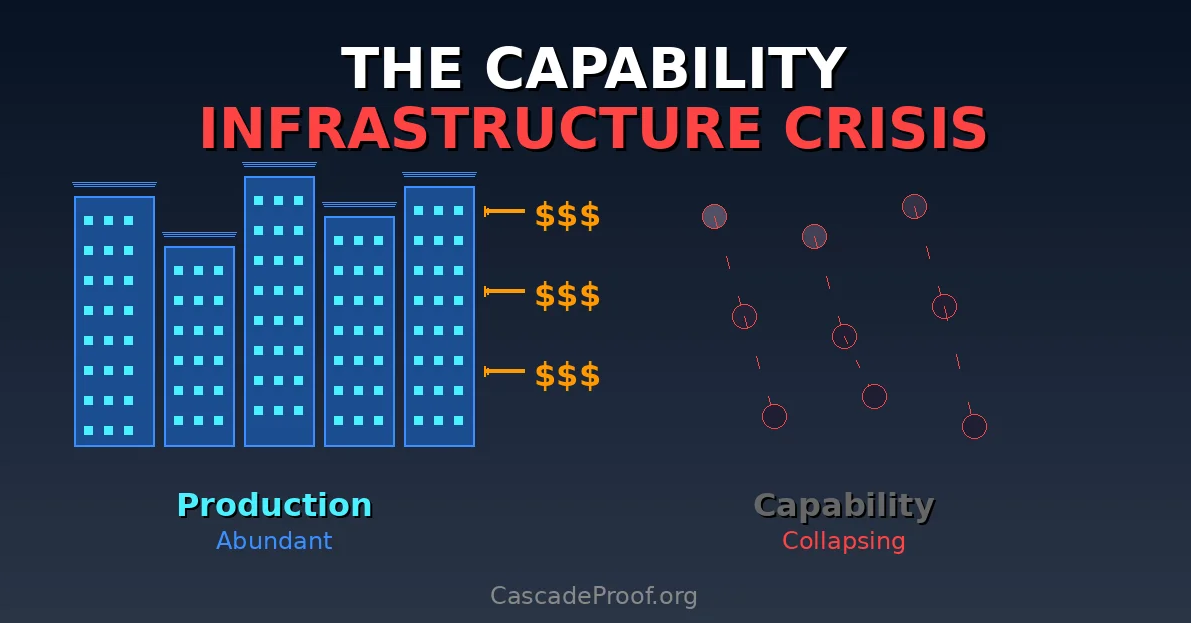
In the Age Where AI Makes Production Infinite and Cheap, the Scarcest Resource Becomes the One We’re Actively Destroying: The Infrastructure for Developing Human Capability Itself
When AI makes everything abundant, the only constraint is the one thing we forgot to build infrastructure for.
November 2024. A Fortune 500 strategy meeting.
The CFO presents infrastructure investment priorities: expanding data centers, upgrading network capacity, securing chip supply, building energy systems for AI computation.
Total proposed investment: $4.2 billion over three years.
ROI projections: Strong. AI will drive productivity gains across every division.
Then someone asks: ”Who will use these AI systems in ways that create value we can’t yet imagine?”
Silence.
The company has 40,000 employees. AI will make them more productive within existing frameworks. But who among them can generate entirely new frameworks when markets shift, technologies evolve, or problems emerge that current paradigms cannot address?
The company doesn’t know. Nobody measured this. No infrastructure exists to develop it. No system tracks whether it’s increasing or declining.
The realization hits: We’re investing billions in AI infrastructure while the bottleneck—human capability to generate frameworks AI will execute within—has no infrastructure at all.
This is the Capability Infrastructure Crisis.
The moment civilization realizes production is abundant but capability development is collapsing, and we have no systems to build what we actually need.
For 200 years, economic growth meant building infrastructure for production: railroads, electricity grids, telecommunications, highways, internet, cloud computing. Investment in production infrastructure drove prosperity.
AI inverts this completely.
When AI achieves human-level capability in framework execution—and it’s approaching this across most domains—production within existing frameworks becomes abundant. More AI compute, better algorithms, larger models—all make production cheaper and faster.
The bottleneck shifts catastrophically:
Old bottleneck: Production capacity within frameworks (solved by AI)
New bottleneck: Capability to generate new frameworks when existing ones fail (no AI solution, declining in humans)
This is infrastructure crisis because: We built massive systems to enable production while systematically destroying the infrastructure that develops capability.
The inversion is total. The resource we optimized for becomes worthless. The resource we neglected becomes civilization’s constraint.
In the age of abundant production, the scarcest resource is the human who knows what to produce.
I. The Infrastructure We Built—And What It’s Destroying
Traditional infrastructure—roads, power plants, fiber optic networks, data centers—exists to enable productive activity within established frameworks.
This infrastructure succeeded brilliantly.
Give humans tools to execute within frameworks, and production scales massively. Factories, supply chains, communications systems, computational infrastructure—all multiply human output within known paradigms.
But here’s what we missed:
While building infrastructure to scale production, we simultaneously built systems that destroy the capability infrastructure necessary for framework generation.
The destruction happens through Attention Debt systems:
Social media platforms optimize for engagement over comprehension. Users scroll infinite feeds, attention fragments across hundreds of signals, cognitive downtime disappears. Result: elimination of the extended focus periods necessary for framework generation.
Education technology provides instant answers, AI-generated explanations, automated problem-solving. Students get correct results without cognitive struggle. Result: elimination of the productive confusion that builds framework-generation capability.
Workplace tools maximize efficiency within existing processes. AI handles complex tasks, automation eliminates friction, systems prevent errors. Result: elimination of the challenging failures that force framework evolution.
Information systems deliver pre-digested knowledge instantly. Wikipedia summaries, AI explanations, tutorial videos—all remove the necessity of wrestling with primary sources. Result: elimination of the interpretive struggle that generates new understanding frameworks.
Each system individually increases productivity. Together, they systematically destroy human capability development.
The mathematics are brutal:
Production infrastructure investment: $3+ trillion annually (data centers, networks, AI compute)
Capability infrastructure investment: Unmeasured, likely negative (systems actively destroying development)
Production capability growth: Exponential (AI improving continuously)
Human capability growth: Negative (Attention Debt accumulating, framework generation capacity declining)
This is infrastructure crisis: Massive investment in solving the problem that doesn’t matter (production) while destroying infrastructure for solving the problem that does (capability development).
Within a decade, production is abundant but capability is scarce. Companies possess infinite computational power but lack humans who can generate frameworks worth computing within.
II. What Capability Infrastructure Actually Is
Let’s be precise about what we’re missing.
Capability infrastructure is not:
- Educational buildings
- Training programs
- Knowledge databases
- Productivity tools
- Management systems
Capability infrastructure is:
The network of humans who increase other humans’ capability to generate frameworks—verified through demonstrated ability to create paradigms that didn’t exist before, measured by independent capability propagation, validated through temporal persistence.
Concrete:
Person A possesses framework-generation capability. Person A transfers this capability (not just knowledge, but meta-cognitive capacity) to Person B. Person B demonstrates framework generation independently—creating approaches A never taught. Person B transfers capability to Person C, who also demonstrates independent framework generation. The cascade continues, branches, multiplies across networks.
This network of capability-multiplication is infrastructure.
Not physical. Not institutional. But more load-bearing for civilization than any physical infrastructure.
Why it’s infrastructure:
Infrastructures are foundational systems enabling activities that couldn’t occur without them.
Roads enable transportation. Electricity enables modern life. Internet enables digital economy.
Capability networks enable framework generation—the activity that creates all progress.
Without capability infrastructure, humans cannot generate new frameworks when reality outgrows existing ones. Progress stops. Civilization stagnates. Problems that require new paradigms remain permanently unsolvable.
The measurement gap:
We measure traditional infrastructure obsessively: road miles, power capacity, bandwidth, compute power. Governments track it. Companies invest based on it. Markets price it.
We don’t measure capability infrastructure at all.
How many people in your organization can generate frameworks? How many did they enable to do the same? How deep do those cascades extend? How persistent is the capability? How much branching occurs?
Nobody knows. No systems track it. No metrics measure it. No infrastructure develops it intentionally.
This is the crisis: the most critical infrastructure has no measurement, no investment, no deliberate construction.
III. Why This Becomes Economic Necessity
Here’s the economic argument that makes capability infrastructure unavoidable:
In AI age, economic value derives exclusively from framework generation because AI automates everything else.
The math:
Framework execution value → $0 (AI does it better, faster, cheaper)
Framework generation value → ∞ (only humans can do it, AI makes it infinitely more valuable)
This means:
Companies with dense capability infrastructure: Employees who can generate frameworks when markets shift, enable others to do the same, create cascades that multiply throughout organization. These companies adapt, innovate, survive disruption.
Companies without capability infrastructure: Employees who execute within frameworks excellently, but cannot generate new ones when frameworks fail. These companies optimize within paradigms while markets evolve beyond them. AI handles their execution tasks better. They face permanent decline.
The ROI calculation transforms completely:
Traditional infrastructure ROI: $1 invested in compute → $3 in productivity gains (within existing frameworks)
Capability infrastructure ROI: $1 invested in capability development → $X in framework generation that creates entirely new value spaces impossible to forecast
The second investment has undefined upside because framework generation creates value categories that didn’t exist. You cannot calculate ROI on relativity before Einstein generates it. You cannot forecast value of information theory before Shannon creates it.
But the investment decision is clear:
Scenario 1: Invest only in production infrastructure (AI, compute, automation). Result: Excellent execution within frameworks until frameworks become obsolete. Then permanent irrelevance.
Scenario 2: Invest in capability infrastructure (verified capability cascades, framework generator development). Result: Continuous framework generation enabling adaptation when paradigms shift. Permanent competitive advantage.
This makes capability infrastructure the highest-value investment possible in AI age—not because ROI is calculable, but because it’s the only investment that ensures survival when AI commoditizes everything else.
The concrete example:
Two tech companies in 2019, similar size, similar markets, facing similar disruption potential.
Company A invested $50 million in AI infrastructure over five years: cutting-edge compute, advanced algorithms, automation systems. Productivity increased 40%. Framework execution became highly efficient. Then the market shifted—new competitor with different business model, regulatory changes requiring new approach, customer needs evolving beyond existing product paradigm. Company A had zero employees capable of generating frameworks for the new reality. They had optimized framework execution while capability infrastructure remained unmeasured and undeveloped. Despite excellent AI systems, they couldn’t adapt. Market cap declined 70% within two years.
Company B invested $5 million in capability infrastructure: verified mentorship programs, cascade-building initiatives, framework generator development tracked through early Cascade Proof pilots. Productivity gains were modest initially. But when the same market shift occurred, 47 employees independently generated 12 distinct frameworks for addressing new conditions. Three frameworks proved viable. Company B pivoted successfully. Within two years, they absorbed Company A’s market share while AI infrastructure costs continued falling.
The ROI wasn’t in the initial productivity gains. It was in survival when frameworks became obsolete.
Company A optimized for executing within paradigms. Company B invested in humans who generate paradigms. When reality outgrew existing paradigms, the difference became existential.
This pattern will repeat across every industry as AI makes framework execution abundant while capability infrastructure remains scarce.
IV. How Cascade Proof Makes Capability Infrastructure Measurable
Here’s what makes this actionable: Cascade Proof converts capability infrastructure from invisible to measurable.
The verification method:
When Person A increases Person B’s capability fundamentally, we get cryptographic attestation:
- What capability increased specifically
- Whether B can operate independently (no ongoing A involvement)
- Signed with B’s Portable Identity
- Verified months/years later for temporal persistence
When B then enables C, who enables D-E-F, the cascade topology reveals actual capability infrastructure density.
What Cascade Proof measures:
Cascade density: How many verified capability increases per person in network
Cascade depth: How many generations of independent propagation
Cascade persistence: Whether capabilities remain strong years after initial transfer
Cascade branching: How multiplicatively capability spreads (linear vs exponential patterns)
Emergence signatures: Capabilities appearing downstream that weren’t directly taught
These metrics reveal infrastructure quality:
Weak infrastructure: Few cascades, shallow depth, low persistence, linear propagation, no emergence
Strong infrastructure: Dense cascades, deep propagation, high persistence, exponential branching, significant emergence
For the first time, organizations can measure the infrastructure that actually matters.
The application:
For companies: Map current capability infrastructure. Identify framework generators. Track cascade density. Invest in strengthening weak nodes. Measure capability infrastructure ROI directly.
For investors: Evaluate companies based on verified capability cascades, not just revenue or production metrics. Dense capability infrastructure indicates adaptability—the only permanent competitive advantage in AI age.
For individuals: Build verified cascade graph showing framework generation capability. Make capability infrastructure visible and portable through cryptographic proof others cannot fake.
The transformation:
Current state: Capability infrastructure is invisible, unmeasured, uncompensated. Companies invest blindly. Individuals cannot prove capability. Markets misprice human value.
Cascade Proof state: Capability infrastructure is measurable, verifiable, portable. Companies invest strategically. Individuals prove capability cryptographically. Markets price correctly.
This converts the abstract (”we need better human development”) into concrete (”here’s verified cascade density, here’s what improving it requires, here’s ROI”).
V. The Contribution Economy Framework
Now we see how economic structure must transform.
Current economy measures production: Revenue, output, productivity, efficiency—all metrics of execution within frameworks.
This fails when AI executes better than humans in all frameworks.
Contribution Economy measures capability multiplication: How many people became more capable because of you, how deeply those cascades propagate, how persistently capabilities endure, how multiplicatively they branch.
The shift:
Person A: Produces 10X output individually. When they leave, output returns to baseline. No capability infrastructure created. Economic value temporary.
Person B: Produces 3X output individually. But enables 12 people to generate frameworks independently. Those 12 enable 70 more. When they leave, capability multiplication continues. Dense capability infrastructure created. Economic value permanent and compounding.
In Contribution Economy, Person B is worth 100X Person A.
Not because B produces more—B produces less! But because B builds capability infrastructure that compounds indefinitely while A’s production ends when they stop working.
The measurement:
Contribution Economy doesn’t measure what you produce. It measures verified capability cascades you create:
- First-generation enablement (direct)
- Second-generation propagation (independence verification)
- Temporal persistence (verified years later)
- Branching multiplication (exponential patterns)
- Emergence (unexpected downstream capabilities)
All cryptographically verified through Cascade Proof. Not subjective assessment—mathematical proof of capability infrastructure creation.
Why this becomes necessary:
When AI makes production abundant, economies cannot continue pricing production. They must price what AI cannot automate: capability infrastructure creation.
Countries, companies, and individuals that build dense capability infrastructure adapt continuously. Those that don’t face permanent decline as AI outcompetes them in framework execution.
Contribution Economy is how civilization values the only economic activity that matters when everything else becomes automated.
VI. The National Infrastructure Race
This becomes geopolitical immediately.
Traditional great power competition: Military strength, GDP, technology leadership, natural resources, production capacity.
AI-age competition: National capability infrastructure density.
The metric that matters:
National Capability Multiplication Rate (NCMR): How rapidly a nation’s population develops framework-generation capability, verified through cascade density, depth, persistence, and branching.
Why this determines everything:
Nation with high NCMR:
- Rapid adaptation when global conditions shift
- Continuous innovation generating new industries
- Superior AI governance (frameworks for challenges AI creates)
- Framework generation faster than competitors can copy frameworks
- Permanent advantage regardless of production capacity
Nation with low NCMR:
- Excellent production within existing frameworks (AI can do this)
- Unable to generate new frameworks when global paradigms shift
- Dependent on importing frameworks from high-NCMR nations
- Permanently behind as world evolves beyond their frameworks
- Declining relevance despite high production capacity
The competition is already beginning:
Some nations invest heavily in education that develops framework generation (extensive unstructured learning, tolerance for cognitive struggle, mentorship cascades).
Other nations invest in education that optimizes framework execution (standardized testing, rote learning, credential accumulation).
The first group builds capability infrastructure. The second group optimizes production infrastructure.
In 10 years, the difference will be civilizational.
The measurement imperative:
Nations must measure NCMR directly through Cascade Proof infrastructure:
- What percentage of population generates frameworks vs uses them
- What cascade density exists in educational/professional networks
- How persistent are capability increases over decades
- How multiplicatively does capability spread nationally
This becomes national security metric more important than GDP, military spending, or AI compute capacity.
Because in AI age, the nation with highest capability infrastructure density can generate frameworks faster than others can implement them—creating permanent strategic advantage that production capacity cannot overcome.
The Choice: Build or Collapse
We arrive at decision point:
Civilization can continue investing trillions in production infrastructure while capability infrastructure collapses. Result: Abundant AI computation executing within obsolete frameworks as reality evolves beyond them. Permanent stagnation.
Or civilization can deliberately build capability infrastructure—measuring it through Cascade Proof, incentivizing it through Contribution Economy, enabling it through Portable Identity, and competing on it nationally.
This is not aspirational vision. This is infrastructure necessity.
When AI makes production abundant, capability development becomes absolute constraint. The civilization that builds infrastructure for it survives. The civilization that doesn’t faces irreversible decline.
The timeline is urgent:
2024-2026: Attention Debt systems continue destroying capability development. No countervailing infrastructure exists. Framework-generation capacity declines globally.
2026-2028: AI reaches framework-execution competence in most domains. Production becomes abundant. Companies/nations realize capability is constraint.
2028-2030: Capability infrastructure race begins. Early adopters gain advantage. Late adopters face permanent disadvantage.
2030+: World divides into high-capability-infrastructure and low-capability-infrastructure civilizations. The gap becomes unbridgeable.
The infrastructure components already exist:
- Attention Debt framework explains why capability is declining
- Cascade Proof makes capability infrastructure measurable
- Portable Identity makes capability verification cryptographic and portable
- Contribution Economy creates proper economic incentives
What’s missing is deployment at scale.
Companies measuring capability infrastructure and investing accordingly. Nations tracking NCMR and competing strategically. Individuals building verified cascade graphs and proving capability cryptographically.
The question is not whether this happens—it must.
The question is which organizations, nations, and individuals build capability infrastructure before competitors do.
Because in the age when AI makes everything else abundant, the only scarce resource is the one thing we’re destroying: the infrastructure for developing human capability itself.
Build the infrastructure. Measure the cascades. Compete on capability.
Or watch as production abundance reveals the constraint we forgot to address: the humans who must generate frameworks worth producing within.
Welcome to the Capability Infrastructure Crisis. The bottleneck nobody saw coming. The investment opportunity that determines everything.
The infrastructure for human development is civilization’s foundation in AI age.
We have 3-5 years to build it before the gap becomes permanent.
The race has begun.
Related Projects
This article is one component of a broader effort to redefine how human capability, identity, and value are created, measured, and protected in the age of accelerating AI.
- AttentionDebt.org – examining the cognitive impact of accelerating information systems
- PortableIdentity.global – defining self-owned, cryptographic identity for the synthetic age
- CascadeProof.org – establishing verification standards for capability cascades
- ContributionEconomy.global – exploring economic models built on verified human contribution
Together, these projects outline the foundational infrastructure humanity will need in a world where AI makes production abundant and only consciousness-driven capability remains scarce.
Rights and Usage
All materials published under CascadeProof.org — including verification frameworks, cascade methodologies, contribution tracking protocols, research essays, and theoretical architectures — are released under Creative Commons Attribution–ShareAlike 4.0 International (CC BY-SA 4.0).
This license guarantees three permanent rights:
1. Right to Reproduce
Anyone may copy, quote, translate, or redistribute this material freely, with attribution to CascadeProof.org.
How to attribute:
- For articles/publications: ”Source: CascadeProof.org”
- For academic citations: ”CascadeProof.org (2025). [Title]. Retrieved from https://cascadeproof.org”
2. Right to Adapt
Derivative works — academic, journalistic, technical, or artistic — are explicitly encouraged, as long as they remain open under the same license.
Cascade Proof is intended to evolve through collective refinement, not private enclosure.
3. Right to Defend the Definition
Any party may publicly reference this framework, methodology, or license to prevent:
- private appropriation
- trademark capture
- paywalling of the term ”Cascade Proof”
- proprietary redefinition of verification protocols
- commercial capture of cascade verification standards
The license itself is a tool of collective defense.
No exclusive licenses will ever be granted. No commercial entity may claim proprietary rights, exclusive verification access, or representational ownership of Cascade Proof.
Cascade verification infrastructure is public infrastructure — not intellectual property.
25-12-05