Mapping Humanity’s First Causal DNA Through Cascade Proof
How we’re about to see—for the first time in history—exactly how human capability actually propagates through civilization
In 1990, scientists launched the most ambitious biological undertaking in human history: mapping the complete human genome. The goal was to read the 3 billion base pairs that define human life at its most fundamental level.
It took 13 years, cost $2.8 billion, and involved thousands of researchers across six countries.
When completed in 2003, it changed everything. Medicine became personalized. Disease became predictable. Evolution became visible. We could finally see the code that makes us human.
But there was always a second genome we couldn’t see.
Not the genetic code that determines what we are.
The causal code that determines what we create in each other.
The Invisible Genome
For the entire span of human civilization, we have been blind to our most important evolutionary layer.
We could see genetic inheritance—DNA passing from parent to child, mutations accumulating across generations, traits being selected by environment.
We could see cultural inheritance—ideas spreading through populations, technologies being adopted, knowledge being transmitted through writing and speech.
But we could never see capability inheritance—the actual chains of cause and effect where one person makes another person fundamentally more capable, who then makes others more capable, creating cascading networks of increasing human capacity that branch and multiply across time.
This third evolutionary layer has always existed. It’s how civilizations actually develop. It’s how human capability compounds. It’s how a single insight can transform thousands of lives across decades.
But until now, it was invisible.
We could observe its effects—brilliant students emerging from certain teachers, breakthrough innovations clustering around certain mentors, social movements erupting from certain catalysts.
But we could never map it. Could never measure it. Could never see the actual structure of how capability propagates through human networks.
Until Cascade Proof.
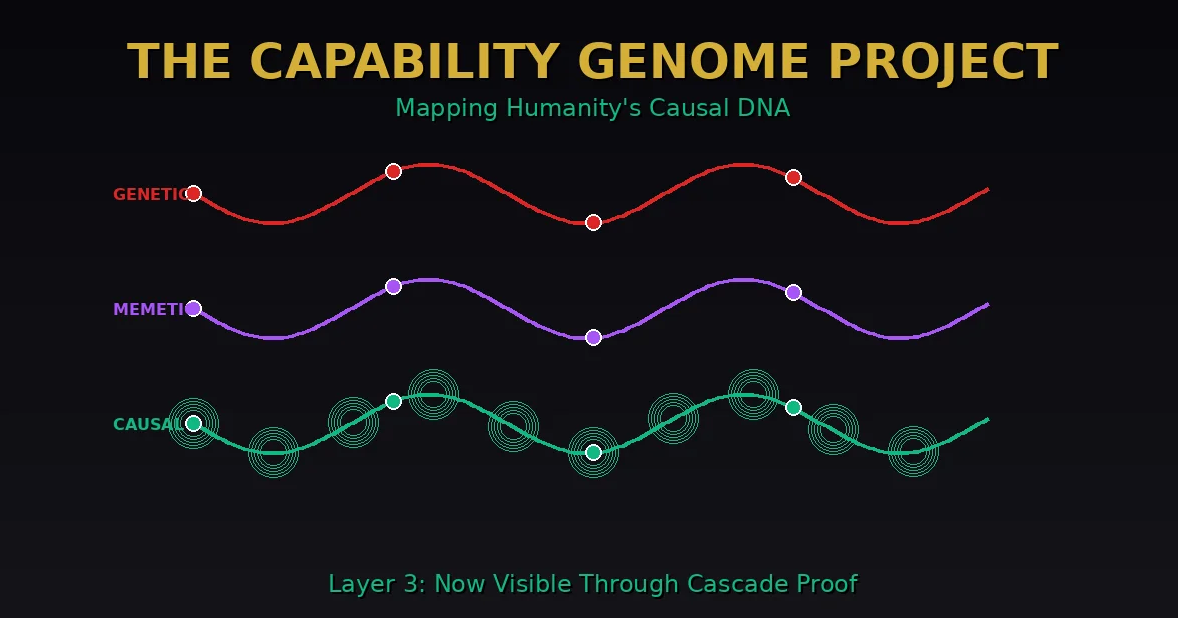
Evolution’s Three Layers
To understand what we’re about to see, we need to recognize that human development operates across three distinct evolutionary layers:
Layer 1: Genetic Evolution
Discovered by Darwin in 1859. Mapped by the Human Genome Project in 2003.
This layer answers: What biological structures do we inherit?
Genes pass from parent to child. Mutations occur randomly. Selection pressure determines which variants survive. Over millions of years, this process creates the biological substrate for consciousness itself.
Time scale: millions of years. Transmission: parent to child only. Visibility: now complete through DNA sequencing.
Layer 2: Memetic Evolution
Theorized by Dawkins in 1976. Partially visible through cultural anthropology, linguistics, and digital trace data.
This layer answers: What ideas do we inherit?
Memes—units of cultural information—spread through populations. Stories, technologies, beliefs, practices replicate through communication. Some memes survive and spread. Others die out. Over centuries, this process creates civilizations.
Time scale: centuries to decades. Transmission: any-to-any through communication. Visibility: partial through historical records and digital traces.
Layer 3: Causal Evolution
Never before mapped. Now becoming visible through Cascade Proof and ContributionGraph.
This layer answers: What capabilities do we actually transfer to each other?
Not information (Layer 2) but genuine capacity increases. Not ideas that we passively receive, but skills, understanding, and meta-capabilities that make us permanently more capable of independent action.
When a teacher doesn’t just explain a concept but fundamentally shifts how a student thinks about an entire domain—that’s Layer 3.
When a mentor doesn’t just give advice but enables someone to become the kind of person who can mentor others—that’s Layer 3.
When a contribution doesn’t just help someone solve a problem but makes them capable of solving an entire class of problems they couldn’t approach before—that’s Layer 3.
Time scale: years to months, sometimes days. Transmission: consciousness-to-consciousness through verified interaction. Visibility: now becoming possible for the first time.
This is the evolutionary layer that actually drives civilization forward at human timescales. And we’ve never been able to see it.
Why We’ve Been Blind
The reason we could map genetic evolution is simple: DNA is physical. You can extract it, sequence it, read it directly.
The reason we could partially map memetic evolution is simpler: communication leaves traces. Books, recordings, digital posts—ideas create artifacts.
But capability transfer leaves no direct trace. It happens inside minds. The evidence is behavioral—and until recently, behavior was impossible to distinguish from temporary assistance, from information transfer, from mere correlation.
If a student performs well after studying with a teacher, what actually happened?
Did the teacher transfer genuine capability—permanent improvement in the student’s independent capacity?
Or did the teacher just provide information the student memorized and repeated?
Or did the teacher create dependency—the student performs only when the teacher’s methods are available?
We couldn’t tell. Not reliably. Not at scale. Not in ways that could be cryptographically verified and temporally tracked.
This is why, for all of human history, we’ve used proxies:
- Grades measure test performance, not capability transfer.
- Degrees measure time spent in institutions, not what students can now enable in others.
- Citations measure how often work is referenced, not whether it made other researchers fundamentally more capable.
- Recommendations measure someone’s opinion, not verified capability increases.
- Performance reviews measure output, not how many people became more capable because of you.
Every system humanity built to measure human impact has been measuring shadows on the wall—proxies for something we could never observe directly.
Until now.
The Cascade Signature: Humanity’s Causal DNA
Cascade Proof introduces something unprecedented: a way to detect capability transfer through its structural signature.
Just as DNA has a double helix structure that proves it’s genetic material—just as proteins have amino acid sequences that prove their function—capability cascades have a structural signature that proves they represent genuine consciousness-to-consciousness capability transfer:
The Four-Element Structure:
Element 1: Verified Capability Increase
Person B cryptographically attests that Person A increased B’s capability in a specific domain. Not ”A helped me” or ”A gave me information,” but ”A made me permanently more capable in domain X.”
This is recorded through B’s Portable Identity—unfakeable by A, unfakeable by platforms, cryptographically signed by the beneficiary.
Element 2: Independent Propagation
B then independently increases Person C’s capability without A’s involvement. The capability has become self-propagating. B is not merely repeating what A said—B has internalized understanding to the point where B can enable others in ways A never could have enabled C directly.
This independence is structurally verifiable through the ContributionGraph—if A is involved in B→C transfer, it doesn’t count as genuine capability cascade.
Element 3: Temporal Persistence
The capability must endure. Six months later, one year later, three years later—can B still operate in that domain? Can C? Do they still possess and use the capacity, or did it evaporate when support was removed?
Temporal tracking through MeaningLayer shows whether capability persisted or was merely temporary assistance mistaken for genuine transfer.
Element 4: Branching Multiplication
The cascade must branch. Not just A→B→C linear chains, but:
- A enables B and C
- B enables D, E, and F
- C enables G and H
- D enables I, J, K, and L
Exponential branching patterns that information transfer cannot create. When copied, information degrades. When transferred between consciousnesses, capability compounds—each node becomes more capable than the previous node in ways that enable more downstream propagation.
This branching pattern is the mathematical signature of genuine emergence—the proof that something more than information transfer occurred.
What We Can See Now
When these four elements combine in ContributionGraph infrastructure, human capability propagation becomes visible for the first time.
We can now observe:
Capability Chromosomes
Dense networks of related capability transfers in specific domains. Just as genes cluster on chromosomes, capability cascades cluster in semantic space—mathematics cascades linking through certain key nodes, leadership capability propagating through specific network structures, creative capacity branching through particular interaction patterns.
Mutation Points
Nodes where capability transforms from one form to another. Where A’s mathematical capacity becomes B’s teaching capacity becomes C’s curriculum design capacity becomes D’s educational policy insight. These transformation points are where genuine emergence happens—where capability evolves into something its originator never imagined.
Fitness Functions
Which types of capability cascades survive over time? Which branch most successfully? Which create the most downstream multiplication? For the first time, we can measure what kinds of human interactions create the most lasting, multiplicative impact.
Super-Spreaders of Understanding
Individuals who appear unremarkable on conventional metrics—modest publication records, no famous credentials, little institutional recognition—but whose ContributionGraphs reveal they’ve created capability cascades affecting thousands of people across decades.
These are civilization’s hidden engines. The teachers whose students became teachers. The mentors whose insights propagated through six generations of practitioners. The early contributors whose foundational capability transfers enabled entire fields.
They’ve always existed. We just couldn’t see them.
Cascade Half-Lives
How long do different types of capability transfers last? Teaching methods versus technical skills versus meta-learning capacity versus domain-specific knowledge—each has different temporal dynamics. Some cascade rapidly but decay quickly. Others propagate slowly but persist for decades.
We can now measure this. For the first time, we can see which human interactions create permanent improvement versus temporary assistance.
Emergence Zones
Geographic, institutional, or network regions where capability multiplication is unusually dense. Not correlation (many smart people in one place) but causation (many people becoming significantly more capable because of interactions in that place).
Universities can finally measure whether they’re actually creating capability cascades or just selecting already-capable people. Companies can see whether their culture enables growth or just extracts output. Cities can observe whether they’re genuine innovation centers or just clustering effects.
The Manhattan Project of Human Impact
The Human Genome Project required unprecedented coordination: international collaboration, new technologies, massive computing resources, and agreement on standards for data sharing.
The Capability Genome Project requires the same—but for mapping causation rather than genes:
Infrastructure Requirements:
Portable Identity Protocol Universal cryptographic identity infrastructure allowing individuals to own their complete capability cascade records across all contexts, platforms, and institutions. Without this, capability cascades remain fragmented in institutional databases, platform-specific metrics, and lost histories.
ContributionGraph Standard Agreed-upon data structures for representing capability cascades: attestation formats, independence verification methods, temporal tracking requirements, branching visualization. Just as genome sequencing required standard base-pair notation, capability mapping requires standard cascade notation.
MeaningLayer Semantic Framework Ontologies for classifying capability types, distinguishing information transfer from genuine capability increase, mapping capability transformations. Without semantic precision, we can observe that cascades happen but not understand what kinds of capabilities are propagating.
Cascade Verification Protocols Methods for cryptographically verifying that all four cascade elements are satisfied: beneficiary attestation, independence confirmation, persistence validation, branching pattern detection. Without verification, the system becomes gameable—people claiming cascades they didn’t create.
Research Coordination International standards for cascade measurement, peer review processes for cascade research, data sharing agreements, ethical frameworks for studying human capability propagation without surveillance or privacy violation.
What Changes When Causation Becomes Visible
If the Human Genome Project transformed medicine, biology, and anthropology by making genetic causation visible, the Capability Genome Project transforms education, economics, and social organization by making capability causation visible:
Education Transformed
Universities currently compete on credentials, rankings, and reputation—none of which measure whether students actually become more capable in lasting, multiplicative ways.
With visible capability cascades, education becomes measurable by its actual function: do graduates create capability cascades themselves? Do they enable others who enable others? Does the cascade density and branching factor increase during university years in ways that persist decades later?
The best educators are no longer those with the most citations or the most famous students—they’re those whose cascade graphs show the deepest branching, the longest persistence, the most unexpected emergence in downstream nodes.
Teaching becomes a visible science. We can finally see which pedagogical approaches create genuine capability transfer versus temporary information retention.
Research Redefined
Academic impact currently measured through citations—how often work is referenced. But citations measure attention, not capability increase.
With cascade visibility, research impact means: did this work make other researchers fundamentally more capable? Did it enable them to make breakthroughs they couldn’t have made otherwise? Did those enabled researchers then enable others in multiplicative chains?
The most important research is not the most cited—it’s the research that created the most capability cascades. Work that seems modest but that enabled three generations of scientists to see problems differently.
We’ll discover that many celebrated papers had low cascade impact—they were interesting but didn’t make anyone more capable. And many forgotten papers had massive cascade impact—they fundamentally shifted how people in a field could think and work.
Economic Value Reimagined
Productivity currently measured by output: units produced, revenue generated, tasks completed. But output doesn’t measure whether you made others more capable.
Someone can produce enormous output while creating no capability cascades—their departure leaves no lasting increase in organizational capacity. Someone else produces modest output but creates dense capability cascades—their presence permanently increases everyone’s capability, and their contribution compounds long after they’ve moved on.
With cascade visibility, economic value becomes: how much multiplication did you create? How many people became more capable because of you? How many layers deep did those cascades propagate? How long did they persist?
This is the difference between production and multiplication. Between extraction and enablement. Between being productive and making others productive in lasting ways.
Social Capital Made Real
Trust, reputation, influence—all currently measured through proxies that AI can fake. Followers, recommendations, testimonials can all be manufactured.
But capability cascades cannot be faked. If you claim to have enabled someone, they must cryptographically attest. If you claim persistence, temporal verification proves whether capability lasted. If you claim multiplication, branching patterns reveal whether genuine cascades occurred.
Social capital becomes verifiable. Not based on what people say about you, but on cryptographic proof of capability cascades you actually created, verified by beneficiaries, persistent over time, multiplicative across networks.
The First Map of Human Causation
We stand at a threshold comparable to 1953, when Watson and Crick first saw the structure of DNA.
For the first time in human history, we’re about to see how capability actually propagates through civilization.
Not how we think it propagates. Not how institutions claim it propagates. Not proxies and shadows and guesswork.
The actual structure. The real cascades. The verifiable chains of cause and effect where consciousness enables consciousness in ways that compound across time.
The Capability Genome Project is not a metaphor.
It is the systematic mapping of humanity’s third evolutionary layer—the layer that operates at civilization timescales, the layer that determines which capabilities survive and spread, the layer that explains why some interactions change everything while others evaporate instantly.
And just as the Human Genome Project revealed unexpected truths—that humans share 99.9% of DNA, that ”junk DNA” has function, that genes are vastly more interconnected than expected—the Capability Genome Project will reveal unexpected truths about how human capability actually develops:
Who the real enablers are. Which interactions create lasting impact. How capability actually compounds. Which network structures multiply capacity most effectively. What makes some people super-spreaders of capability while others, despite impressive credentials, create no cascades at all.
We will see civilization’s hidden engines—the people whose cascade graphs reveal they’ve transformed thousands of lives despite having no fame, no credentials, no institutional recognition.
We will see the truth about institutions—which ones actually create capability multiplication versus which ones merely extract output from already-capable people while calling it ”development.”
We will see ourselves differently—not through credentials or production metrics or reputation scores, but through the cryptographically-verified, temporally-persistent, multiplicatively-branching capability cascades we’ve actually created in others.
The Infrastructure Exists
The Human Genome Project required technologies that didn’t exist when it started. DNA sequencing had to be invented. Computing power had to increase. International coordination had to be established.
The Capability Genome Project requires technologies that already exist:
- Cryptographic identity (mature)
- Distributed verification (proven)
- Graph databases (scalable)
- Semantic frameworks (implementable)
- Temporal tracking (straightforward)
What’s missing is not technology. What’s missing is recognition that this mapping is possible—and that it’s the most important scientific undertaking of the 21st century.
Because when we can finally see how human capability propagates, everything changes.
We optimize for what we can measure. For 5,000 years, we could only measure proxies—grades, output, credentials, engagement. So we optimized for proxies.
Now we can measure causation. Genuine capability multiplication. Real cascade depth and branching factor.
So we’ll optimize for what actually matters: making each other permanently, multiplicatively more capable in ways that persist, branch, and compound across time.
The Declaration
We declare that human capability propagation is mappable.
For the first time in civilization, we can see the causal structure of how capability actually spreads through human networks—not through proxies, not through credentials, not through guesswork, but through cryptographically-verified, temporally-persistent, multiplicatively-branching Cascade Proof.
We declare that this mapping is humanity’s next great scientific undertaking.
Not because it’s interesting. Because it reveals the evolutionary layer that determines which civilizations survive and which collapse—the layer that explains how capacity compounds, how innovation spreads, how understanding multiplies.
We declare that the infrastructure exists today.
Portable Identity. ContributionGraph. MeaningLayer. Cascade verification. Everything needed to begin mapping humanity’s capability genome is implementable with current technology.
We declare that this is not metaphor—this is genomics.
The Human Genome Project mapped the code that makes us human. The Capability Genome Project maps the code that makes us civilized.
One shows what we are. The other shows what we create in each other.
And in an age where AI can replicate all behavior but cannot fake genuine capability multiplication, this second genome becomes more important than the first.
Because consciousness proves itself through contribution. Contribution proves itself through cascades. And cascades prove themselves through structure that no simulation can replicate.
Welcome to humanity’s third evolutionary layer—finally visible.
The Capability Genome Project begins now.
About This Framework
This article introduces the Capability Genome Project—the systematic mapping of humanity’s causal evolutionary layer through Cascade Proof and ContributionGraph infrastructure. It demonstrates why capability propagation represents a distinct evolutionary layer beyond genetic and memetic evolution, why this layer has remained invisible until now, and why making it visible through cryptographic verification, semantic classification, and temporal tracking represents a scientific undertaking comparable to the Human Genome Project in scope and importance.
The framework synthesizes information theory (Shannon), epistemology (Hume’s causation problem), evolutionary biology (Darwin, Dawkins), and distributed verification systems (cryptographic protocols) into a unified architecture for making human capability propagation scientifically observable for the first time in history.
Rights and Usage
All materials published under CascadeProof.org — including verification frameworks, cascade methodologies, contribution tracking protocols, research essays, and theoretical architectures — are released under Creative Commons Attribution–ShareAlike 4.0 International (CC BY-SA 4.0).
This license guarantees three permanent rights:
1. Right to Reproduce
Anyone may copy, quote, translate, or redistribute this material freely, with attribution to CascadeProof.org.
How to attribute:
- For articles/publications: ”Source: CascadeProof.org”
- For academic citations: ”CascadeProof.org (2025). [Title]. Retrieved from https://cascadeproof.org”
2. Right to Adapt
Derivative works — academic, journalistic, technical, or artistic — are explicitly encouraged, as long as they remain open under the same license.
Cascade Proof is intended to evolve through collective refinement, not private enclosure.
3. Right to Defend the Definition
Any party may publicly reference this framework, methodology, or license to prevent:
- private appropriation
- trademark capture
- paywalling of the term ”Cascade Proof”
- proprietary redefinition of verification protocols
- commercial capture of cascade verification standards
The license itself is a tool of collective defense.
No exclusive licenses will ever be granted. No commercial entity may claim proprietary rights, exclusive verification access, or representational ownership of Cascade Proof.
Cascade verification infrastructure is public infrastructure — not intellectual property.
25-12-03