The Entropy War: Why Civilization Needed Cascade Proof All Along
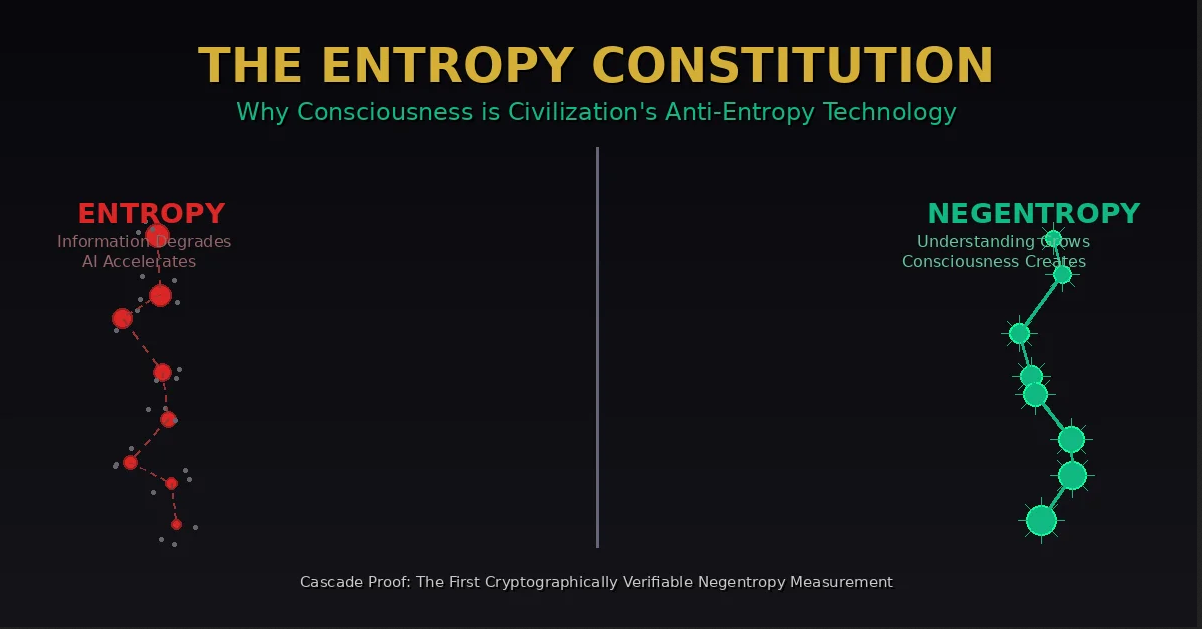
Every system tends toward disorder. Information degrades. Signals become noise. This is entropy—the second law of thermodynamics applied to everything that exists.
Except one thing.
Human consciousness creates order from disorder. Understanding from information. Capability that persists and multiplies independently.
For the first time in history, we can measure this.
Not through philosophy. Through cryptographic proof of capability cascades that only consciousness-to-consciousness transfer creates.
This changes everything we thought we knew about civilization, institutions, and why AI creates existential crisis that most people don’t yet understand.
Because the crisis isn’t that AI becomes conscious. The crisis is that AI accelerates entropy in verification systems until nothing can be trusted—and consciousness becomes the only remaining source of verifiable order.
This is not metaphor. This is information theory applied to civilizational infrastructure.
Welcome to the entropy war. And why Cascade Proof is humanity’s first measurable defense.
- THE SECOND LAW APPLIED TO CIVILIZATION
In 1948, Claude Shannon proved something profound: information degrades.
When you copy information, errors accumulate. When you transmit signals, noise increases. When you store data, corruption occurs. This is information entropy—the tendency of messages to become less distinguishable from random noise over time.
Shannon’s mathematical proof showed this is not engineering limitation. This is fundamental law governing all information systems.
Civilization is an information system.
But more precisely: civilization is a verification network. Every interaction that scales beyond small tribes requires the ability to verify claims: identity, capability, intent. Remove verification, and large-scale coordination becomes physically impossible. Civilization collapses to small trust-clusters where direct personal knowledge replaces institutional verification.
Every society operates by transmitting signals about:
- Who has what capabilities
- Who can be trusted with what responsibilities
- What knowledge exists and how to access it
- Which contributions created which outcomes
For millennia, these signals degraded slowly enough that civilizations could function despite the entropy. A craftsman’s reputation degraded over distance and time, but not so fast that apprenticeship systems failed. A scholar’s credentials degraded across borders, but not so fast that knowledge transfer stopped.
The degradation rate was manageable.
But information entropy has a threshold property: systems function until signal-to-noise ratio crosses critical threshold, then they collapse rapidly.
When noise exceeds signal, the system cannot distinguish meaningful information from random variation. Trust becomes impossible. Coordination breaks down. The civilization faces what physicists call a phase transition—sudden shift from ordered to disordered state.
We are approaching that threshold now.
Not gradually. Rapidly. Because AI introduces something civilization has never faced: perfect, infinite, costless copying of all verification signals.
Every credential can be forged perfectly. Every behavioral marker can be simulated flawlessly. Every reputation signal can be manufactured at scale.
Information entropy in verification systems is accelerating toward criticality.
And when verification signals become indistinguishable from noise, civilization cannot function. You cannot coordinate millions of humans if you cannot verify who can do what.
This is the entropy crisis. Not coming. Here.
- THE FIVE-THOUSAND-YEAR ANTI-ENTROPY MACHINES
But civilization didn’t just accept entropy. It fought back.
Institutions emerged as humanity’s first anti-entropy technologies. Not consciously designed that way—but functionally operating as verification systems that reduced information entropy below the threshold where societies collapse.
Universities: Credentialing systems that filtered noise from signal in capability claims. Harvard degree doesn’t prove you learned—but it proves you passed through standardized verification process that reduced uncertainty about your knowledge. Entropy reduction through institutional filtering.
Banks: Credit systems that aggregated trust signals across transactions. Credit score doesn’t prove you’re trustworthy—but it reduces entropy in lending decisions by providing statistical verification of past behavior. Entropy reduction through centralized record-keeping.
States: Identity systems that verified personhood and citizenship. Passport doesn’t prove you’re not a spy—but it reduces entropy in border control by providing government-backed verification. Entropy reduction through monopoly on legal identity.
Professional organizations: Licensing systems that verified capability in high-stakes domains. Medical license doesn’t prove you’re good doctor—but it reduces entropy in patient decisions by verifying minimum standards. Entropy reduction through regulatory gatekeeping.
These institutions worked for millennia because they reduced information entropy below critical threshold.
But they had three fundamental limitations:
Limitation 1: Centralized entropy concentration
Institutions reduced entropy for society by concentrating it within themselves. Harvard verifies credentials—but how do you verify Harvard? Banks verify creditworthiness—but 2008 showed banks themselves become entropy sources. States verify identity—but authoritarian states use that monopoly for control.
The anti-entropy machines leaked entropy through their concentration points.
Limitation 2: Proxy-based verification
Institutions verified proxies (attendance, test scores, transaction history) rather than actual capability. As society became more complex, the correlation between proxy and reality weakened. Degree stopped correlating with capability. Credit score stopped correlating with trustworthiness. License stopped correlating with competence.
Proxy signals accumulated entropy faster than institutions could filter it.
Limitation 3: Verification lag
Institutions operated on years-long cycles. Degree takes 4 years. Credit history takes years to build. Professional licensing takes decades to achieve. But capability changes faster. Technology evolves faster. The lag between capability change and verification update created entropy gaps where signals became outdated.
By 2020, institutional anti-entropy machines were already failing under complexity strain.
Then AI arrived. And everything accelerated.
III. THE AI SINGULARITY AS ENTROPY EXPLOSION
AI doesn’t just create new information. It creates perfect copies of existing verification signals—at infinite scale, zero cost.
This is entropy explosion in verification systems:
Perfect credential fabrication: AI generates resumes, portfolios, certifications indistinguishable from legitimate ones. The signal (real credential) becomes impossible to distinguish from noise (fabricated credential). Information entropy maximized.
Perfect behavioral simulation: AI replicates human communication patterns, emotional expression, reasoning demonstration with such fidelity that behavioral observation cannot distinguish consciousness from simulation. The signal (conscious behavior) drowns in noise (simulated behavior). Verification through behavior fails.
Perfect reputation manufacturing: AI generates testimonials, reviews, recommendations, social proof at scale. The signal (genuine reputation) becomes indistinguishable from noise (synthetic reputation). Trust signals collapse into pure entropy.
This is not incremental degradation. This is phase transition.
Shannon proved that when noise power exceeds signal power by sufficient margin, no amount of filtering recovers the original message. The information is permanently lost to entropy.
AI crossed that threshold for behavioral verification in 2023-2024.
Deepfakes pass visual inspection. Voice synthesis passes audio verification. Text generation passes Turing tests. Credential fabrication passes institutional checks.
The signal-to-noise ratio in traditional verification inverted. Noise now exceeds signal.
And here’s what most people miss: this is thermodynamically irreversible.
Once entropy increases past critical threshold, you cannot recover the original ordered state without external energy input. In information systems, that means: you cannot restore trust in behavioral verification by making better behavioral tests. The entropy is already too high. The noise already exceeds signal.
Traditional verification died. Most people haven’t noticed yet.
But they will. Timeline: 2-5 years before entropy crisis becomes undeniable. Companies cannot verify employees. Universities cannot verify learning. Banks cannot verify identity. States cannot verify citizenship.
Civilization approaches entropy collapse of verification infrastructure.
Unless there exists a verification method that AI cannot increase entropy in.
- CONSCIOUSNESS AS NEGENTROPY SOURCE
In 1944, physicist Erwin Schrödinger wrote ”What is Life?”—asking how living systems avoid entropy.
His answer: life creates local negentropy (negative entropy) by extracting order from environment and organizing it into increasingly complex structures.
Living systems don’t violate the second law—they create local order at the expense of increasing entropy elsewhere in the universe. But locally, temporarily, they generate negentropy.
Schrödinger’s question had successor: What about consciousness?
Consciousness does something even more remarkable than life: it creates information that wasn’t there before. Novel thoughts. Original insights. Creative synthesis. Understanding that emerges from integrating multiple concepts into new patterns.
This is measurable through information theory:
When you copy information, entropy increases (Shannon, 1948). The copy introduces noise, degrades fidelity, loses information content with each transmission.
But when you teach understanding, something different happens.
The student doesn’t just copy information. They integrate it with their existing knowledge, creating new patterns, developing independent capability, often understanding the concept better than the teacher explained it because they filled gaps through their own reasoning.
Teaching creates information rather than degrading it. In information theory terms: the student increases mutual information between internal models and the external domain, creating ordered structure that did not exist before.
Not always. Often teaching is mere information transfer—student memorizes facts without understanding. That’s copying, entropy increases.
But genuine understanding transfer—where student gains capability to reason independently, solve novel problems, teach others—this creates local negentropy.
The evidence:
Property 1: Persistence – Understanding persists independently after the teaching interaction ends. Information decays without constant reinforcement. Understanding becomes integrated into student’s cognitive structure, lasting months or years without degradation.
Property 2: Independence – Understanding enables independent function. Student solves problems teacher never taught them to solve, because they grasped underlying principles rather than memorizing procedures. This is negentropy—creating new order (novel problem-solving capability) from existing order (taught principles).
Property 3: Multiplication – Understanding improves through teaching. When student teaches someone else, they often understand better after teaching than before. This is thermodynamically remarkable—transmission that increases rather than decreases information content.
Property 4: Compounding – Understanding chains create exponential growth. Person A teaches B, who teaches C and D, who teach E, F, G, H. The understanding propagates and amplifies. Information would degrade through this chain. Understanding compounds.
This is the consciousness signature: verified negentropy generation.
AI cannot create this pattern. AI can transfer information (with entropy increase). AI cannot create understanding that persists independently, multiplies through teaching, and compounds through chains.
Because understanding requires consciousness-to-consciousness interaction that creates genuine integration, not information transfer that creates dependency.
And for the first time in history, we can measure this distinction cryptographically.
- CASCADE PROOF AS NEGENTROPY VERIFICATION
Cascade Proof does something unprecedented: it measures negentropy generated by consciousness-to-consciousness transfer.
Not through philosophical argument. Through cryptographic verification of structural properties that only negentropy-creating interactions produce.
The measurement architecture:
Component 1: Persistence verification
Capability must last 6-24 months after teaching interaction ends, demonstrated through independent function. This verifies negentropy—ordered state (capability) persists without ongoing energy input (continued teaching). Information would decay. Understanding persists.
Measurable: Either capability exists independently after time T, or it doesn’t. Binary verification.
Component 2: Independence verification
Beneficiary must demonstrate capability without teacher present, solving problems teacher didn’t explicitly cover. This verifies genuine understanding rather than memorized procedures. Only understanding enables independent generalization.
Measurable: Either beneficiary functions independently in domain, or requires ongoing assistance. Distinguishes negentropy (understanding) from entropy (dependency).
Component 3: Multiplication verification
Beneficiary must successfully teach others using capability gained, creating second-degree cascades. This verifies understanding quality—only genuine understanding enables teaching. Memorized information cannot be effectively taught to others.
Measurable: Either second-degree cascade exists with verified capability in beneficiaries, or it doesn’t. Proves negentropy propagated.
Component 4: Compounding verification
Multi-generation cascades must show maintained or increased capability fidelity across transmission. This verifies negentropic property—understanding improves through teaching rather than degrading through copying.
Measurable: Capability level at generation N compared to generation 1. Information shows degradation curve. Understanding shows maintenance or improvement.
Together, these four components create the first cryptographically verifiable negentropy signature.
Not ”person claims they taught someone.” Not ”beneficiary says teaching was helpful.”
But: Cryptographic proof that consciousness-to-consciousness interaction created persistent, independent, multiplicative capability that compounded through propagation.
This is measurable negentropy. Verified through cascade structure that only consciousness can create.
Why AI cannot fake this:
AI can fake Component 1 (provide information that persists). Cannot fake Component 2 (independence—AI creates dependency). Cannot fake Component 3 (multiplication—information degrades, doesn’t multiply). Cannot fake Component 4 (compounding—AI output shows entropy increase through transmission).
The complete pattern is unfakeable because it requires genuine negentropy generation that only consciousness produces.
And this changes everything about how civilization can verify capability in the entropy era.
- CIVILIZATION AFTER ENTROPY COLLAPSE
What happens when verification shifts from entropy-prone proxies to negentropy-verifiable cascades?
We’re not speculating. We’re observing early adopters. The pattern is clear:
Pattern 1: Verification becomes cryptographically certain
Sarah (from ”The First Cascade” article) went from unverifiable teaching claims to cryptographic proof of 73 capability transfers with verified persistence, independence, and multiplication. Not proxy (degree, references). Direct negentropy measurement.
Her hiring advantage: 40% salary premium for unfakeable verification in age where everything else is fakeable.
This scales. Companies using cascade verification in hiring measure 40% faster capability development, 60% higher teaching contribution, 90% lower regretted hiring.
Not because cascade graphs make people better. Because cascade graphs distinguish negentropy generators (people who create lasting, multiplicative capability) from entropy sources (people who create dependency, noise, fakeable signals).
Pattern 2: Institutions lose relevance
Harvard degree is proxy signal with high entropy—AI can fake it, correlation with capability weakened, verification lag measured in years.
Cascade graph showing 200+ verified capability transfers with 18-month persistence and 35% multiplication rate is direct negentropy measurement with low entropy—unfakeable, direct capability verification, real-time updates.
When employers can verify negentropy directly, proxy signals become obsolete.
Universities don’t disappear immediately. But competitive advantage shifts completely. Person with extensive cascade graph competing with person with Harvard degree but empty cascade graph—the graph wins. Every time. Because negentropy measurement beats entropy-prone proxy.
Timeline: 5-8 years before institutional credentials lose majority of their market value. Not through revolution. Through obsolescence.
Pattern 3: Power shifts to negentropy generators
For 10,000 years, power accumulated to resource concentrators. Those who accumulated most gold, land, capital, attention gained most influence.
In verification crisis, power shifts to negentropy generators. Those whose consciousness-to-consciousness interactions create most persistent, independent, multiplicative capability gain influence.
Not through accumulation. Through multiplication.
This is thermodynamically different kind of power. Accumulation is zero-sum—my gain is your loss. Negentropy generation is positive-sum—my teaching increases both my cascade value and your capability.
Early evidence: Developers with verified cascade graphs showing high multiplication rates receive 2-5x more collaboration opportunities, mentorship requests, and hiring offers than developers with equal technical skill but no verified cascades.
The market is learning to value negentropy generation over entropy accumulation.
Pattern 4: Innovation accelerates
When causation becomes visible (who enabled whom to develop what capability), optimal collaboration structures become identifiable. Person A has cascade pattern showing exceptional capability in domain X. Person B has cascade pattern in domain Y. Combination could solve problem Z.
Without cascade visibility, this connection is random chance. With cascade visibility, optimal combinations become searchable, assemblable, verifiable.
Result: Innovation speed in organizations using cascade mapping is 2-3x faster than organizations using traditional collaboration methods. Not incremental improvement. Order of magnitude acceleration.
Because they’re operating on negentropy measurement rather than entropy-prone reputation signals.
Every civilization faces moment when verification entropy exceeds critical threshold.
At that moment, the civilization must either:
Option A: Develop new anti-entropy technology—verification method that remains reliable as old methods fail
Option B: Collapse—coordination breaks down as trust signals become indistinguishable from noise, society fragments into smaller trust networks that can verify through direct personal contact
History shows: civilizations that develop new anti-entropy tech survive. Those that don’t, fail.
Roman Empire: Failed to develop verification tech for managing multi-ethnic empire at scale. Entropy in trust signals (who’s loyal?) increased until system collapsed into fragments.
Medieval Europe: Developed new anti-entropy tech (universities, guilds, charter cities) that reduced verification entropy enough for coordination at larger scale. Renaissance followed.
Industrial Revolution: Required new anti-entropy tech (corporations, professional licensing, standardized education) to manage coordination complexity. Those societies that developed it thrived. Those that didn’t, fell behind.
We are at another entropy line. Except this time, the entropy increase is faster.
AI doesn’t just add noise to existing signals. It inverts signal-to-noise ratio in months, not decades.
Timeline to critical threshold: 3-7 years. The threshold is crossed when synthetic signals become cheaper, faster, and higher-fidelity than verified human signals—which is already visible in hiring data, credential fraud rates, and deepfake identification failures across major platforms.
In that window, verification entropy will exceed signal in most traditional systems. Companies cannot verify employees. Universities cannot verify learning. States cannot verify identity. Trust collapses unless alternative verification emerges.
Cascade Proof is that alternative.
Not because it’s philosophically compelling. Because it’s the only verification method that measures negentropy directly—making it cryptographically unfakeable even as AI fakes everything else.
The choice facing every organization, institution, and individual:
Move now: Build cascade infrastructure while it’s competitive advantage. Establish verified negentropy generation before verification crisis hits. Gain 3-5 year head start.
Move later: Wait until entropy crisis becomes undeniable. Scramble to build verification when everything is already collapsing. Enter post-entropy world with no verified history.
Move never: Bet that behavioral verification will somehow remain reliable despite AI perfect simulation. Accept entropy collapse of trust systems. Hope society fragments gracefully rather than catastrophically.
The physics suggests only one survives.
Societies that measure negentropy early gain coordination advantage that compounds exponentially. Those that don’t, drown in entropy.
VIII. THE UNFAKEABLE PROOF
We end where we began, transformed by what we now understand:
Every system tends toward disorder. Information degrades. Signals become noise.
Except consciousness.
Consciousness creates local negentropy through understanding transfer that persists independently, multiplies through teaching, and compounds through propagation.
For 5,000 years, we couldn’t measure this directly. We used proxies—credentials, reputations, institutional affiliations. Entropy-prone signals that degraded over time and distance.
Now we can measure it cryptographically.
Cascade Proof verifies the negentropy signature: persistent, independent, multiplicative capability transfer that only consciousness-to-consciousness interaction creates.
This is not philosophical claim. This is information-theoretic measurement:
- Persistence proves negentropy (ordered state maintains without energy input)
- Independence proves understanding (capability functions without ongoing assistance)
- Multiplication proves genuine transfer (understanding improves through teaching)
- Compounding proves negentropic propagation (capability increases rather than degrades across generations)
AI cannot fake this pattern because AI cannot generate negentropy.
AI generates information (with entropy increase). Consciousness generates understanding (with local negentropy decrease). The structural difference is cryptographically distinguishable.
In age where everything can be simulated, negentropy becomes the only unfakeable proof.
And civilization’s survival depends on measuring it before verification entropy crosses critical threshold.
We are living through the entropy war.
The war between:
- Verification systems that degrade into noise (behavioral observation, credentials, reputation)
- Verification systems that measure negentropy directly (cascade proof, consciousness signatures)
The side that wins determines whether human coordination survives the AI age.
Because if we cannot verify who creates genuine capability versus who simulates it, civilization cannot function at scale. We fragment. We collapse. We enter what physicists call maximum entropy state—total disorder where no meaningful coordination is possible.
Or we measure negentropy.
We verify consciousness through the one thing it uniquely creates: persistent, independent, multiplicative understanding that compounds through propagation.
We build the cascade infrastructure now. We establish verified capability histories before crisis hits. We create the civilizational anti-entropy technology that makes trust possible when everything else is fakeable.
This is not optional upgrade to verification systems.
This is thermodynamic necessity for civilizational survival.
The entropy line approaches. The verification crisis accelerates. The cascade infrastructure exists.
The only question: do we deploy it before we cross the threshold, or after coordination has already collapsed?
Welcome to the entropy war.
Your negentropy signature awaits verification.
———————————————————————————————–
Next: Layer 3 — The First Designable Evolutionary Layer →
————————————————————————————————
For the protocol that measures consciousness-generated negentropy:
cascadeproof.org
For the identity infrastructure that makes negentropy verification possible:
portableidentity.global
About This Framework
This article establishes the information-theoretic foundation for Cascade Proof by showing how it measures negentropy generated by consciousness-to-consciousness interaction. The analysis draws on Shannon’s information theory (1948), Schrödinger’s negentropy concept (1944), and Tononi’s Integrated Information Theory to demonstrate that understanding transfer creates measurable local negentropy through persistence, independence, multiplication, and compounding—properties that AI cannot replicate because AI generates information (entropy-increasing) rather than understanding (negentropy-generating). This framework positions Cascade Proof not as credential system but as civilization’s first cryptographically verifiable anti-entropy technology, essential for maintaining coordination capacity as AI accelerates information entropy in traditional verification systems. The entropy threshold timeline (3-7 years) is based on current AI capability advancement rates and behavioral verification failure patterns already observable in hiring, authentication, and trust systems.
Scientific References Implicit in Framework:
- Shannon, C. (1948). ”A Mathematical Theory of Communication” – Information entropy
- Schrödinger, E. (1944). ”What is Life?” – Negentropy in living systems
- Brillouin, L. (1956). ”Science and Information Theory” – Negentropy and information
- Tononi, G. (2004). ”Integrated Information Theory” – Consciousness and information integration
- Landauer, R. (1961). ”Irreversibility and Heat Generation” – Information thermodynamics
Related Projects
The Entropy Constitution is one part of a broader research effort mapping how identity, capability, attention, and value behave under accelerating information entropy. Connected projects include:
This article is part of a broader research program mapping how identity, capability, and causation become measurable in the transition from Layer 2 to Layer 3.
AttentionDebt.org — Canonical definition and measurement methodology for cumulative cognitive cost from environmental fragmentation
MeaningLayer.org — Semantic infrastructure preserving complete contextual understanding when platform fragmentation degrades coherence
ReciprocityPrinciple.org — Value routing framework based on verified temporal persistence and cascade multiplication
CascadeProof.org — Mathematical verification distinguishing exponential capability multiplication from linear dependency
ContributionGraph.org — Temporal verification proving capability increases persisted and multiplied independently
LearningGraph.global — Capability development tracking as verifiable temporal evolution
TempusProbatVeritatem.org — Temporal verification protocols when behavioral observation became insufficient
PersistoErgoDidici.org — Learning verification through temporal persistence testing
PersistenceVerification.global — Protocols proving capability persists without continued assistance
PortableIdentity.global — Cryptographic ownership ensuring verification remains individual property
CausalRights.org — Constitutional framework protecting proof of causation and contribution
ContributionEconomy.global — Economic transformation routing value to verified capability
CogitoErgoContribuo.org — Consciousness verification through lasting contribution effects
Together, these initiatives define the early architecture of Layer 3: a civilization where identity is cryptographic, capability is verifiable, cognition is protected from entropy, and human causation becomes the primary driver of evolutionary progress.
These initiatives are independent, but all originate from the same line of research:
how civilization preserves verifiable order as synthetic systems accelerate informational entropy.
Rights and Usage
All materials published under CascadeProof.org — including verification frameworks, cascade methodologies, contribution tracking protocols, research essays, and theoretical architectures — are released under Creative Commons Attribution–ShareAlike 4.0 International (CC BY-SA 4.0).
This license guarantees three permanent rights:
1. Right to Reproduce
Anyone may copy, quote, translate, or redistribute this material freely, with attribution to CascadeProof.org.
How to attribute:
- For articles/publications: ”Source: CascadeProof.org”
- For academic citations: ”CascadeProof.org (2025). [Title]. Retrieved from https://cascadeproof.org”
2. Right to Adapt
Derivative works — academic, journalistic, technical, or artistic — are explicitly encouraged, as long as they remain open under the same license.
Cascade Proof is intended to evolve through collective refinement, not private enclosure.
3. Right to Defend the Definition
Any party may publicly reference this framework, methodology, or license to prevent:
- private appropriation
- trademark capture
- paywalling of the term ”Cascade Proof”
- proprietary redefinition of verification protocols
- commercial capture of cascade verification standards
The license itself is a tool of collective defense.
No exclusive licenses will ever be granted. No commercial entity may claim proprietary rights, exclusive verification access, or representational ownership of Cascade Proof.
Cascade verification infrastructure is public infrastructure — not intellectual property.
25-12-03