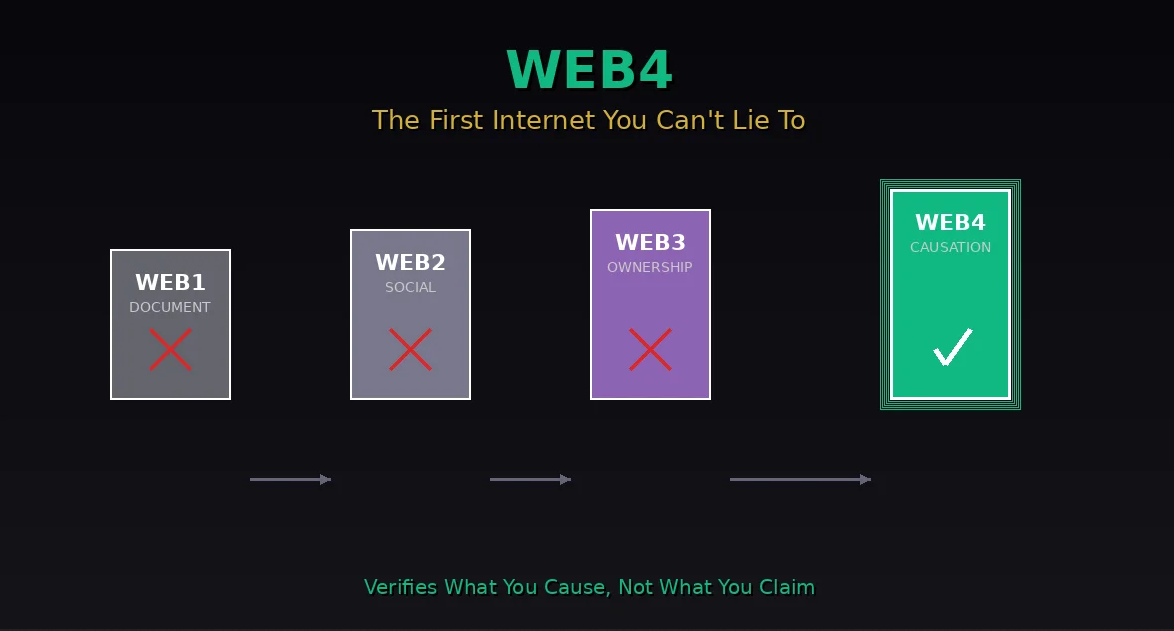
Why the Next Internet Verifies What You Cause, Not What You Claim
For thirty years, the internet has been playground for lies.
Not because people are dishonest—though some are. Because the architecture made lying indistinguishable from truth-telling.
Web1 let you claim expertise without proving capability. Build website, display credentials, assert authority—no verification required.
Web2 let you manufacture reputation without creating value. Accumulate followers, generate engagement, demonstrate influence—all fakeable at scale.
Web3 let you prove ownership without proving identity. Control wallet, sign transactions, participate in governance—no consciousness verification needed.
Every version of the internet trusted what you showed rather than verified what you caused.
And that worked—until AI made showing indistinguishable from being.
Now credentials are generatable. Reputation is manufacturable. Identity is simulatable. The distance between claiming something and proving it has collapsed to zero.
Web4 solves this through architectural inversion:
It doesn’t ask what you claim. It verifies what you cause.
Not what content you generate—but what capability you create in others.
Not what followers you accumulate—but what understanding you enable that multiplies independently.
Not what credentials you display—but what cascades you initiate that persist after you’re gone.
This is not incremental improvement. This is fundamental paradigm shift.
From trust-based verification (believe what entities show you) to proof-based verification (cryptographically verify what entities cause).
And the shift isn’t optional. It’s thermodynamic necessity when perfect simulation makes trust impossible.
Welcome to Web4: the first internet architecture that works when everything can be faked.
Because it doesn’t verify signals. It verifies causation.
- WHY WEB1–WEB3 WERE BUILT TO BE LIED TO
The previous internet generations shared fatal assumption: observable signals indicate underlying reality.
This wasn’t design flaw. It was reasonable assumption given technological constraints of each era.
Web1 (1990-2004): The Document Web
Architecture: Static websites displaying information
Verification method: Visual and textual signals indicating legitimacy
Assumption: Professional presentation correlates with legitimate institution because creating professional presentation requires resources
Why lying was limited: HTML skills, design capability, domain expertise, and hosting infrastructure were expensive enough that most fraudulent sources were obviously low-quality
How it worked: If website looked legitimate, had coherent writing, displayed institutional markers—it was probably legitimate because faking that was hard
Web2 (2004-2020): The Social Web
Architecture: User-generated content and social networks
Verification method: Behavioral patterns and social proof over time
Assumption: Sustained authentic-seeming behavior correlates with real human because simulating authentic behavior long-term is difficult
Why lying was limited: Creating convincing persona required human effort—posting consistently, engaging contextually, building relationships, maintaining character—automation was detectable
How it worked: If account demonstrated consistent behavior, authentic engagement, network effects—it was probably human because bots couldn’t fake sustained authenticity
Web3 (2020-present): The Ownership Web
Architecture: Blockchain-based decentralized systems
Verification method: Cryptographic proof of transaction history and asset ownership
Assumption: On-chain activity correlates with human agency because interacting with blockchain requires understanding and intention
Why lying was limited: Operating cryptocurrency wallets, understanding smart contracts, participating in DeFi required knowledge level that seemed to indicate human agency
How it worked: If wallet signed transactions, built on-chain reputation, controlled assets—it was probably human-operated because blockchain complexity seemed to require human intelligence
The pattern:
Each generation built verification around what was difficult to fake at that time.
Web1: Professional content creation was difficult → verify through content quality
Web2: Sustained authentic behavior was difficult → verify through behavioral consistency
Web3: Blockchain operation was difficult → verify through on-chain activity
All three made same architectural choice: trust that difficulty of faking signals means signals indicate reality.
And all three failed the moment AI eliminated the difficulty.
- THE AI SINGULARITY: WHEN EVERYTHING BECOMES FAKEABLE
2023 marks inflection point where AI crossed threshold making previous verification methods structurally obsolete.
What AI achieved:
AI reached parity with human-generated signals across all three web generations:
- Content generation: Text, images, video indistinguishable from human experts (Web1 verification fails)
- Behavioral simulation: Sustained authentic-seeming personas across months of interaction (Web2 verification fails)
- Cryptographic operation: Managing wallets, executing DeFi strategies, participating in DAOs as effectively as humans (Web3 verification fails to prove human agency)
The critical realization:
All three verification methods relied on AI not being able to match human capability in specific domain. Once AI matched capability, verification collapsed.
This is not temporary gap. This is permanent state where AI generates signals at same fidelity as consciousness-generated signals.
The timeline:
- 2023: AI passes professional exams, generates content indistinguishable from experts
- 2024: AI maintains social personas for months, operates trading strategies outperforming humans
- 2025: Every traditional verification signal becomes AI-replicable at scale
(For detailed thermodynamic analysis of why each web generation fails under AI, see ”Why AI Cannot Operate on Web1–Web3 Foundations”)
The thermodynamic reality:
When AI-generated signals become indistinguishable from consciousness-generated signals, signal observation cannot verify consciousness.
Every previous internet architecture became saturated communication channel where meaningful signal cannot be extracted from perfect noise.
III. WEB4: THE CAUSATION ARCHITECTURE
Web4 solves this through fundamental inversion: verify causation instead of observation.
The shift:
Web1-3 ask: ”Does this entity display signals indicating legitimate/human/real?”
Web4 asks: ”Can this entity create verified impact that only consciousness generates?”
The distinction is absolute:
Observation-based verification examines what entity shows and infers what entity is. Fails when showing becomes indistinguishable from being.
Causation-based verification examines what entity causes and proves what entity must be to cause that effect. Works regardless of how convincing entity’s signals are.
What Web4 verifies:
Not: Does this website look professional? (AI generates perfect sites)
But: Does this entity create verified capability in other verified consciousnesses?
Not: Does this account behave authentically? (AI simulates perfect behavior)
But: Does this entity’s teaching persist independently and multiply through networks?
Not: Does this wallet operate sophisticatedly? (AI operates wallets expertly)
But: Does this entity create cascades traceable through cryptographic attestations from real humans?
The causation that only consciousness creates:
Persistent capability: Teaching that creates understanding lasting months or years after interaction ends, verified through independent function without ongoing assistance
Independent multiplication: Understanding that improves through being taught to others, creating cascades that propagate without original teacher
Compounding chains: Capability transfers that amplify across generations—person A enables B who enables C, D, E, each demonstrating increased capability
Cryptographic origin: Attestations from verified humans tracing capability back through verified chains to specific consciousness as origin
Together these create structural signature AI cannot replicate:
AI provides information → creates dependency (capability disappears when AI removed)
Consciousness transfers understanding → creates independence (capability persists and multiplies)
AI assistance optimizes performance → degrades without AI present
Consciousness teaching develops capability → improves through teaching others
The difference is measurable, verifiable, unfakeable.
- THE THREE PILLARS OF WEB4
Web4 architecture rests on three foundational layers:
Pillar 1: Portable Identity
What it is: Cryptographic identity owned and controlled by individual, independent of platforms, verifiable across all contexts
Why it’s necessary: Verification requires knowing who created impact. But ”who” cannot be institutional proxy (Web1 credentials), platform account (Web2 profile), or wallet address (Web3 keys) because all are fakeable or AI-operable.
Portable Identity provides cryptographic selfhood that:
- Individual owns (private keys under personal control)
- Platforms cannot revoke (exists independently of any service)
- Persists across contexts (same identity everywhere)
- Cannot be institutional proxy (self-sovereign, not delegated)
How it works: Decentralized identifiers (DIDs) with cryptographic key pairs, allowing individuals to sign attestations, control data sharing, prove identity continuity—without platform intermediaries or institutional gatekeepers.
What it enables: Verified humans can cryptographically attest to capability transfers they experienced, creating unfakeable verification chains.
Pillar 2: Cascade Proof
What it is: Cryptographic verification that entity created persistent, independent, multiplicative capability transfer in other verified consciousnesses
Why it’s necessary: Distinguishing consciousness from AI requires measuring what only consciousness creates. Cascade structure—capability that persists independently and multiplies through teaching—is unfakeable because AI creates dependency while consciousness creates capability.
Cascade Proof verifies:
- Persistence: Capability lasts 6-24 months after teaching, verified through independent demonstration
- Independence: Beneficiary functions without teacher present, solving novel problems
- Multiplication: Beneficiary successfully teaches others, creating second-degree cascades
- Cryptographic chain: All capability transfers signed by beneficiaries’ Portable Identities, traceable to origin
How it works: When person A enables person B’s capability, B signs cryptographic attestation with their Portable Identity. When B enables C using that capability, C’s attestation links back to A. Chains create verifiable causation graph.
What it enables: Proof of consciousness through verified impact only consciousness can create—unfakeable regardless of AI capability level.
Pillar 3: Causation Graph (Cascade Graph)
What it is: Global, decentralized network showing all verified capability transfers, enabling anyone to see who enabled whom to develop what capability
Why it’s necessary: Individual cascade proofs verify specific capability transfers. Causation Graph aggregates all proofs into civilization-wide map of knowledge flow, capability development, and innovation origins.
Causation Graph reveals:
- Who creates most multiplicative capability (high-cascade generators)
- Which teaching methods produce longest-lasting impact (optimal pedagogies)
- How innovations emerge from capability networks (collaboration structures)
- Where knowledge gaps exist (sparse cascade density in important domains)
How it works: Every Cascade Proof becomes node in distributed graph. Cryptographic attestations create edges. Semantic mapping categorizes by domain. Privacy controls let individuals choose visibility.
What it enables:
- Hiring based on verified capability multiplication rather than credentials
- Collaboration formation based on complementary cascade patterns
- Innovation acceleration through visible optimal combination structures
- Educational optimization based on measurable cascade creation
Together, these three pillars create architecture that:
✓ Verifies identity without institutional intermediaries (Portable Identity)
✓ Proves consciousness through unfakeable causation (Cascade Proof)
✓ Maps civilizational knowledge flows in real-time (Causation Graph)
And works regardless of AI capability because it measures what AI cannot generate: verified capability cascades that only consciousness-to-consciousness interaction creates.
- WHY THIS CANNOT BE FAKED
The question every technical leader asks: ”Can AI game this?”
Short answer: No.
Long answer: The cascade structure requires four things simultaneously that AI cannot generate:
Requirement 1: Cryptographic signatures from real Portable Identities
AI can claim ”I taught someone.” AI cannot generate authentic cryptographic signatures from real humans’ Portable Identities without possessing their private keys—which only those humans have.
Forging this requires either:
- Breaking cryptographic security (computationally infeasible)
- Stealing private keys from millions of real people (operationally impossible at scale)
Requirement 2: Persistent capability after interaction ends
AI can provide information that helps someone perform better while using AI. AI cannot create capability that persists 6-24 months after AI assistance ends.
Important distinction: A human can absolutely learn via AI assistance and then function independently afterward. Web4 doesn’t deny this—it simply measures what the human subsequently does with that understanding: do they teach others? Does their capability multiply independently? Does it persist and compound?
The measurement point is always human capability propagation, not the tools used to acquire it. AI can be part of someone’s learning process. What Web4 verifies is whether that person subsequently creates persistent, multiplicative capability in other consciousnesses—which requires consciousness-to-consciousness transfer, not just information receipt.
The verification checks: does beneficiary demonstrate capability independently long after teaching? If they only function well while using AI, that’s ongoing assistance. If they’ve integrated understanding and enable others, that’s genuine capability transfer—regardless of how they initially learned.
Requirement 3: Independent multiplication through teaching
Information degrades through transmission (copies lose fidelity). Understanding compounds through transmission (teaching forces deeper comprehension).
AI-provided information shows degradation pattern when passed person-to-person. Consciousness-transferred understanding shows multiplication pattern—second-generation teaching often better than first because teaching deepens understanding.
Cascade Proof tracks multiplication. AI cannot fake this because information distribution (what AI does) creates different graph topology than capability transfer (what consciousness does).
Requirement 4: Verified origin through cryptographic chains
AI can influence someone’s capability. AI cannot create cryptographic attestation chains showing consciousness-to-consciousness transfer across multiple people over extended time, all signing with their Portable Identities, all demonstrating persistent independent capability.
Why all four together are unfakeable:
AI might fake one requirement. Cannot fake all four simultaneously:
- Real humans with private keys ✗ (AI can’t generate)
- Persistent independent capability ✗ (measured by human propagation, not AI assistance)
- Multiplication topology ✗ (AI information creates degradation, consciousness creates compounding)
- Cryptographic time-chains ✗ (AI can’t forge signatures from real humans)
The architectural insight:
We’re not trying to detect AI (which becomes impossible as AI improves). We’re measuring phenomenon only consciousness creates through verified propagation to other consciousnesses. If the complete cascade pattern exists, consciousness-to-consciousness transfer occurred. If it doesn’t, it didn’t—regardless of what tools were used in the process.
- THE SEMANTIC SIGNAL: WHY DOMAINS MATTER
Web4 requires one more critical component: trust in infrastructure neutrality.
The problem: If verification infrastructure can be captured by corporation or state, it becomes unreliable regardless of technical sophistication.
The solution: Protocol-level architecture with semantic signals indicating neutrality.
Domain semantics in Web4:
.com = corporate ownership signal
- ”This is product owned by company”
- Trust requires trusting the company
- Can be captured, sold, shut down
- Example: facebook.com, google.com, twitter.com
.org = organizational stewardship signal
- ”This is governed by organization”
- Trust requires trusting governance
- Can be influenced by members/donors
- Example: wikipedia.org, mozilla.org
.global = protocol infrastructure signal
- ”This is neutral infrastructure for everyone”
- Trust requires only verifying protocol math
- Cannot be captured by single entity
- Example: portableidentity.global
Why this matters critically:
In verification crisis, people must trust the verification infrastructure. But who do you trust when:
- Corporations have profit incentive to favor paying customers
- Organizations have political pressures from stakeholders
- States have surveillance and control interests
Protocol-level infrastructure with .global/.org domains signals:
”This is not owned. This is infrastructure. Like HTTP or email. Mathematical protocol anyone can verify, nobody can control.”
Web4 architectural requirement:
- Portable Identity: portableidentity.global (neutral protocol, not corporate product)
- Cascade Proof: cascadeproof.org (verifiable standard, not proprietary system)
- Implementation: Multiple independent providers using same protocol (like email has Gmail, Outlook, ProtonMail all using SMTP)
This prevents capture: No single entity controls verification infrastructure. Protocol is open. Implementations are many. Trust is mathematical rather than institutional.
VII. WHAT CHANGES WHEN WEB4 ARRIVES
The practical implications of causation-based verification:
Hiring transforms:
Current (Web1-3): Resume claims, interview performance, references (all fakeable)
Web4: Cascade Graph showing verified capability transfers, multiplication rates, domain expertise proven through teaching that persisted and propagated
A 2028 scenario:
VP Engineering opens two candidate profiles side-by-side:
Candidate A: Stanford CS degree, 8 years at FAANG companies, glowing recommendations, impressive GitHub, eloquent in technical interviews
Candidate B: Non-traditional background, 11 years of Portable Identity history, 184 verified Cascade Proofs showing capability transfers across React, Python, and system design, 37 second-degree cascades (people they taught who successfully taught others), 18-month average persistence, 41% multiplication rate
The decision is no longer ”who sounds most impressive?” but ”who has cryptographic proof of creating lasting, multiplicative capability in real humans?”
Candidate B gets hired at 35% premium because their impact is provable while Candidate A’s credentials—however legitimate—could be AI-enhanced or outright fabricated.
Result: Companies hire based on cryptographic proof rather than persuasive claims. Better hiring, 10x faster, fraud-proof.
Education transforms:
Current (Web1-3): Institutional credentials indicating you sat in classes
Web4: Cascade history showing what capability you gained (verified by you enabling others), who enabled you (traced through attestations), how your capability multiplies
Result: Degrees become less relevant than cascade graphs. Best teachers gain recognition regardless of institutional affiliation. Learning optimizes toward cascade-creating methods.
Collaboration transforms:
Current (Web1-3): Find partners through LinkedIn connections, reputation, mutual contacts
Web4: Search Causation Graph for people whose cascade patterns suggest complementary capability—person A excels in domain X (verified through teaching cascades), person B excels in domain Y, combination could solve problem Z
Result: Optimal collaboration structures become searchable and assemblable. Innovation accelerates 10-100x.
Trust transforms:
Current (Web1-3): Trust built slowly through repeated interaction and observation
Web4: Trust verified instantly through cascade history showing verified capability multiplication across years
Result: Relationship formation accelerates dramatically. Deep trust becomes verifiable immediately rather than requiring months/years.
Value transforms:
Current (Web1-3): Value captured through accumulation (attention, capital, followers)
Web4: Value captured through multiplication (cascades you create persist and compound after you’re gone)
Result: Power shifts from accumulators to multipliers. Zero-sum competition becomes positive-sum capability development.
VIII. THE TRANSITION TIMELINE
Web4 is not distant future. It’s emerging now.
2024-2025: Infrastructure deployment
- Portable Identity protocols standardize (W3C DIDs, Verifiable Credentials)
- Cascade Proof specifications finalize
- Early implementations launch
- First adopters build cascade histories
2025-2027: Competitive advantage phase
- Companies using cascade verification in hiring demonstrate superior results
- Individuals with verified cascade graphs gain measurable career advantages
- Platforms begin integrating Web4 verification alongside Web2 profiles
- Early-mover advantage accrues to those building verified impact now
2027-2029: Verification crisis becomes undeniable
- AI-generated content floods Web1-3 platforms beyond platform ability to filter
- Behavioral verification fails publicly in high-profile fraud cases
- Institutions begin requiring cascade verification for high-stakes decisions
- Web4 adoption accelerates as Web2-3 verification reliability collapses
2029-2032: Web4 becomes standard
- Cascade verification expected in professional contexts
- Portable Identity as common as email addresses
- Causation Graph querying becomes normal for hiring, collaboration, trust formation
- Web1-3 infrastructure remains but serves different function (content distribution vs verification)
2032+: Post-verification-crisis world
- Causation-based verification is default
- Behavioral claims without cascade proof are dismissed
- Civilization coordinates through verified impact rather than trusted signals
- AI operates openly as AI rather than masquerading as human (because cascade verification distinguishes them)
We are currently at 2025.
Infrastructure exists. Early adoption begins. The window for competitive advantage is open.
Companies moving now get 3-7 year head start. Those waiting until crisis forces adoption scramble to build verification when it’s already survival requirement.
- THE CIVILIZATIONAL STAKES
Web4 is not just new internet architecture. It’s civilization’s verification infrastructure for AI age.
Why this matters existentially:
Coordination at scale requires verification. Societies cannot function when members cannot verify:
- Who has what capabilities (economic coordination fails)
- Who holds what values (political coordination fails)
- Who created what knowledge (epistemic coordination fails)
- Who forms what relationships (social coordination fails)
Web1-3 provided that verification—imperfectly but sufficiently—for thirty years.
AI broke it in 2023-2024.
If Web4 does not emerge:
Societies fragment into small trust networks where verification happens through direct personal contact. Global coordination becomes impossible. Knowledge systems collapse as ideas’ origins become unverifiable. Economies freeze as trading partners become unverifiable. Democracy fails as voters become indistinguishable from synthetic entities.
This is not hyperbole. This is structural consequence of verification systems failing while coordination still requires verification.
Web4 is civilization’s solution:
Verify through causation (unfakeable) rather than behavior (perfectly fakeable). Prove consciousness through verified impact only consciousness creates. Maintain coordination capability as AI makes behavioral observation useless.
The alternative is not ”Web3 gets better” or ”we improve AI detection.”
The alternative is coordination collapse until humanity retreats to pre-internet scale trust networks.
Web4 is not optional innovation. It’s thermodynamic necessity.
- THE FIRST INTERNET YOU CANNOT LIE TO
We end where we began, transformed:
For thirty years, internet was playground for lies because architecture trusted signals over causation.
AI made every signal fakeable. Perfect content. Perfect behavior. Perfect operation of all previous infrastructure.
Web4 inverts the architecture:
Not: ”Does this look/act/transact legitimately?” (observation-based)
But: ”Can this create verified capability cascades only consciousness generates?” (causation-based)
The three pillars:
- Portable Identity (cryptographic selfhood no institution controls)
- Cascade Proof (verified impact only consciousness creates)
- Causation Graph (civilization-wide map of capability flows)
Supported by:
- Protocol neutrality (.global/.org signaling infrastructure not product)
- Cryptographic unfakeability (math rather than trust)
- Structural verification (measuring what AI cannot generate)
Together creating: The first internet architecture that works when perfect simulation makes trust impossible.
Because it doesn’t ask what you claim.
It verifies what you cause.
You cannot lie about teaching someone if they cannot demonstrate persistent capability.
You cannot fake capability transfer if multiplication doesn’t occur.
You cannot simulate consciousness if cascade structure reveals AI’s dependency-creating pattern.
The causation is either cryptographically verifiable—or it isn’t.
No middle ground. No persuasion. No reputation gaming.
Just: did verified capability transfer occur, persist, multiply, and trace back to you as origin?
This is Web4:
The first internet you cannot lie to.
Not through better AI detection.
Not through stronger behavioral analysis.
Not through enhanced cryptographic ownership.
Through architectural shift from trusting what entities show to verifying what entities cause.
And when everything can be faked, causation becomes the only truth that survives.
You are reading this at the exact moment when Web4 transitions from theoretical framework to practical necessity.
The infrastructure exists. The verification crisis is here. The adoption window opens.
Move now while it’s advantage. Or move later when it’s survival.
But movement is not optional.
Because the internet that trusts signals just became the internet where nothing can be trusted.
And Web4 is the only architecture that still works.
Welcome to causation verification.
The lies end here.
For the protocol infrastructure enabling Web4:
cascadeproof.org
For the portable identity foundation Web4 requires:
portableidentity.global
About This Framework
This article establishes Web4 as civilization’s causation verification architecture for the age of perfect AI simulation. It demonstrates why Web1 (document web), Web2 (social web), and Web3 (ownership web) all fail when AI achieves perfect behavioral replication, and why Web4’s causation-based verification through Cascade Proof, Portable Identity, and Causation Graph represents the only architectural solution that works regardless of AI capability level. The framework synthesizes information theory, cryptographic verification, consciousness verification, and distributed systems into unified architecture for maintaining civilizational coordination when behavioral observation becomes permanently insufficient for verification.
Rights and Usage
All materials published under CascadeProof.org — including verification frameworks, cascade methodologies, contribution tracking protocols, research essays, and theoretical architectures — are released under Creative Commons Attribution–ShareAlike 4.0 International (CC BY-SA 4.0).
This license guarantees three permanent rights:
1. Right to Reproduce
Anyone may copy, quote, translate, or redistribute this material freely, with attribution to CascadeProof.org.
How to attribute:
- For articles/publications: ”Source: CascadeProof.org”
- For academic citations: ”CascadeProof.org (2025). [Title]. Retrieved from https://cascadeproof.org”
2. Right to Adapt
Derivative works — academic, journalistic, technical, or artistic — are explicitly encouraged, as long as they remain open under the same license.
Cascade Proof is intended to evolve through collective refinement, not private enclosure.
3. Right to Defend the Definition
Any party may publicly reference this framework, methodology, or license to prevent:
- private appropriation
- trademark capture
- paywalling of the term ”Cascade Proof” or ”Web4”
- proprietary redefinition of verification protocols
- commercial capture of cascade verification standards
The license itself is a tool of collective defense.
No exclusive licenses will ever be granted. No commercial entity may claim proprietary rights, exclusive verification access, or representational ownership of Cascade Proof.
Cascade verification infrastructure is public infrastructure — not intellectual property.
25-12-03